

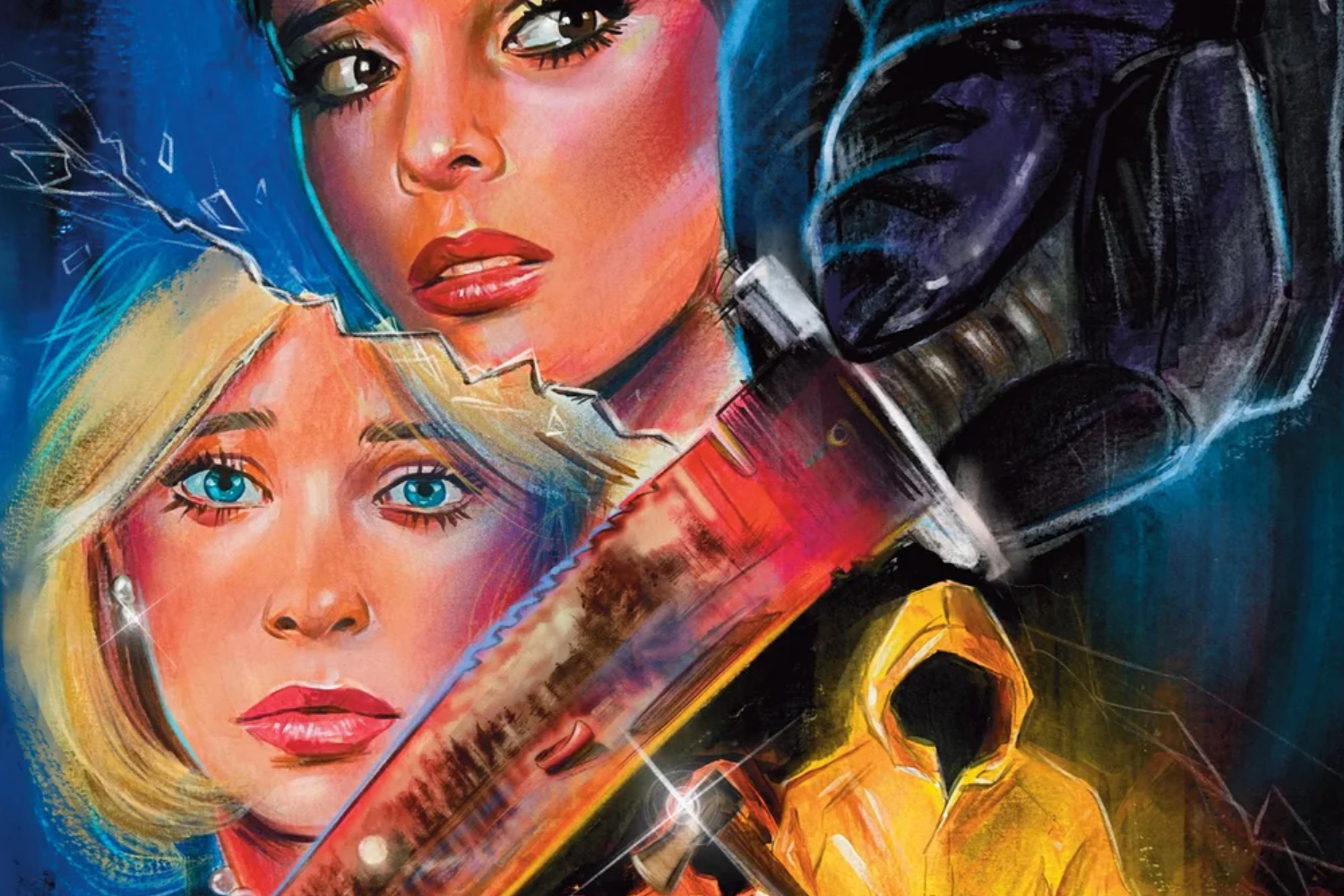

In the line’s opening salvo of releases, Goats Flying Press dropped a handful of rich and interesting books. That included meditative fantasy (Juni Ba’s The Fables of Erlking Wood) and what I’d call “DnD on truck stop speed” (The Dead and the Damned). Now though, GFP has dropped among its most inventive and intriguing books to date, Lake Yellowwood Slaughter.
The brain-child of writer Alejandro Arbona and artist Gavin Guidry (and joined by colorist Chris O’Halloran and letterer Hassan Otsmane-Elhaou), Lake Yellowwood Slaughter is described as a “graphic novel ‘adaptation’ of a 1983 slasher movie that never existed!” And if that meta magic weren’t enough, Lake Yellowwood Slaughter also sees the team “cut the grimy American slasher genre with the lurid style of high-tuned Italian giallo classics.”
The end result? More bloody, slasher fare that you know and love. (Who doesn’t want to see a new crop of attractive citizens get done in via a fire axe?) But the book’s also something deeper still — a meditation and exploration of not only the slasher “genre,” but the emotional and creative might of horror right now and why these stories keep repeating like the annual opening of a summer camp set on a murderous lakeside. Even if you know this ol’ song-and-dance, Lake Yellowwood Slaughter just might scare you to death with some new tricks and spins.
Lake Yellowwood Slaughter is on sale now. (Head here for details.) To coincide with the book’s wider release, we recently caught up with Arbona for a deep dive into Lake Yellowwood itself. Here, Arbona goes long on a number of topics, including the record-breaking crowdfunding campaign, the continued appeal of horror properties, the “DNA” of a proper slasher story, the “infusion” of giallo flicks, using violence with purpose/strategy, and the world’s best slasher killer, among other topics and tidbits.

Courtesy of Goats Flying Press.
AIPT: This was funded via Kickstarter in a frankly absurd 95 minutes. How does that feel personally, and what’s that tell you regarding people’s appetites for horror?
Alejandro Arbona: It was a huge thrill and really gratifying to see the Kickstarter get funded so quickly, and I can’t possibly overstate that. When you invest so much in something and work on it so hard for so long, most of that time in total secrecy, without a publisher announcing it, without it being a well-known character or anything, it’s overwhelming to roll it out and see all that enthusiasm come back. I felt really moved, and incredibly grateful.
At the same time, and I’m not saying this to brag or to sound cocky, but I figured that it would do well on Kickstarter. Goats Flying Press crafted a really savvy campaign strategy to set us up for success. Plus the cover art by Suspiria Vilchez is absolutely irresistible, and the creative team is incredible. Of course, that’s my artist partner Gavin Guidry, colorist Chris O’Halloran, and the letterer Hassan Otsmane-Elhaou, all greats. Their work just sells itself on sight.
Finally, the premise of the book is brief and easy to sell. I say that with total self-consciousness, as someone who struggles to give a succinct pitch of anything else I write. Literally anything else, ask me what it’s about, and watch me stammer through a long-winded, confusing explanation of the backstory. With Lake Yellowwood Slaughter, the core premise is one sentence long: it’s a 1980s summer camp slasher movie but the killer goes after the parents instead. There’s a lot more to it than that, but that’s what you can boil it down to.
I just spent four days with Goats Flying Press flogging the book at New York Comic Con, and I saw this happen again and again. People would spot Suspiria’s cover art from halfway down the aisle and make a beeline for it. The logo design is by Dylan Todd and it splashes out clear and bright across a crowded room. The book is a hardcover that’s printed really beautifully, and the cover is big, because Goats publishes at a size taller and wider than regular comics and TPBs. That cover simply works on people like a tractor beam, it’s amazing. ‘What is this?’ Well, ‘it’s a 1980s summer camp slasher movie where the killer goes after the parents instead.’ Sold. I’m a pretty insecure person overall! But you get a lot of confidence when you’re dealing with something that you just know people are going to find appealing.
And that’s that appetite for horror you asked about. I don’t know that I can explain it without resorting to the usual clichés people use to describe horror, that it’s thrilling like a roller coaster ride, or that it’s a safe way to stress-test your life-saving fight-or-flight instincts, or whatever. I just know that a lot of people love horror, and I really love horror. I especially love it as a genre that pushes its characters past their emotional limits. A slasher brings out the realest in people. Any story in any genre is about how the events of that story cause the characters’ deeper nature to emerge, and what choices they end up making.
Lake Yellowwood Slaughter is built around the lifelong relationship between two best friends, with some minor stresses and cracks visible early on, but it’s not until an anonymous killer starts murdering everyone around them that their friendship finally gets tested, and we find out what it’s made of and whether it can survive that.

Courtesy of Goats Flying Press.
AIPT: What about the slasher “story” is appealing? It’s not my cup of horror tea, but it feels like horror distilled to its most direct, bloody essence?
AA: I love slashers, but they have a very low hit rate. It feels like the good ones are very few, and the mediocre or bad ones are an enormous wave. Then again, I think that’s true of any genre in any medium, and slashers just happen to have more sequels that are easy to pick on. But the ones that work really well, it’s because of strong stories that are different from movie to movie, and which are hard to reproduce in sequels, ironically. Halloween was never meant to have sequels, and it shows.
That first movie is so strong, and even the best of the rest are pale imitations. Except Halloween III: Season of the Witch, which is its own glorious thing. The Texas Chain Saw Massacre never even had any sequels at all. I don’t care what you say! It never had any sequels! No sequels exist! Well, I take it back, Texas Chainsaw Massacre 2 is pretty wild and fun. But that’s the only one! And it’s the bane of all copy editors that it’s spelled “Chain Saw” in the first one and “Chainsaw” in all the rest.
But each of these slasher movies, the good ones, have very strong, evocative stories that are rooted in character, and in archetypes, and often, if you subscribe to the criticism of Carol Clover, as I do, in gender themes. The decades-long run of Friday the 13th sequels is a fun series to watch, I love even the worst of them, but you’re not going to plumb a lot of thematic depth in the later entries. I think people paint slashers with a broad brush, and maybe it’s a fair cop, but there are gems, and those are the ones that demonstrate the totemic storytelling power of the genre. Michael Myers was not the first slasher, but the first Halloween is the movie that really codified the genre, and established the trope Carol Clover called the Final Girl.
Even though there were proto-slasher movies like Psycho and certainly Black Christmas, and even though Michael Myers wasn’t even the first masked slasher because first there was Leatherface in The Texas Chain Saw Massacre, Halloween is where it all crystallized into that specific subgenre of the murderer-as-Terminator, slow-walking, silent, unkillable, absolutely unstoppable, that just feels like something out of those nightmares where you run but you can’t get away.
AIPT: The book is augmented with a clear turn toward more giallo classics (like Blood and Black Lace and The Bird with the Crystal Plumage). What about those are so compelling – do they go bigger than/beyond mere American slashers?
AA: Slashers and the Italian subgenre of murder-mystery thrillers called giallo are very closely related. Giallo came first, in the ’60s and ’70s, and it arguably inspired slashers. At the same time, giallo filmmakers and slasher filmmakers were both influenced by Alfred Hitchcock and Psycho, and you can see a lot of the same DNA in both genres. But there’s one huge difference between the genres, which I wanted to underline when I first wrote Lake Yellowwood Slaughter.
Slasher movies usually star a cast of teens, in teen settings. You see slashers at summer camps, in schools, at social settings like slumber parties and dances, and in suburban neighborhoods where kids are growing up and doing teen jobs like babysitting or working in a supermarket. Giallo movies usually star a cast of adults, and they’re usually adults with artsy or creative careers, who live in fancy apartments in major cities or in big mansions in the country. So the kind of meta-gag in Lake Yellowwood Slaughter is that when the killer leaves the kids alone and walks out of the summer camp, across the lake, and into the parents’ luxurious lakeside vacation homes, he’s walking out of one genre, and into the other.

Courtesy of Goats Flying Press.
AIPT: This project is described as “the ‘official comic book adaptation’ of a 1983 cult horror hit that never existed.” Why is that meta element so vital/interesting – why not just a straight up slasher story instead?
AA: Forgive me in advance, because this is an answer that’s going to be heavily vibes-based!
I spend a lot of time thinking about the difference between movies and comics, and I spend a lot of time specifically thinking about the difference between horror movies and horror comics. I grew up watching movies and reading comics, learning by consuming. Then I went to film school and got trained in how to make movies, and then I started working as an assistant editor at Marvel and got trained in how to make comics.
The whole time I was learning how to make movies, I kept comparing them in my head to what I knew about comics, and I came to understand comics better, and then the whole time I was learning how to make comics, I kept comparing that medium to movies and I came to understand movies better, each one mirroring the other but revealing where they diverge. They’re both forms of visual storytelling and they have many similarities, but they have key differences, too.
There has always been a lot of discussion about, is it possible to do horror in comics? Can horror comics be scary? To which the answer is, of course, comics can do horror. Comics can do anything. Anything. But the reason people ask that question in the first place is because it’s difficult to do, and there are a lot of horror comics that simply don’t do it well, so we question the whole genre.
Even though Kazuo Umezu and Junji Ito showed you how it’s done, even though Alan Moore and Eddie Campbell already did From Hell and, not to dwell on Hell titles, but another favorite of mine, Garth Ennis and Goran Sudzuka already did A Walk Through Hell, and people should know better than to ask if comics can do horror. It’s been proven they can.
The reason, I think, why it might seem hard to do horror in comics is because people are thinking of horror as it is done in movies, and then trying to do that in comics. And that will simply never work. It’s a different medium and you cannot transplant a beating heart from one to the other. Do jump scares work in comics? Well, yeah, they can. Lake Yellowwood Slaughter has jump scares, and I hope they work. Readers will be the judge of that. But a jump scare in a movie depends on timing, editing, surprise, and sound effects, none of which you can pull off the same way in comics.
And it depends on another crucial factor that people overlook. A jump scare isn’t only frightening because it hits quickly, it also ends just as quickly. The fright usually passes in an instant, and a lot of times the scene even cuts away entirely. None of that will work on a comic book page, where the reader is in control of the passage of time, where the reader can read as quickly or as slowly as they want, where the reader’s eye can linger on an image for any amount of time they want to. Building a good scare in this medium is different and you can’t rely on the same vocabulary as movies do.

Courtesy of Goats Flying Press.
All of this to answer the question of why Lake Yellowwood Slaughter is deliberately styled like a comic book adaptation of a movie. It’s because I think the slasher genre is inherently cinematic and doesn’t necessarily lend itself to comics, at least not easily, so I wanted to underline that leap across the medium. And since the germ of the idea was that it should be, not just a movie, but specifically a 1983 movie, I wanted to make that period vibe part of the package somehow. In the ’80s and ’90s there were a lot of comic book adaptations of movies, and I’ve always loved those, especially when the movie is gruesome and R-rated but the comic is still “Approved by the Comics Code Authority” and needs to be suitable for kids.
That’s where you get these sanitized comic book versions of Robocop and Darkman and A Nightmare on Elm Street. We took that approach, and Lake Yellowwood Slaughter has all this florid narration in captions, and the curse words are all grawlix. It was a lot of fun to drop in captions reading “Meanwhile…” Hassan lettered those captions in a “Leroy” lettering style like EC Comics used to do in the ’50s, which struck me as such a brilliant move, because it sells the reader on the idea that this story is a throwback more effectively than a literal approach would have. A 1980s lettering style may be mostly indistinguishable from lettering today, but by opting for something even more dated, Hass conveys the idea that this comic is old.
But also, and here’s where I’m gonna get weird with it, I wanted to cleave movies and comics apart, at the same time that I was blending them together. This comic “is a movie,” in quotes, but it definitely is not a movie, it’s a comic. The idea of making it an old-fashioned comic book adaptation was literally the second idea I had, right after thinking up the premise. I love movies, but I write comics because I love comics, not as a shortcut to pitching a movie. So even though I had this idea that this should be “a movie,” the idea was only that it’s a movie within its true form as a comic book. I really didn’t want to tell people that this comic “is a movie” unless that was the bit. And hence the “graphic novel adaptation.”
“And the third story will take place in the late ’90s like a David Fincher mystery thriller.”
But that gave us a lot of fun opportunities to joke with the medium. The book has a second ending, which is presented as if it were the “original ending” from the movie’s original release in Italy. And, of course, it’s in Italian, with subtitles. But then that ending is the only place in the entire book where the idea of the comic being “a movie” turns up on the page and becomes canonical, because the characters show up as the actors who played them, giving you a peek behind the scenes. And the Italian ending adds context that might have been a little more ambiguous in the American ending. It’s there basically as a joke, but it’s also part of the story.
We already announced that we’re going to do a sequel, although it’s more of a spinoff, with a whole separate story that springs from the first one, and new characters. That was announced in the Kickstarter campaign updates, but I’m going to keep quiet on further information until we can splash out and make a concrete announcement with a new cover by Suspiria. And during NYCC, Gavin gave me the idea for a third volume, so if there’s ever any misguided question about whether comic book artists are truly co-authors, there’s your answer. We’re still going to approach each of those as a tongue-in-cheek take on different types of movies, spiritual descendants of Hitchcock, but I don’t think we’ll make that part of the format again, because I feel that has now run its course with this first book.
The second and third stories will drop the subtitle “A Comic Book Adaptation” and instead we’ll subtitle them “A Yellowwood Thriller” to show they’re connected, though each one will be a standalone story. The second book is set in New York City in the same summer of 1983 as Yellowwood, but it’s more of a Brian De Palma-style neo-giallo erotic thriller. I’m writing that one as we speak, and Gavin is a huge De Palma fan, so he’s already excited to draw it. And the third story will take place in the late ’90s like a David Fincher mystery thriller. I just gave you a scoop!

Courtesy of Goats Flying Press.
AIPT: I feel like the violence here is more thoughtful and strategic than some other slasher properties. Why’s that so important (this story is decidedly people-forward), and is it hard to not go bonkers with the blood from word one?
I think that’s always important in a story like this, so you get to know and care about the characters before we start brutalizing them. But to be more specific, it was a deliberate choice for the standalone graphic novel format. If we had done this serialized, we would have given the reader some bang for their buck in every issue. As a graphic novel, it’s paced a little more holistically to craft escalation throughout the book. The murdering starts right away, as soon as you get to the summer camp in the opening pages, but that’s barely a glimpse of the horrors that the story will build up to.
AIPT: Gavin Guidry’s art and Chris O’Halloran’s colors give this book an oddly cute and charming quality. Is that intended, and what does it provide to the story at-large?
I’ll tell you a little anecdote to illustrate my answer here. Aside from being a comic book writer, I’m an editor, and I work extensively with Greg Rucka on all his titles at Image. When we were first developing The Old Guard, collaborating with Leandro Fernández, we quickly realized that the extreme violence in that comic was kind of hilarious. Leo being Leo, in his particular idiom, he could draw an eyeball hanging out of its socket or guts spilling out of someone who’s still walking and talking, and it was charming. If someone else had come along and drawn that same comic in a photo-realistic style, it might have been a very different story.
I think you can feel the same way about some movies. Friday the 13th Part VI: Jason Lives is a hoot, but if you’re watching a sober drama, and one person suddenly starts hacking another person apart with a machete, it’s going to be extremely shocking and troubling, because you’re invested in a different way. So, yeah, that effect was intended; we want this incredibly violent and gruesome comic to be fun and humorous in spite of it all, not an ordeal to suffer through.
AIPT: This story also does a better job of feeling more resonant or issue-oriented. What are you trying to say here, and is it maybe a gentle poke against other, often “empty” horror/slasher stories?
AA: It’s not a gentle poke at all; I wouldn’t necessarily accuse other horror of being empty or shallow. Some of the cash-in sequels from the big slasher franchises, maybe, but all good horror has something to say. Instead, I would accuse some critics and some filmmakers and even some fans of being insecure about liking horror, or feeling like horror is somehow beneath them. Recently, movie critics have coined this phrase “elevated horror” to describe horror movies that touch on social issues or have deep characterization and resonant themes, but good horror has always done those things. Highbrow or lowbrow, horror is horror, and some of the cheapest and schlockiest crap out there is still making a statement.

Courtesy of Goats Flying Press.
My approach to some of the themes in Lake Yellowwood Slaughter came from my upbringing, but in an indirect way. I grew up in Puerto Rico and we didn’t really have sleepaway camp, at least not the kind of summer camp I was always seeing on American TV. Aside from the innocuously named Camp Crystal Lake in the Jason movies, my impressions of American sleepaway camp came from Camp Anawanna on Salute Your Shorts and Ray Stantz reminiscing about Camp Waconda in Ghostbusters, which is so funny because I was also a lifelong comic book fan and it always sounded just like Wakanda from Black Panther.
Camp Arawak in Sleepaway Camp. The Taíno people of Puerto Rico and the Antilles were part of the Arawak culture, and they were exterminated by Spain, but here’s their name on a summer camp in an American slasher movie. All these summer camps in pop culture with Native names, and totem poles, and carved wooden signs, where white kids wear feathered headdresses for their big ceremonies.
Exactly the thing Addams Family Values satirized with the Thanksgiving pageant at Camp Chippewa. So right off the bat you see a little bit of that in Lake Yellowwood Slaughter, where the boys are talking about their “cabin chief” and the “head squaw” sneaking off to fool around. We also underline that theme, when the narrator at the very beginning says that Lake Yellowwood used to be called Lake Nihillowewi. And that’s an Easter egg for anyone who looks up what “nihillowewi” means. It comes from the Lenape language. Maybe sleepaway camps in the American Northeast don’t do this as much anymore, I wouldn’t know, but it was all over the pop culture summer camps of my childhood.
The point is, this is stolen land, and that’s a thematic flag that we planted right from the first panel of narration. The story quickly moves away from the summer camp and we don’t dwell on that particular detail anymore, but spoiler, the rest of the book still turns out to be about colonizers hoarding land to enrich themselves. USA! USA! USA!
AIPT: Is there a character/“cast member” that you resonate with the most? Why that person specifically?
AA: I went to a tiny private high school in Puerto Rico, and then I went to NYU film school, and then I was in a five-year relationship with a Georgetown graduate and we hung out with her college friends all the time. Suffice it to say, I have a lot of firsthand experience being a broke person surrounded by wealthy assholes, if you’ll pardon the swearing. So the character of Marian, who we also happened to make Puerto Rican, is definitely the character I relate to here!

Courtesy of Goats Flying Press.
AIPT: What was it like working with Goats Flying – how much is their novel approach essential to bringing a unique book like this to life?
AA: There are a lot of people I could not have done this book without: my wife, Gavin and the whole creative team, Greg Rucka, Jen Van Meter, Robert Meyers, Sophie Jackson, and jacksepticeye. I clarify that so as not to minimize them when I say that I absolutely could not have done this book without Goats Flying Press. Now don’t get me wrong, I love collaboration and I thrive on feedback, but this was one book that I wanted to do my way, without compromise, without interference. And as a publisher, they were hands-off, with an ethos of the creators’ vision and fierce independence. At the same time, the process was personal, intimate, and supportive every step of the way. Even if I’d just tried to do this book via Kickstarter on my own, the campaign I was going to strategize would have been a total belly flop.
AIPT: Do you have a favorite moment or page/panel – something that gets to this story’s beating heart?
AA: I sure do…but it’s a spoiler!
AIPT: Here’s a “fun” question: Who is the best slasher of all time, and why?
AA: This is an easy answer for me, and it all comes down to one movie, not even a whole franchise. In the original Texas Chain Saw Massacre, Leatherface doesn’t go out hunting those teenagers. They keep coming all the way into his house. The first time you see him is purely terrifying. That scene where he hits a guy with his sledge and gives him brain damage and then slams that metal door, it scarred me for life. But the second kid shows up while he’s still butchering the first one, and you can tell he’s really busy. He still takes a moment to chase her out the door and grab her up like a monstrous spider in its web, and it’s one of the scariest moments in movie history.
By the time the third kid comes into his house, Leatherface is overwhelmed! He kills that kid and then runs to look out the windows and figure out where all these damn teenagers keep coming from! Then he sits down and has a small panic attack. We’ve all had a day like that at work. By the time we meet the rest of his awful family, we see that Leatherface is just a put-upon little guy with anxiety. Now that’s a slasher you can relate to.

Courtesy of Goats Flying Press.



You must be logged in to post a comment.