

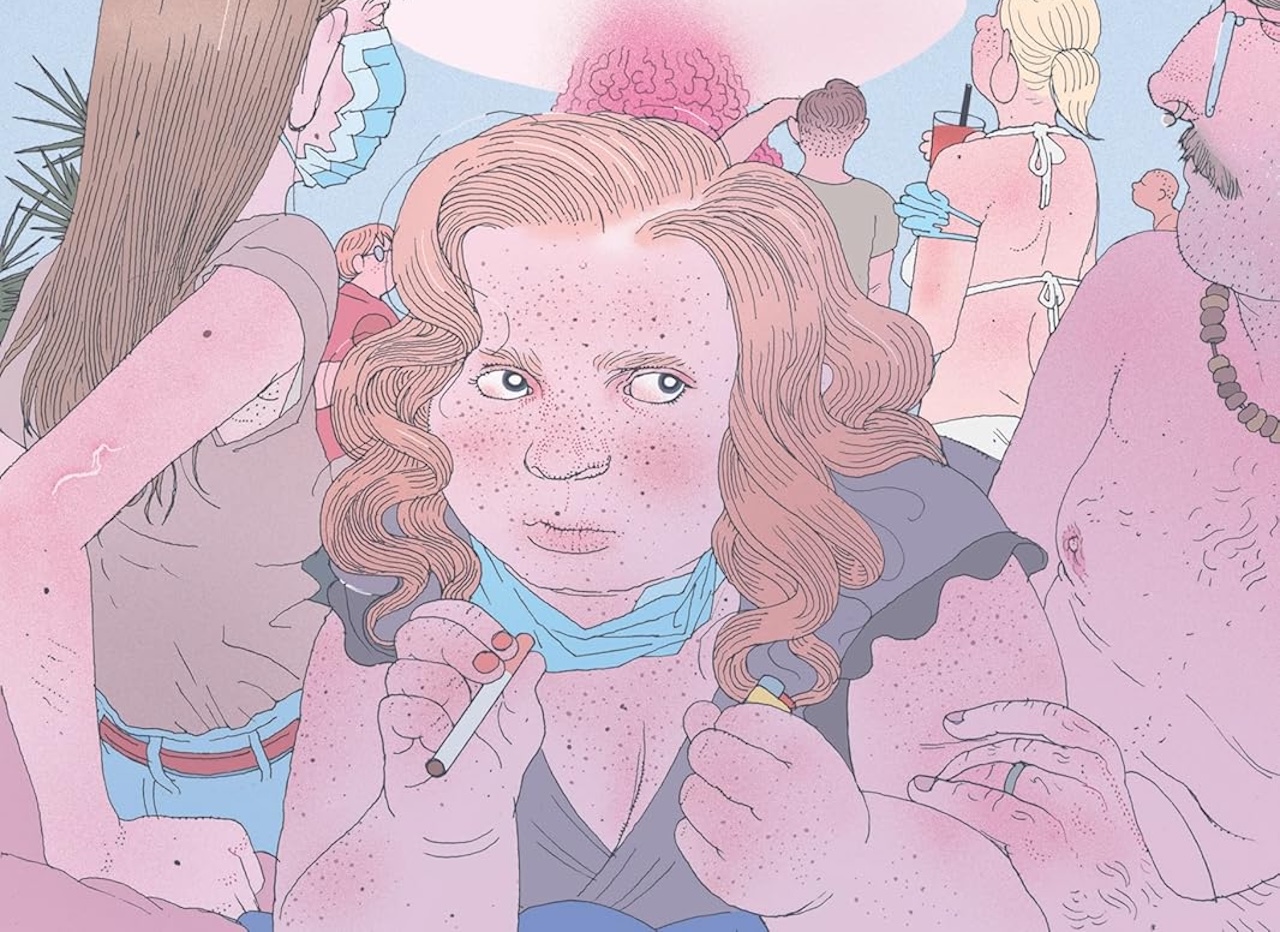

The Covid lockdown wasn’t easy for any of us. It’s still incredibly recent, but the memory of it fades a little bit with each passing day – how claustrophobic we were, how desperate to maintain our relationships over FaceTime, how listless and worried we were – but those feelings are still so fresh so as to be instantly relatable, easily recalled.
Further, for a good number of us, it feels as if life since the pandemic has been met with blow after blow of bad social change. The world is closing in, nations becoming more isolationist, so that we are a people becoming politically claustrophobic. The pandemic could be seen as the beginning of an incredibly rough, grueling time.

Fantagraphics
Miguel Vila’s Comfortless captures those initial feelings with extreme accuracy. In a series of interconnected vignettes, the book explores those feelings of desperation, from the initial realization that something was wrong in the book’s first short, “Clickbait”, to the panic of forgetting your mask when going out in public in “Boomer”. There’s a slight dread over everything, but having lived through it all it’s a sort of familiar – if not comforting – sense of dread.
Things escalate, as in “Escalation”, in which we witness the slow unwinding mental state of a young woman growing obsessed with a runner she sees out her window. Why should he get to be out there, she seems to think, when she’s stuck inside?

Fantagraphics
But Comfortless also taps into that feeling of post-pandemic decline, imagining a world where things get even worse. Not just in the character’s lives – breakups happen, faked Covid test results may or may not lead to the death of an elderly man – but in the world at large. In the titular story, a mass shooting plays out with silent horror; in “Blast”, the horror of an explosion leads a country to fear its very air.
This may sound like an utterly dreadful reading experience, but in truth Comfortless defies its title and provides a sort of macabre nostalgia. These are experiences we might very well have had ourselves, however minor or catastrophic they might be. We can see ourselves in the friendship skewing more and more toxic over FaceTime and text; we can see ourselves in the blind panic of that misplaced mask.
Vila’s cartooning, at turns microscopic and macroscopic, is both indelible and grotesque. The camera zooms far out, reducing shapes to iconographic people shapes adrift in pastels, before zooming in to make extreme caricature of its characters. Every pore, every imperfection, is rendered with great attention to detail. The book wants you to understand the very human heart of even its biggest, world-shattering moments.
Comfortless is a book that fully captures an era that we still aren’t quite on the other side of, and while it shows us a bleaker set of experiences, they all feel eerily familiar. It’s a work that will feel as relevant to those of us who experienced the lockdown even as we get years distant from the event, as if its captured those feelings in amber where time cannot diminish them.




You must be logged in to post a comment.