

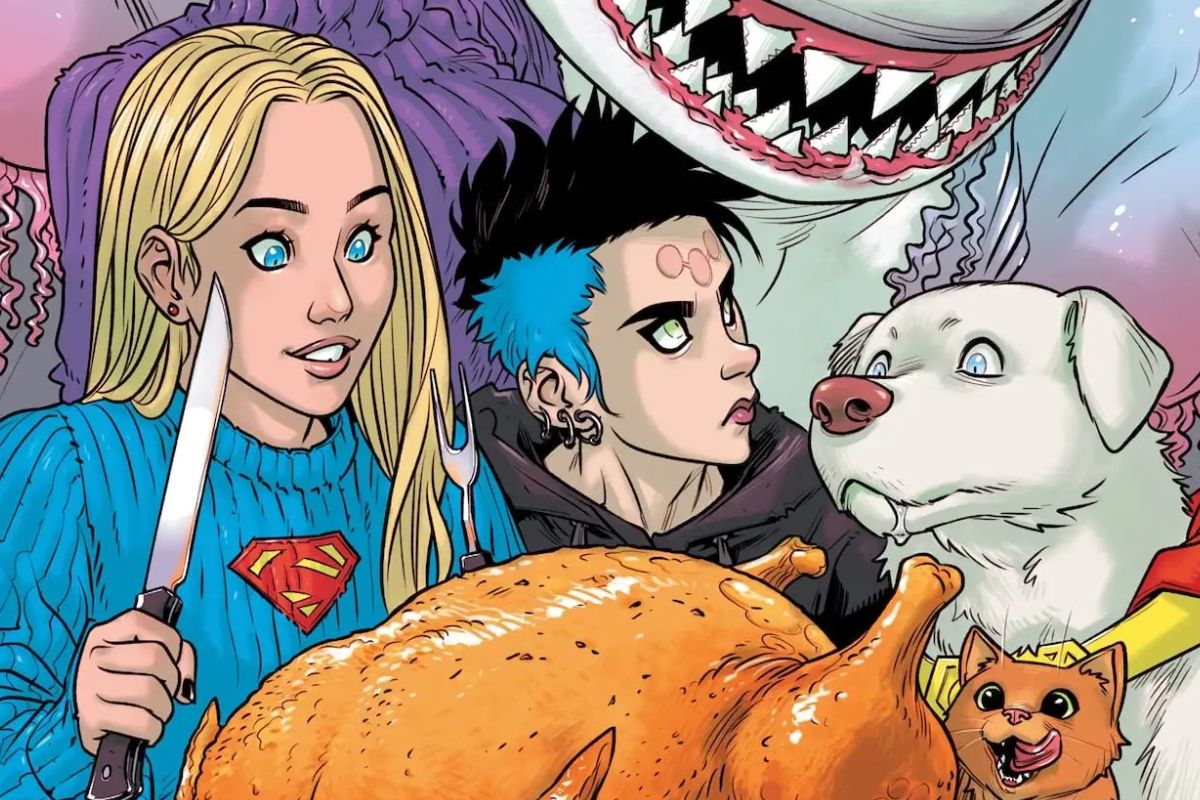

After an outstanding Halloween issue in Supergirl #6, Sophie Campbell continues the holiday trend by tackling Thanksgiving – an American holiday with a complicated past. But in addition to addressing the holiday’s troubling history, Campbell brings back a recurring villain from her run for a Disney-style storyline: Princess Shark.
Similar to the Halloween story, Campbell once more tells two different stories in Supergirl #7 that are glued together by one common thread: family and friendship. The first story that addresses this is Kara Zor-El (magically transformed into a mermaid) being summoned into the sea by Princess Shark. An obvious homage to Disney’s The Little Mermaid, Campbell succeeds at surprising the reader with an unexpected revelation: the shark was never evil to start with.

DC Comics
What’s absolutely magical about Princess Shark’s storyline is that it succinctly addresses her tragic circumstances in a way that garners sympathy for her character and feelings of hope. Campbell achieves this by showing readers how Princess Shark became the entity she is now: by doing the normal thing of being a shark searching for food. Because she kept eating in the territory of a “Sea Hag” named Glurga Gristleglob, the latter used that basic instinct to enchant the female great white into doing her bidding. But the surprises don’t end there.
Despite being clearly inspired by The Little Mermaid’s Sea Witch, Ursula (complete with iconic imagery from the movie), Glurga lacks the malicious intent of the Disney villain. Instead, she’s motivated by something else entirely: a desire to be a mother, with Princess Shark unknowingly fulfilling that goal for her. This effectively makes Glurga a tragic character in her own right, with her desire for motherhood giving her emotional depth. Campbell even alludes to this with the story’s title, “Unfortunate Souls.”
Of course, this is an obvious callback to Urusula’s iconic song, “Poor Unfortunate Souls,” but Campbell gives it a completely different meaning. In this case, Campbell spotlights Glurga’s isolation, which helps make Supergirl and Princess Shark more sympathetic towards her. This also succeeds at spotlighting Princess Shark’s own isolation from her family, due to how Glurga transformed her. This allows Campbell to keep building Supergirl’s empathetic personality, which is best spotlighted by her decision to invite the lonely great white to her family’s Thanksgiving dinner.

DC Comics
Another way that Campbell perfectly captures the spirit of her story’s title is through the characters of Lena Luthor and Lesla Lar. Like the “Sea Hag,” Lena experiences her own form of isolation, as the daughter of two Superman villains: Lex Luthor and Brainiac. More specifically, she is Lex’s biological daughter who was raised by Brainiac, which makes her feel unworthy of love and acceptance. This is best conveyed in the scenes between Lesla, Lena, and Luna, with Lena outright rejecting Kara and Lesla’s invitation to the Danvers’ Thanksgiving dinner. She even rejects Luna’s company on Thanksgiving Day.
Campbell perfectly captures Lena’s self-hatred with Luna spotlighting her desire to be loved and accepted, but struggles to accept those things when she finally gets them. Campbell even poignantly captures Lena’s complex feelings by returning to art duties in Supergirl #7. In this case, Campbell’s highly expressive art style captures the polarity of Lena’s emotions: anger towards her own origins, but also her deep seeded need for family.
Another character who is well-served by Campbell’s artwork is Lesla, who finally calls out Superman for his decision to abandon Kara to an orphanage instead of taking her in. This angers Lesla even more, knowing that Kara brought her home to her adopted family in Midvale when she herself was rejected by her Kandorian family. Through her artwork, Campbell continues to show Lesla’s character evolution, while not neglecting that Lesla is still lacking basic social skills and is still adjusting to life on Earth.

DC Comics
Though Campbell primarily focuses on the themes of isolation, friendship and family for her “Unfortunate Souls” story, she also doesn’t end Supergirl #7 without addressing the major elephant in the room: the troubling history of Thanksgiving. In this case, Campbell tactfully addresses the two truths (good and bad) surrounding the American holiday. First, she addresses (through the Danvers) what Thanksgiving means to modern Americans: a time of acknowledging the things and people they’re grateful for, in addition to being a family gathering.
Second, through Lena’s character, Campbell acknowledges how the holiday truly came to be. Though many non-Natives know the myth of Thanksgiving as being a day in which English colonists broke bread with the Natives of the lands they invaded, the reality is actually much worse. The ugly truth that Thanksgiving celebrates is England stealing Native land and pillaging its resources for increasing their own material wealth. This was also accomplished through Native genocide and enslavement – something England did in Africa as well, and remains an ongoing problem to this day.
All in all, Campbell delivers another strong story in Supergirl #7, much in the same vein as her Halloween story in issue #6. Though she centers her story on a major theme of Thanksgiving (family and friendship) with a Disney flavor, she also manages to squeeze in an acknowledgement of the holiday’s ugly truth without distracting from the larger point of her story.



You must be logged in to post a comment.