


Well, I’m a man of my word.
After an increasingly tenuous journey, we have arrived at last to I, Tyrant #5. I nearly gave up midway into my review of issue #4, as creators e e zann and Godfarr had a basically tried the very last molecule of my patience and generosity after a, well, interesting start. Their deeply meta, half-cocked story of a Persian warlord (Zahhak) trying to find immortality through a modern storyteller (Hafez) could have been good (maybe great?), but an uneven tempo, an inability to maintain cohesion, a general sense of over-confidence, and some ultimately half-cocked storytelling meant I, Tyrant’s reign was always doomed to be short, brutal, and pointless.
But even I couldn’t predict the depths we’d achieve with issue #5.

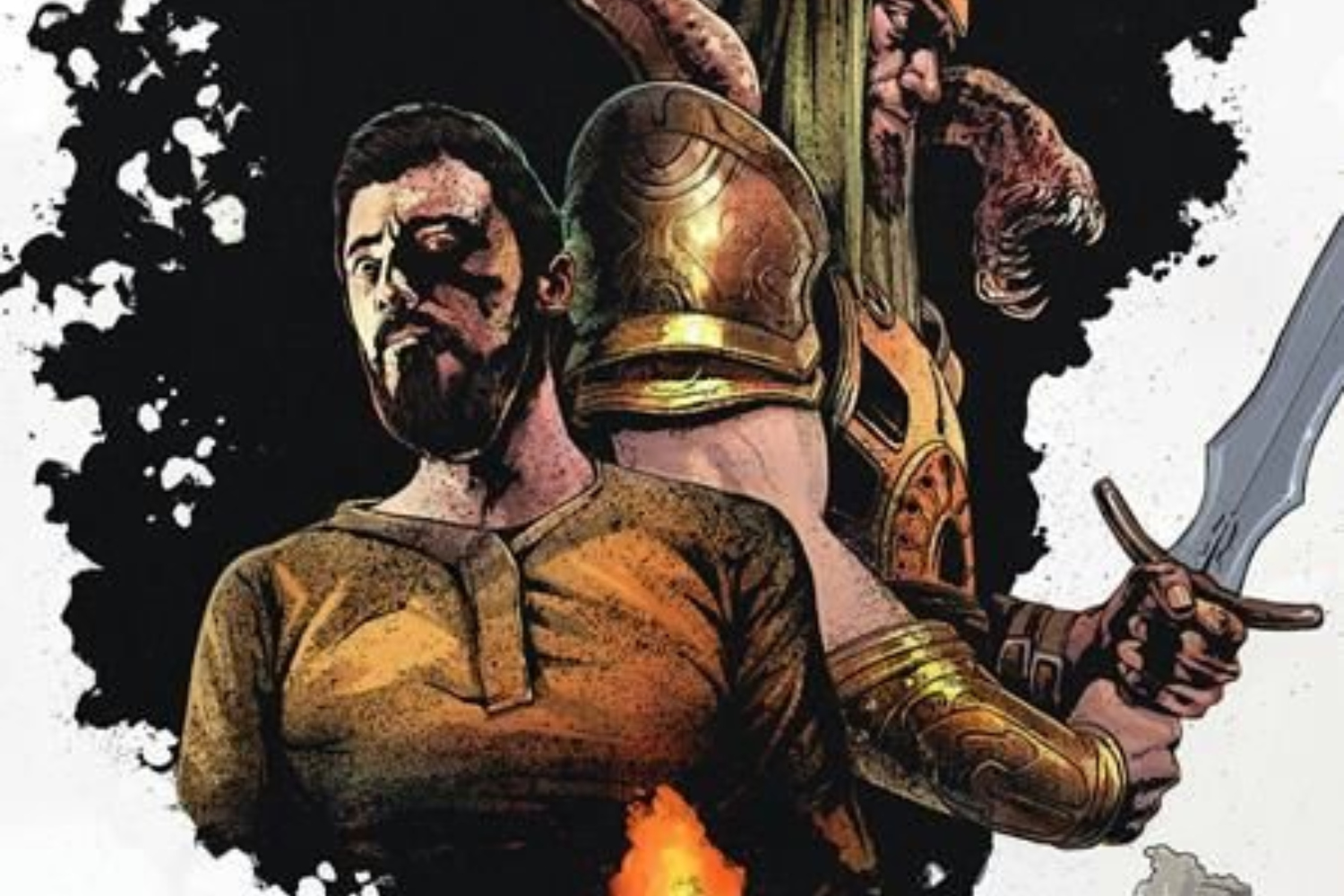
Variant cover by Valerio Giangiordano. Courtesy of Image Comics.
This book’s sole redeeming quality (aside from routinely less time with Hafez in modern times) had always been the stuff with Zahhak — specifically any combat. And I, Tyrant #5 certainly has that — getting to see Zahhak use his snake appendages like Jackie from The Darkness felt initially satisfying and fulfilling in a primal sense. Only all that blood and gore and stylish action gets lost in this mostly indecipherable mess of Persian leaders and Zahhak’s continued ascension that fluctuates between generally boring, mildly hard to follow, and so richly unimpressive that I just stopped trying to figure out the story’s arc and what it all really meant.
For most stories, that would be a death knell. And while that’s mostly true for I, Tyrant, it’s just not at all surprising at this point. That it would end so half-heartedly, in such a mess of promising human suffering and the kind of human suffering that makes you question why the Tower of Babel didn’t also take storytelling from us to boot, just seems On Point. I couldn’t have ever expected it to do anything else, but the fact that it happened regardless just makes the struggle I’ve experienced all the more irksome and painful. Like, if the story could have somehow rebounded, I might be surprised at this book getting its multifaceted -ish together. But being right about this has never once made me feel better. I truly wanted to believe in this story, and the fact that I was eventually right is a validation of the worst kind.

Variant cover by Ryan Gajda. Courtesy of Image Comics.
Yet even that preceding story’s maze of feckless narrative building couldn’t compare to the actual ending. I dare not spoil it, but it’s perhaps one of the most ludicrous, bizarre, and unwarranted meta-centric reveals I’ve ever seen. It’s a moment that hangs around on the page like a bad fart, and if all of this was just meant to be some huge joke — or better yet, they’re genuinely serious about following this direction — then either way I’m so mad that I could spit. Add in that the solicitation for this issue calls it a “wondrous mess of a wrap to the first story arc,” and it’s all so profoundly un-self aware that I feel like I’m on a terrible episode of Punk’d and I want to pull my skin off. That was their big move, and it was the sound of a colon shifting following a dinner of all sauerkraut.
And it’s not just that it’s a dumb move that has only one outcome (and that outcome is so dumb.) No, that meta moment even strips Hafez of any significance (and even now we’re scraping the bottom of the barrel with him); it makes Zahhak feel like a joke (and the whole point of his search for immortality is that he’s something of a threat!); and basically makes this whole story a long, drawn out waste of time. Had they maybe busted this “twist” out at the very start, it could have been so ridiculously odd that it could have worked. But they did it after five agonizing months, and all I feel like doing is cursing everyone’s blood lines and setting my eyeballs on fire. Seriously, I’ve been powerbombed on concrete by my only brother, and that move didn’t feel nearly as painful or overtly menacing.

Variant cover by Ryan Gajda. Courtesy of Image Comics.
So, then, what is the real point? Why did I fully sit through five full issues of I, Tyrant? I’ve tried to touch on some of that in previous reviews — usually it was some variation of why it’s important to engage with things you don’t like; getting full or more full parts of a story before making any lasting conclusions; and how great criticism can uplift important works (even when it also makes comparisons to bowel movements). And those insights generally remain true, but even they’re not enough. Because I, Tyrant has somehow moved beyond other lackluster books, and into a realm where I may never forget this book (no matter how many night caps I have after this review). Here, at the very end, are the biggest lessons are:
- Great meta storytelling has to come from a place of love and fandom and not cynicism and jokes. Think Cabin in the Woods and not Date Movie.
- Your best character is only as good as your worse. And in the case of this book, that means Zahhak was doomed from the start. (However, everything else still stands regarding his role.)
- Bad stories may still have lots to teach us as fans and readers, but that doesn’t mean they won’t still make us suffer. Keep that balance of pain and transcendence in mind, folks.
- Being cool and/or edgy means nothing if you can’t make me care. I’d rather you engage me through something silly or earnest than a story that’s posturing just to seem hip.
- You should trust yourself if a story makes you queasy. If you don’t, it will reward you with more bile.
- At the same time, there’s something to be learned from surviving a bad story. Maybe not some “strength” as a reader, but even just a skill to recognize when things actually do work for ya.
- And, once again, cool premises don’t make a good story. There’s a reason The Family Circus whips the ass of Primer.

Courtesy of Image Comics.
It’s here that you might expect me to say something like, “Despite it all, I’ll still read I, Tyrant’s second arc starting with issue #6.” But instead, I’ll just avoid that book like the plague, or seeing my extended family completely nude. Because for all the great lessons, catharsis, and solid jokes that have come from my reviews, I’d rather I never started on this journey to begin with. All I have to really take away is that I finished it, and thus I made it to the end because it’s not only the most professional move, but it’s important that I beat this thing (as much as it beat me). I made it through as a slightly different critic, and while I wish that weren’t the case, it felt important to make something, anything out of a genuinely, earnestly irksome book like this. Good reasons or not, I couldn’t live in a world where this thing came to pass without some kind of active (if ultimately fruitless) confrontation. Was that the point? Heck no. But at least it remains memorable, and maybe there’s significance in that.
To close this chapter for good, though, I’m celebrating one of the greatest album reviews ever with my very own extra appropriate GIF:





You must be logged in to post a comment.