

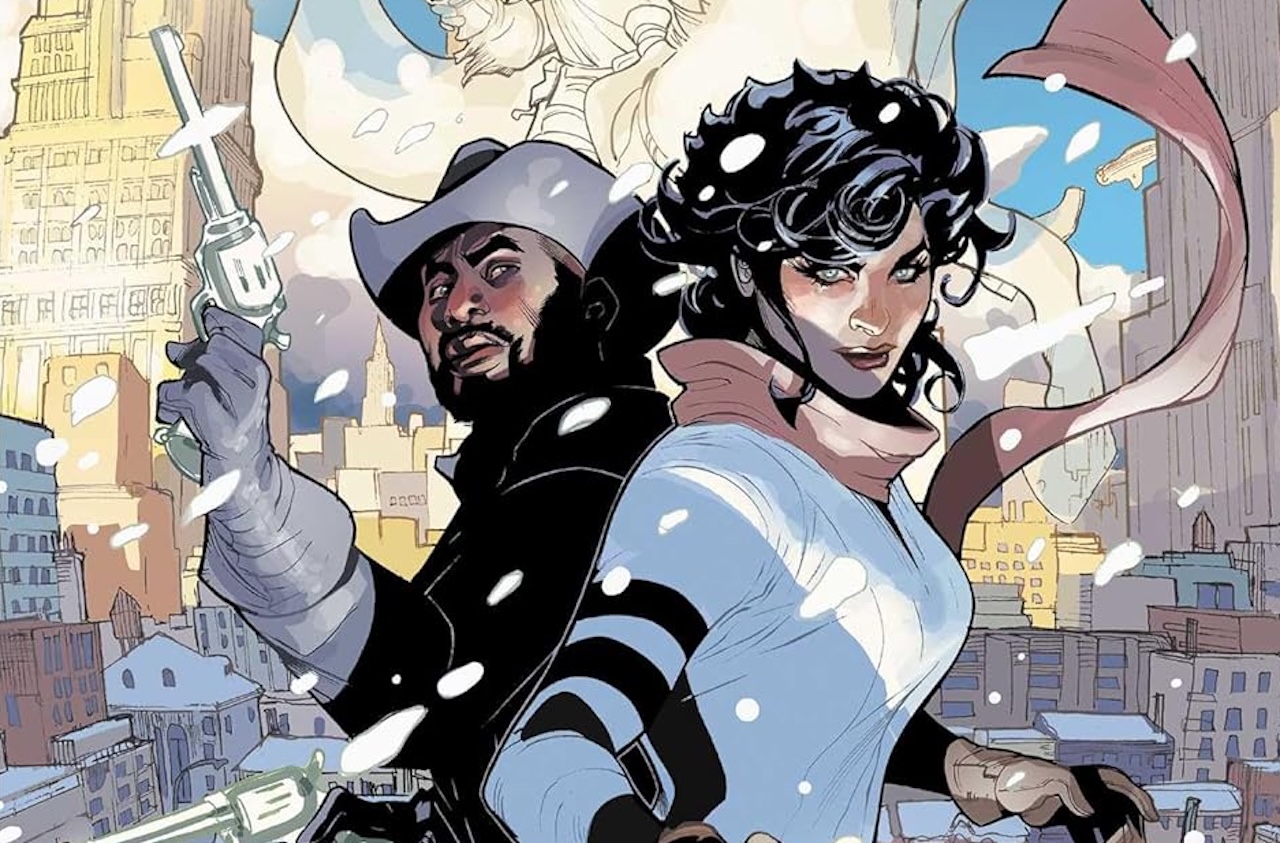

I like Rachel Dodson, Terry Dodson, and Matt Fraction’s Adventureman, their affectionate, pedal-to-the-metal 21st-century riff on pulp adventure stories. It has ambition to spare, its cast is charming, its central conflict is interesting, and the sheer density of its ideas is always welcome. At the same time, I wish I loved Adventureman. The kicker is that many of its pain points are intricately tied to its pleasures. The things that make it good are the same things that keep it from being great.
Adventureman‘s far-ranging ambitions require significant setup to realize. This eats into page space that could go to giving the cast space to grow and the conflict a personal stake. Consequently, while the cast are charming, none of them stand out the way that, say, the leads of the Fraction-written graphic novel series November do. The conflict, while fun to chew on, lacks the weight of Clint Barton and Kate Bishop fighting to save the apartment Clint’s friends and neighbors call home in Hawkeye. The density is intense enough that the central focus of volume 2, A Fairy Tale of New York, doesn’t become clear until late in the story.

Image Comics
At its worst, Adventureman feels like less than the sum of its parts. It’s the work of wildly talented people going all in, but it doesn’t click. It’s too much, too fast, and when it does stop to take a breath, the quiet feels incongruous, rather than a natural part of narrative flow. What’s all the more frustrating is that, on their own, the individual beats of A Fairy Tale of New York, bombastic and sedate alike, range from solid to downright terrific.
A Fairy Tale of New York puts protagonist Claire Connell, the newly minted Adventureman, against a ghostly conspiracy around the holidays. At her side is her family: her son Tommy, her sisters, and her father. United with her in battling the wicked and being deeply confused by a newly and increasingly fantastical New York is Champion Strong, the latest in a family line of Black cowboy vigilantes called the Crossdraw Kid. Against her stands an army of ghosts led by a spirit-conjuring crime lord who’s incensed by the prospect of aging and death.

Image
The Dodsons and Fraction’s best work in Adventureman marries and contrasts the familiar and the fantastic. In the comic’s world, Claire becoming Adventureman is of a piece with the impossible bleeding into the real world. Flying cars do not exist, yet they were also real by 1999, and specific models are regarded as classics by gearheads. A long-abandoned subway station is both a decayed ruin and a perfectly preserved hub that’s as spectral as crime boss Caspar Spettero’s ghostly army. Adventureman is a series of explicitly fictional pulp novels about a two-fisted hero, and it’s also true.
Claire understands this, and she’s accepted it, but she’s a long way from being used to it. She has a super serum that gives her superhuman strength and speed. And she got to juggle her capital-A Adventuring with her being a parent and figuring out what the family will do with their late mother’s bookstore, and the fact that there are times when, despite everything, she worries that she’s making it up as she goes. Claire is magnificent and infuriating, and now she punches ghosts, too.

Image
The needle the Dodsons thread with Adventureman is the fact that its fantastic elements need to be incongruous with the world and yet feel natural to it at the same time. For the ghostly army and their phantom world, Terry Dodson (who colors in addition to pencilling) adopts a consistent minty-green palette. Aside from being a handy visual identifier, this gives the ghosts structure: they may be out of left field in reality as we know it, but they do follow coherent rules. It’s a skillful piece of comicscraft, taking advantage of the medium’s tools to convey a key part of its world, and emblematic of the Dodsons’ mastery of their craft, which is also visible in the book’s more down-to-earth moments, like when Claire and Champion go ice skating.
Fraction’s script excels at extremes. Claire and Champion’s halting flirtation and their shared fumbling due to being unsure if the other is attracted to them is sweet, distinct character work. Caspar’s wicked plot gains menace from the fact that it’s just as much his throwing a tantrum about getting old as it is his genuine desire to rule New York’s underworld. Where Adventureman struggles is in tying these extremes together and letting itself breathe. A Fairy Tale of New York is rich with interesting ideas (a previous Crossdraw Kid opposed an evil previous Adventureman, Caspar’s plotting put him at odds with his fellow crime lords, some of Claire’s sisters worry about the long-term effects of the Adventureman serum) that stick around long enough to cast a hook before fading into the background, and consequently take space away from Claire’s figuring out how she lives now that she’s Adventureman and her conflict with Caspar. It feels breathless, and while it’s a lot of fun to read, it doesn’t give itself the space to sit in a moment, to let Claire and Champion come into their own as characters. The character moments that are present are strong, but they’re downright incongruous with how frantic Adventureman frequently insists on being. It isn’t empty, but it is a bit underbaked.

Image
Adventureman is an enjoyable, well-crafted comic that could be great with a bit of structural adjustment and focus. There’s plenty about it to like, but its creative team has done significantly better work elsewhere. It’s not a fans-only proposal like, say, Eric Nguyen and Rick Remender’s Strange Girl, but it’s what the good folks at the A.V. Club might call “advanced studies.”




You must be logged in to post a comment.