

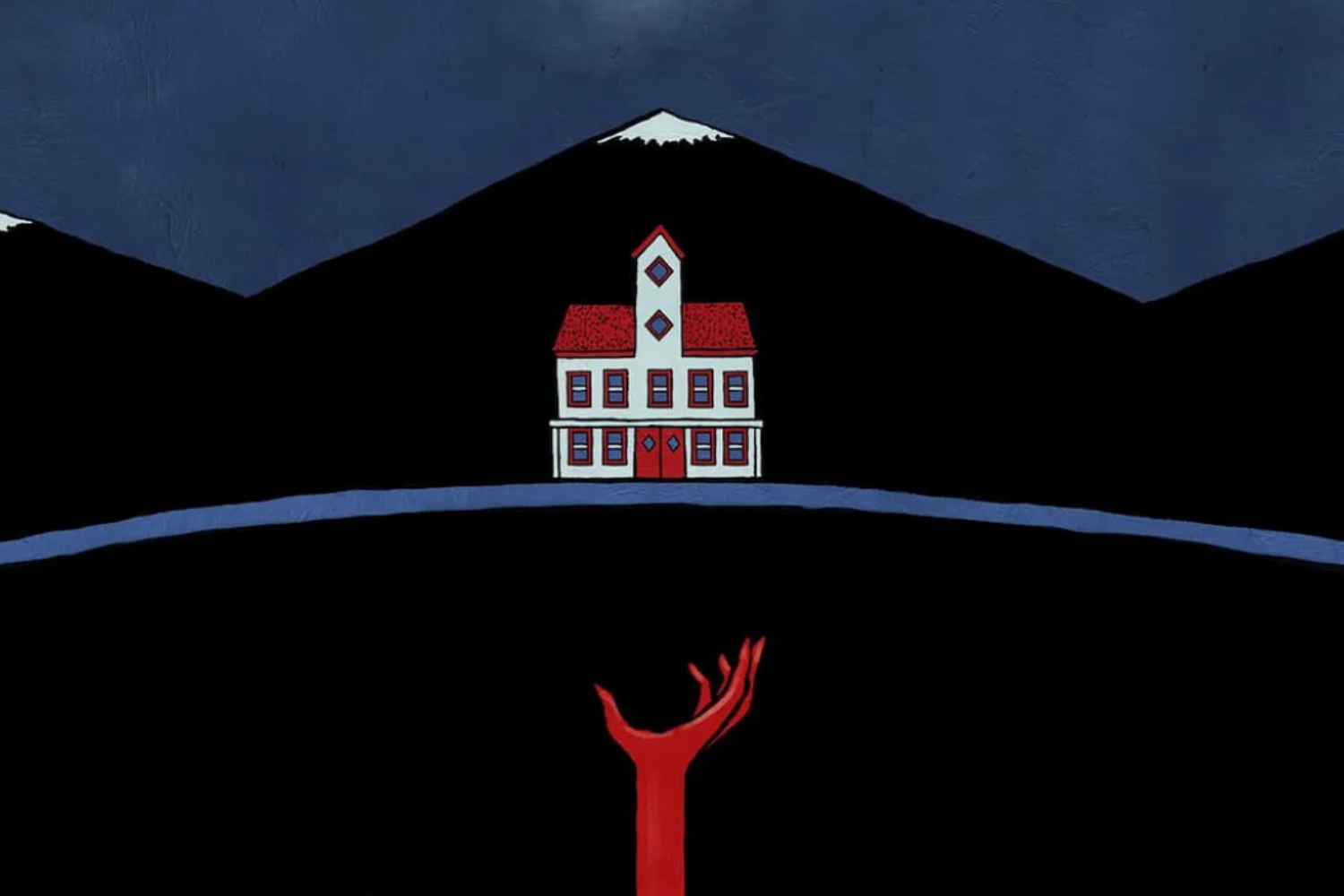

There’s coming-of-age stories, and then there’s Pig Wife.
To some extent, writer/artist Abbey Luck sticks pretty close to the “formula.” We follow Mary, who is dragged by her mom (Vanessa) and step-dad (Roger) to claim the will of Roger’s recently-deceased Aunt Pearl. However, rather than be stuck in some dead mining town with her lame parents, Mary would rather see her dad, the cool rock star Diego.
But even the original idea behind this teen drama proved decidedly dark.
“The original idea…it moved away into something else, which I thought was actually better,” Luck said during a recent Zoom call. “The original idea was, ‘What would cause you to dehumanize someone?’ Like, to treat them in some animalistic way?”
Even with changes, that process is facilitated by Ed and Tommy, two fellas that Mary finds living under Pearl’s home in a massive abandoned mind. Thinking they’re stuck underground thanks to the Apocalypse, Ed and Tommy carry a “complicated” connection to Pearl, and they slowly bring Mary into a world that’s both sinister and oddly juvenile. Mostly, though, it gets at some big ideas —about relationships, family, and even how we survive even the worst situations imaginable. It all makes sense as we see how Luck’s original idea evolved.
“And I was like, ‘Well, what situation would it be for a woman or anybody who would be treated like an animal so that the person could feel better about the way they’re treating you,'” Luck said. “But then I started to think about the person who would do that. And I was like, ‘Well, it would have to be someone who was also abused themselves and hurt people.'”
Even with the story’s inevitable “transformation,” Luck found something that actually resonated with her own family life. An important connection that made this very real story of trauma and survival all the more potent.
“It came from a family story,” Luck said. “My great-grandmother Pearl had my grandmother out of wedlock, and my grandmother was raised to believe that this was her sister and her grandparents raised her [as parents]. She didn’t find out until she was 13 or something that those weren’t her real parents. And Pearl was so mean to my grandma. She was so ashamed of her and it was this whole thing.”
Luck added, “I honestly didn’t realize how personal it was until I was well into the project. I didn’t even consciously know why I named that woman Pearl and stuff. And I was like, ‘Oh, this is kind of like my grandmother’s story a little bit.’ So I don’t feel exploitive about it. My grandmother would have loved this book.”

Courtesy of Top Shelf Productions.
And it was another, albeit less personal relationship that helped whip Pig Wife into shape. Before eventually sending the book over to Top Shelf, Luck hired an editor, who not only cut 100 pages (the book still ended up being some 536 pages), but they also clarified an essential focus on the larger story.
“It started out as a story that was about Mary and her father – Mary and the way she felt about her father,” Luck said. “But then when the editor read it he was like, ‘Diego is not a good guy. This is about Mary and her mother.’ Like, her mother is the one that’s like fighting for her the whole time.”
And from that pivotal moment, the rest of the story coalesced and crystalized.
“Mary’s in denial about how much her mother means to her because she’s pissed at her right now,” Luck said. “And so she’s just idealizing this fantasy version. She needs to face reality, just like these guys trapped underground need to face reality.”
And in the journey to “face reality,” as it were, Luck made a few other, equally important editorial decisions along the way. That includes using only dialogue throughout the bulk of the story.
“I cheated on this a few times, but I wanted it to be only dialogue,” Luck said. “I wanted it to feel like entering a movie. It wasn’t going to have people’s internal thoughts or anything like that. So I think that’s why it’s a quicker read.”
She also leaned into her robust background in animation, with the ability to quickly and efficiently create a storyboard proving especially important for this rather large book.
Again, it’s the personal stories that matter. Aside from tales plucked from her own lineage, Luck references a few other infamous tales to fully nail the situation of Ed and Tommy. And, in some really vital ways, these same stories speak volumes about the tension at the book’s core.
“I’ve always been very interested in isolation stories,” Luck said. “Like, the story of Genie is the most famous one of childhood isolation. Then there was that movie, The Wolfpack, about those boys that were basically kept inside. And it seemed like every time it was to protect the child or the children, but it was really about protecting the parents themselves. That was Pearl’s story with Ed – Ed was being protected this whole time, but really he was just suffering unimaginable abuse.”
Genie and the Wolfpack stories were just the tip of the iceberg. Luck also leaned into another story that complicated the already fraught dynamic in the mines. Ed and Tommy dynamic may have spent their entire lives together (playing odd games, seeking a “wife” in Mary, and always waiting for Pearl), but the pair maintain an important but thematically significant difference.
“I was also inspired by another story of isolation,” Luck said. “I think it was the 1930s or 40s and a girl named Isabelle – she had a similar experience of [Genie] they were like locked in a room, but she had her mother (even though her mother was deaf and mute).”
Luck added, “And most of these stories of childhood isolation, if they’re by themselves and they grow up, they never are able to really understand speech fully. But she was just because she had her mother there and they had like this hand gesture communication system. She made a full recovery even though she was in there for a really long time. Tommy had his mom growing up, and so he turned out a lot more normal. I just wanted to show the contrast of how their environments shapes them a little bit.”

Courtesy of Top Shelf Productions.
More than almost anything else discussed so far, that’s precisely what Pig Wife is about: Parenting. Or, more specifically, how it shapes and informs us as people, and how this “process” is a kind of stand-in for how we engage with others and the world. And, try as you might, it’s an “obstacle” that Mary must face head on.
“Well, she’s running away from the very beginning of the book,” Luck said. “Like, all she wants to do is run away from her family. She can’t stand her family. And that ends up getting her trapped underground. Once she’s there, she can’t stand these guys. They’re like creepy incels in a game.”
From there, facing the truth will set you free. Sorta.
“And I think she eventually realizes, especially through Tommy, she’s not going to get out of there unless she warms up to these guys and tries to understand them a little bit more,” Luck said. “And eventually it’s her say, ‘I’m done running.’ That’s when they decide to all work together and escape and she finds her way out. So it’s about a girl that stops running and faces the truth of what she needs to do.”
For Mary, this kind of reconciliation doesn’t just happen via Ed and Tommy. It’s also very much through her relationship with her dad, Diego. Just as she realizes that life can’t be run from, it’s the Mary and Roger relationship that pushes our young lead to fully grapple with her parental issues.
“I wanted Mary to seem like she felt out of place,” Luck said of why she made Roger a step-parent. “And so the way I did that was just having this new father figure come in and take her away from the idealized version of her own father, who had disappeared and ditched them.”
Because like Tommy and Ed, Mary finds herself trapped in a cave of sorts, and even if she recognizes that, or is somehow better socialized, nothing’s really changed if she can’t escape it outright.
“It’s a story about knowing more about yourself,” Luck said. “But also understanding that there’s stories that we tell ourselves to convince ourselves that what we want to believe is true.”
Again, to revisit Mary and Diego’s relationship, there’s a huge story being told there, and Mary will come to see that it’s easy to lull yourself into complacency because you like the shape of this narrative.
“But she just has it in her head that [her father] was so great and everything was good,” Luck said. “But then through her journey, she realizes how she’s been mistreating her mother and blaming her for a lot of things that weren’t her fault. Everything her mother did was to help Mary. When it seemed to Mary as a child, she was ruining her life.”
Luck hopes that even if you can’t sympathize with Mary’s rather specific situation, you can still find something emotionally resonant.
“And I think that even if your parents aren’t divorced, you have that experience growing up as an angsty teen with your parents where you’re like, ‘Why are you doing this to me?’ You just don’t get it until you’re a parent,” Luck said. “And then you’re like, ‘Oh man, what was I thinking?’”

Courtesy of Top Shelf Productions.
As much as this is Mary’s story, it also touches on Vanessa in a really important way. On the one hand, as we’ve touched on already, Vanessa is a decidedly sympathetic character.
“I don’t know what Vanessa is a stand-in for…if it’s anyone for me,” Luck said. “I don’t know if that came through at all, but I feel like all Vanessa wants to do is protect her little girl. And then she has all these ambiguous problems and thoughts about how Mary is being a problem. But then once Mary’s gone, it just becomes very singular. It’s like anything she can do to get her back is what she’s focused on.”
At the same time, Vanessa also facilitates some issues across Pig Wife. (Or, more accurately, she does things with unintended effects.) It’s her actions and behaviors, no matter how well-intentioned, that might extend/further Mary’s innate issues. Which is to say, parents may love their children, but they don’t always show it so well.
“A cynical way to look at her marriage to Roger was that she was probably doing that in a way for Mary,” Luck said. “This is a really stable guy who has a lot of money. He’s going to always be around. He’s the exact opposite of Diego, who she left.”
A similar scope occurs with Pearl. Yes, she’s the reason Tommy and Ed are stuck underground. However, it’s another case of great intentions, awful execution.
“There was just so much going on with Pearl,” Luck said. “Like, her telling Ed that the world is like overrun with demons…what good does it do to tell him that there’s not demons, but he’s just going to be down there anyway? She believes it and also she thinks she’s helping him.”
Similarly, Ed and Tommy experience their own kind of “disillusionment.” It’s easy to build stories, but not so easy to keep them going in your head.
“These guys are convincing themselves that it was OK to stay down underground and never see the real world because there was an apocalypse,” Luck said. “But they probably deep down even knew that wasn’t true.”
And, of course, Diego also contributes to this theme in his own roguish way.
“I think even Diego, to a certain extent, would like to present himself as this talented rock star, because that’s maybe the thing that he wants his daughter to believe,” Luck said. “But I think she just wants him around.”
Even Roger gets in on the action. Without revealing too much, he’s hoping that acquiring Pearl’s house will help the family financially and perhaps address some larger “troubles” he’s found himself facing.
“For Roger, hiding the fact that he has these losses pending and trying to find that money…he was just very ashamed of it,” Luck said. “And he thought, ‘This is going to fix the problem, why tell anybody?’ Because then they’re co-conspirators in a way, and it doesn’t really help them to know that.”
If anything, Roger may be the prime example of Pig Wife‘s core theme of “You have to face facts even if the fantasy seems so much better.” Especially if you have the most to lose.
“I think that’s the story behind a lot of white collar crime that it spirals out of control,” Luck said. “They don’t go into it thinking they’re going to steal a bunch of money. They go into it being like, ‘We’re going to pay it back. We’re going to be successful.’ It’s delusional, so that’s what he’s suffering from.”

Courtesy of Top Shelf Productions.
Oh but wait, there’s one more character who is on this similar journey of growth and realization: Luck herself.
“I started this book a long time ago; it was almost 10 years that it took working on and off on this book to finish it,” Luck said. “And when I started it, I was not a parent. I didn’t have kids. And so I think I was relating more to Mary’s experience of feeling like these adults ruled your world.”
Having her own “angsty teen,” then, has allowed Luck to undergo a change in perspective that made all the difference.
“And so then, becoming a mother throughout this, it was like, ‘Oh, this is a story about a girl who just really needs her mom right now and realizing that she’s not a grownup,” Luck said. “She’s, like, 14 years old and she needs her mommy.’”
As such, Luck went on to describe the experience of making Pig Wife as “little bit backwards.” Not just because of employing an editor beforehand, which meant she had a sizable amount of cut art afterward. Or that she gained new insight into her own life and family. It’s also that a fundamental component of this book changed.
“When I started writing it, I think that there was a moment when I was like, ‘OK, maybe this is a pregnancy that happened down in the cell,” Luck said. “But then I was like, I see Ed as such a child still, and he is so stunted that I just didn’t see that working for me. It seemed more like they would feel like they were brothers in a way. So I decided to make it happen before that.”
And you can see those same ideas and energies in the important plot where Tommy and Ed believe that Mary will marry one of them (and Mary uses that to try and escape the cave, of course). It’s about family, yeah, but it’s also very much about our flawed understanding and how relationships can shift/feel nebulous.
“Also to Tommy, this is the first time he’s ever seen a girl or a woman,” Luck said. “It’s the best thing that’s ever happened to him in a long time. So it’s just so exciting. But they also don’t really have a conception of what a wife is. They just have this vague religious stuff that they told them. And I liked that because I really didn’t want this to go too hard or be too creepy. I don’t even know if I qualify it as a horror novel in my mind. I think that that’s the genre that it’s closest to, I guess.”
With enough bloodshed and violence within its 536 pages, you could call Pig Wife a horror story. But it’s something that Luck also wanted to avoid wherever possible.
“I love the horror genre, but there’s a lot of shock value,” Luck said. “And I didn’t really want to do that in this book. I didn’t want to do cheap shots to get an emotional reaction. I wanted to just keep it a little more tame, but just really hit people emotionally in that sense.”
Luck added, “I want this to be accessible to a younger audience. When I was younger, I really loved horror. But I didn’t want it to be too much to a younger reader that might be attracted to this material as well.”
There’s also moments where the horror is somehow “mitigated.” For instance, Luck employs several “a day in the life” pages for characters. There’s some intense, heady events within each, but they ultimately serve a much more multifaceted purpose.
“I wanted to show, in as few panels as possible, what are they doing all day down there? Or, what was Pearl’s history? Just cram it in real quick,” Luck said. “I just wanted to see how quickly I could do it because I didn’t want to do too much backstory or anything.”

Courtesy of Top Shelf Productions.
Plus, there’s much more overtly psychedelic imagery across Pig Wife. These massive, sprawling double splashes where Mary experiences the most absurd and beguiling fever dreams you could ever imagine. Picture melting skin and eyeball monsters, and you’re mostly there.
“That was Bosch-inspired…The Garden of Earthly Delights,” Luck said of the aforementioned monster. “I don’t know if you could see it, but it’s like they’re all circling around a pit in that painting.”
But even focusing on the utterly bizarre visuals seem like they needlessly box in both Luck and Pig Wife. The story she ultimately needed to tell existed far beyond genres.
“I wanted it to just be a story about isolation and abuse,” Luck said. “That’s a strange horror story to take on, but that is a horror story. Isolation and abuse is a horror story.”
Luckily, there were some guideposts along the way.
“I’m a big David Lynch fan, and I think his work does the same thing,” Luck said. “Is Twin Peaks a horror show? Kind of, but it’s also a comedy. It’s a drama. It’s David Lynch. David Lynch could his own genre. I definitely think Pig Wife should be its own corresponding genre tag.”
What Luck is ultimately getting at is something she’s lived her whole life. People have assumptions and expectations of others (as happens in the story proper), and those aren’t always the most accurate. Or, to put it another way, as much as well tell stories about ourselves, other people tell other stories about us all the time.
“Every time Halloween comes around, people are like, ‘Oh, are you going to wear a crazy costume?’ Or people are like, ‘Are you going to do this weird psychedelic retreat or something,'” Luck said. “I feel like I’m already there. I live so deeply in the world that it’s like Halloween every day. I’m pretty basic besides the art.”
There’s a great example in one of Luck’s own favorite sequences, in which Mary goes “drinking before school, when she drinks all that vodka on the bus and then she gets busted and has to go to therapy.” It’s a slightly cliched moment of teenage rebellion, but it gets at a larger idea: You are and are not where you came from, the people who raised you, and the clothes you wear.
“That little journey, to me, reflected on the nature of who people really are and the nature versus nurture argument,” Luck said. “Like, what really makes you who you are, and when you think you’re doing something, is it really you or is it all these things that have happened in the past and brain cells firing? How much of you are you really? So I thought that that was like a nice little foray into philosophy.”

Courtesy of Top Shelf Productions.
And we see more of that across other parts of Pig Wife. This idea that “there are no supervillains,” just people trying to sort it all out the best they can through layers of existential trauma and hope for the future. Or, as a press release put: “Survival doesn’t depend on our strength and wits alone, but on our ability to love others, even in the most horrific circumstances.”
And, yes, even someone like Ed deserves just such a fair and nuanced level of engagement.
“Ed, in a way when you first see him, he’s like the stereotypical monster,” Luck said. “He’s violent and he looks weird and all that stuff. But I think by the end, I don’t think of him as a monster at all. I think of him as a child that was abused and doesn’t even understand…he never even had a chance to learn what was right or wrong necessarily. So can he be blamed for anything? At the end, he’s just a little boy that wants to cuddle with his toy and wants someone to love him and doesn’t want to be alone anymore.”
The same goes for Pearl, too.
“It’s really hard to see anyone through the lens of their history,” Luck said. “And Pearl is suffering from extreme mental illness; she’s schizophrenic. So it’s hard to say that she’s even making half of the decisions that she makes – she’s being convinced by this demon entity to do these things half the time. So not to absolve her of responsibility, but it just isn’t realistic that someone would do that out of nowhere. Like, there’s something going on with a person who would isolate their child like that. So I wanted to capture that.”
And while not as overtly dangerous as Ed or Pearl, Roger’s treatment gets at this very same end goal or theme. Because, yes, Luck is very much interested in people’s “downfalls,” and Roger’s white collar crimes are a way to understand this basic function of psychology (which Luck said is the “source of where creativity comes from as well.”) But in all of these instances, you’ve got to have a little empathy and prepare yourself to confront even your own fables/stories.
“I think that we live in a world where it’s really easy to jump on the bandwagon, especially with someone like a white collar criminal – this f**king rich guy thinks he can do whatever he wants,” Luck said. “But if you peel away the layers, anybody that was in that person’s situation might have done the same thing. You can’t really judge from the outside how it feels to be them. And so I didn’t want to make anyone too cartoonish. I mean, this book is a cartoon, but hopefully readers can feel a little bit of empathy for where Roger’s at, even though he is pretty annoying in the story.”
At the end of the day, though, Luck isn’t trying to make you decide if good people are really bad, or if bad people are really good. For instance, when she showed Pig Wife to her parents, they each had different reactions to Ed’s fate: her mom “felt really bad for him,” while her dad said that “Ed sucked. He was a bad guy.”
Because Pig Wife is, in all the ways that matter the most, a true coming-of-age story. It’s just that with any luck, you’ll be the one experiencing those sweet, sweet growing pains right alongside these characters.
“My goal was to keep people just completely immersed as much as possible,” Luck said. “And so hopefully that happens for some people out there.”
Pig Wife is due out January 13 via Top Shelf Productions.

Courtesy of Top Shelf Productions.



You must be logged in to post a comment.