

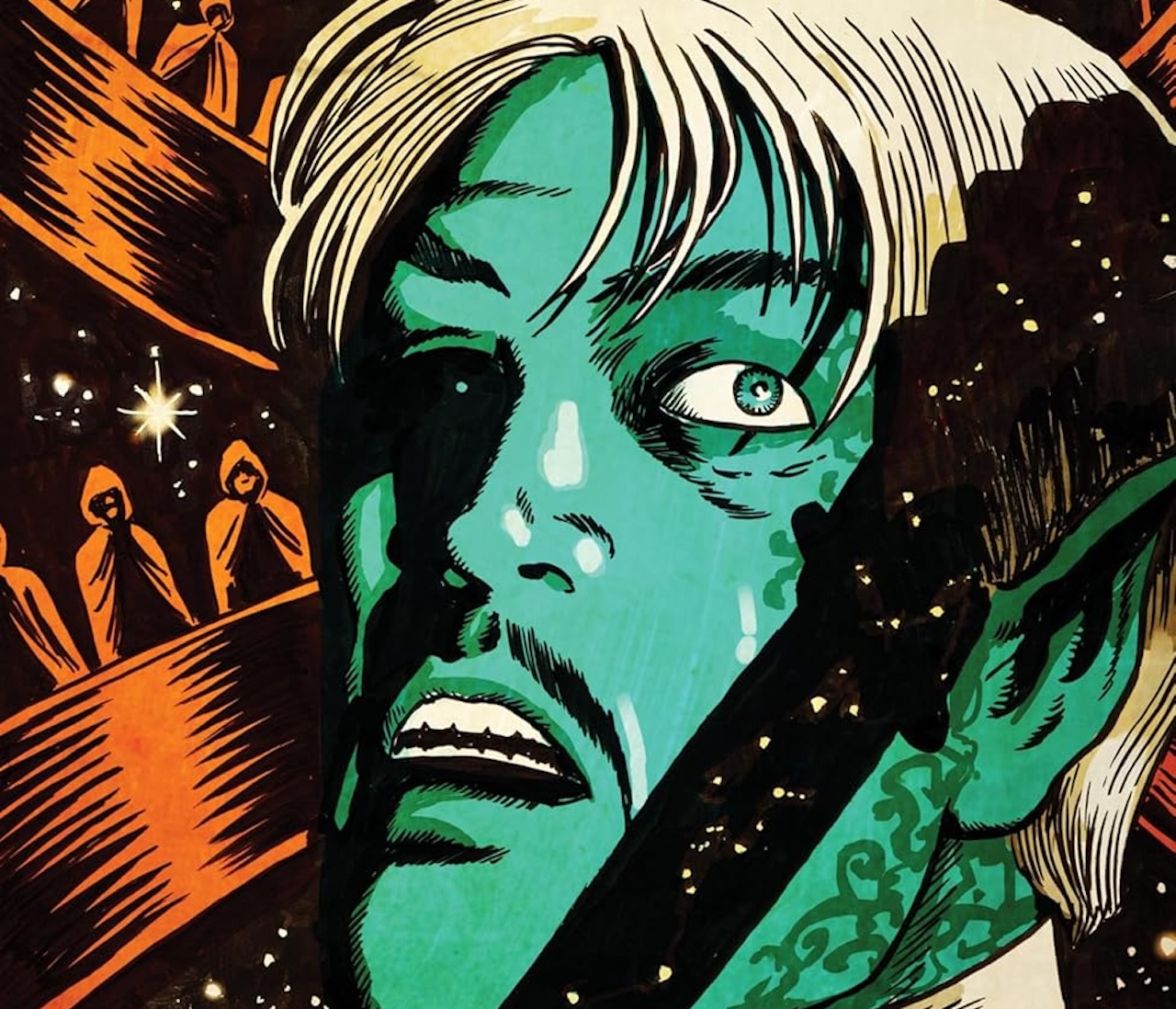

Starship battles and hand-to-hand combat are things you can find in Star Trek: The Last Starship, but there’s also the drive for problem-solving and diplomacy. The Federation is on its last leg, and with Earth leaving the Federation, it’s up to Captain Sato to muster some kind of alliance, or let it die on the vine.
Enter Star Trek: The Last Starship #5, out February 18th, in a story where Sato and his crew have had a few months to prepare for a conference of worlds, but due to space travel, the worlds they need to convince have had 20 years to deliberate. If you know anything about time and history, focus can be lost, but certainly not in a hopeful universe like Star Trek, right? The series continues to defy expectations in a universe that typically leans toward a message of the greater good prevailing.
Jackson Lanzing and Collin Kelly have crafted a thoughtful issue here, exploring what it means for an idealist like Sato to convince people across the planets to come together for the greater good. The Federation lasted 930 years up until this issue, and thus, he thinks it’s only logical that the people of Andoria, Tellar, Ferenginar, Ni’Var, and Tholia would want to return to that level of peace and prosperity. The problem, however, is that the dilithium shortage makes its usage thin for so many worlds, plus the very real danger that it could explode again.

Courtesy IDW
You feel for Sato here, especially for anyone who adores the idealist nature of Star Trek. It’s a lot easier to side with him here, as opposed to his desire for peace while under fire, as in previous issues. On the reverse side, Sato’s practically blind to reality, as Kirk points out at one point. It makes his actions feel a bit rash, and you might expect things to turn even though it’s supposed to be a surprise.
There are also two well-written data pages that do a lot of heavy lifting to convey information in this issue, making the world-building feel resolute and detailed. It’s quite clear that the problems Sato and the Federation face are due to these data pages.
Beyond Sato’s hopefulness, which has already proven a weakness in battle, this issue also develops the drug-addicted doctor and a sub-plot involving Wowie and the crew. These scenes help flesh out characters and set up the big cliffhanger, which should make the next issue an action-focused issue, to say the least.
Adrian Bonilla continues to deliver highly detailed atmospheric art that honors the Star Trek legacy. The very first page features an excellent interior of a lavish room with giant windows as Sato walks solemnly. A key element of the issues is Sato’s speech scene, depicted with rings that allow people to view it from all angles, like an Escher design riffing on the Galactic Senate Chamber. It’s a tricky double-page layout that Bonilla captures well. Largely a dialogue-heavy issue, Bonilla’s acting carries every scene.
Star Trek: The Last Starship #5 delivers a thoughtful and emotionally grounded chapter that leans heavily into the franchise’s philosophical roots. Jackson Lanzing and Collin Kelly focus on the political and moral weight placed on Sato as he attempts to rally fractured worlds toward unity. The issue thrives on strong character exploration and rich world-building, supported by Adrian Bonilla’s expressive and detailed art. While the slower pacing may not satisfy readers seeking constant action, the story strengthens its thematic core and sets the stage for explosive consequences ahead.




You must be logged in to post a comment.