

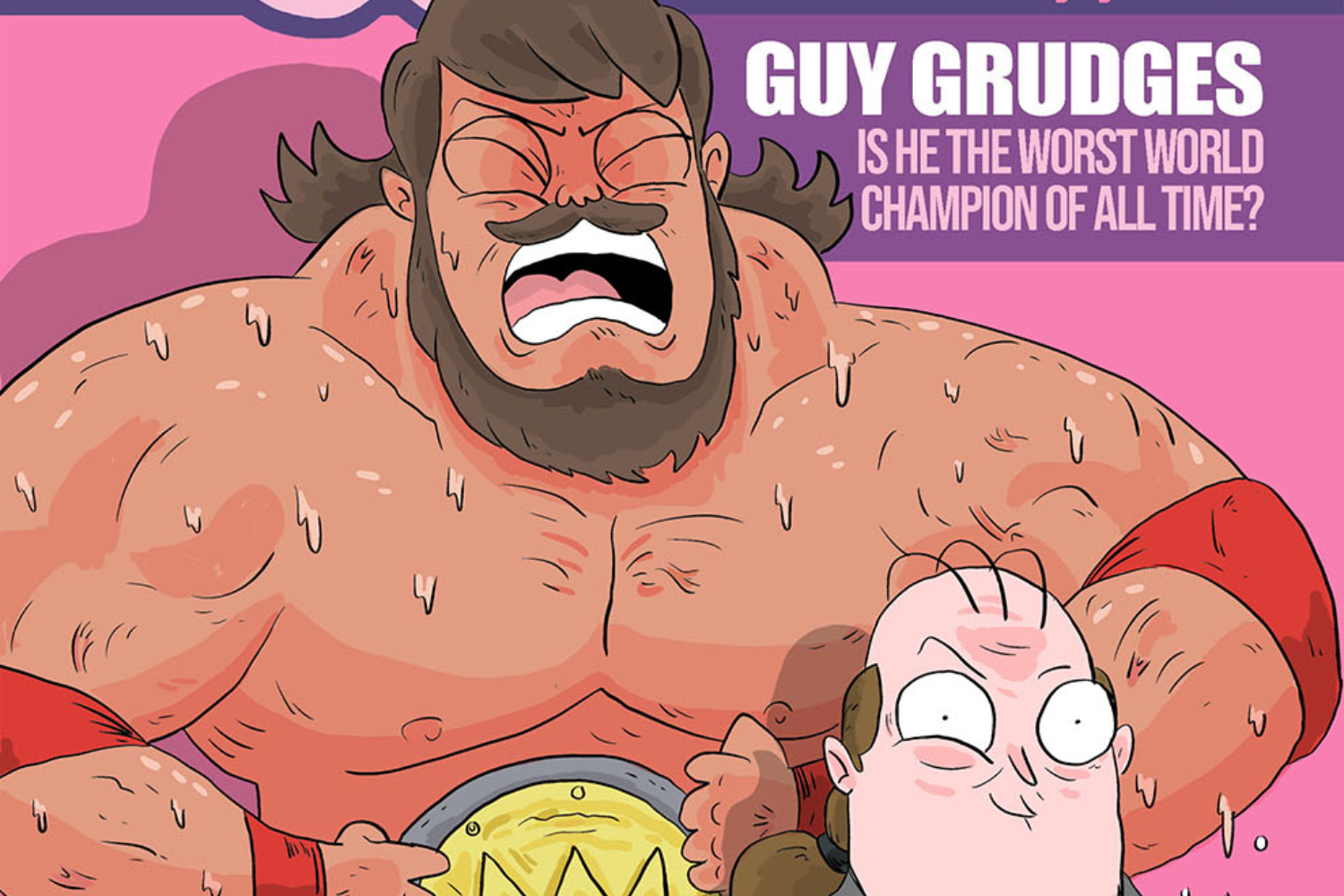

I basically likened Wrestle Heist #2 to Brock Lesnar circa March 2002.
Which, if you’re unaware of wrestling history, means that issue built on a solid debut (in the “farm leagues” of OVW) and instantly made heaps of noise with an even bolder follow-up. Issue #2 saw writer-artist Kyle Starks (alongside colorist Vladimir Popov) further Sterling Steele’s revenge plot/robbery with bigger stakes, grander emotional arcs, and a sense that this story could truly marry crime and wrestling into something wondrous and poignant AF.
Wrestle Heist #3, then, is maybe more like a debuting Chris Jericho.
(Perhaps before we learned some important behind-the-scenes tidbits.)

Courtesy of Image Comics.
Because, sure, just like the former Y2J, this issue could have solely gone one way: We began exactly where issue #2 took off with Grave Digger stuck in a deathmatch in order to help Hijo de Ocho Bola out of a jam (and thus secure both father and son for the ploy to rob promoter Buddy Hansen blind). And if we’d just gotten an action-packed issue, that would’ve been fine. Starks and Popov are the British Bulldogs of wrestling comics as they blurred the line between genuine fight and choreographed match in such a way that it made wrestling feel more real (while respecting its unique confines).
Yet just as Jericho turned out to be a pro in pivoting when the moment called for it, Starks and Popov quickly transitioned to this issue’s true main event: a Thanksgiving dinner. It’s here that we got all sorts of yummy treats, including more of Sterling’s background. His whole “wrestling broke my home” gimmick ain’t exactly novel, but it did let him connect with Ocho Bola, and that furthered Wrestle Heist‘s interests in wrestling’s core of brotherhood and camaraderie. It’s good that Wrestle Heist is even deeper for Sterling, and greater odds bring us in beyond the cheap thrills.

Courtesy of Image Comics.
Those yummy yams were then joined by a great debut from Bearwolf, who might seem like this book’s Ultimate Warrior (his speech patterns are like the most ridiculous spin on Thor ever), but was surprisingly nuanced and texture. In fact, the reveal around Bearwolf was a genuinely wonderful surprise, and it serves as just more proof that Starks wants to use wrestling as a springboard to tell stories that have real teeth. And yet he always does that in honor of wrestling, pushing the sport forward so that fans appreciate its true depth and universality and non-fans can see what this thing is capable of as a genuine storytelling and community-building machine.
If anything, I’d say surprising us was the proper theme of this dinner. (Aside from Hijo de Ocho’s shtick, which is on par for Starks and the right kind of weird humor to temper our immersion.) I’ve mentioned in both reviews Grave Digger’s unique role as a Black wrestler, and at the table he brings that very prospect up himself. It’s a perfect moment to get really real about wrestling’s bad history/tendencies, and to show us the other side of this book’s love affair. That’s not only more balanced but it’s continued to be done in honor of wrestling, proving that if you love something you can absolutely critique it to hell.

Courtesy of Image Comics.
We get even more of that with the really sharp intro of another character who has felt wrestling’s sting, and I hope she gets a chance to have some kind of redemption (even if a direct channel doesn’t seem possible). It’d just be more of what really was a truly filling dinner: Proper emotional development done with care, consideration, and lots of love for the thing it’s exploring.
And, sure, a wrestling story that mostly took place at a dinner table doesn’t seem all that thrilling. (Again, though, we got plenty of blood and body slams in the beginning, and even I was satiated for the time being.) But I think it just gave me extra time to appreciate Starks’ character designs/drawings.
It’d be easy to only spend time ooh-ing and awe-ing over, say, a spot with a weed whacker. But getting to look at everyone’s face, and watch these men tie up their hair and eat while covered in bandages, really brought home the emotionality here in a new way. These aren’t the folks that, on paper, you’d expect to be so open and vulnerable; even out of “uniform,” Bearwolf oozes pro wrestling numbskull. But then maybe that’s the point: We’re meant to see both who they are and who they’d rather be/who they can be, and in that space, we can see these folks who are so strong and robust struggle with just trying to make it through. That they may all be champions, but they’re people first, and the chasm they must span is something we all understand to one extent or another.

Courtesy of Image Comics.
It grounds them like nothing else so far in Wrestle Heist, and makes us really consider if we also might be able to overcome our own shortcomings given that these giant gladiators can as well. Or, if we can’t do just that, then perhaps that would lend some solace knowing that even these larger-than-life heroes often fall short personally. Either way, it’s the kind of character work I expected from a Y2J type: Maybe it’s a bit obvious, or even overwrought in parts, but then that drama and theatricality is what we need to really understand and explore our own personal lives.
And there will be some extra juicy leftovers moving into Wrestle Heist #4. (Issue #3 ends with the promise of a turn, and while I won’t spoil that any further, it’s a pretty masterful coalescing of traditional and wrestling-based storytelling tropes.) But in the meantime, Wrestle Heist #3 is worthy of your enthusiastic consumption, and fully relishing the undeniably human side of this wacky little sport. The action was big and bold, unnerving while also thrilling; the pace/momentum felt masterful in its control of the crowd; and there’s so many added channels for big reveals and character turns alike.
In short, Wrestle Heist #3 made the list, baby!




You must be logged in to post a comment.