

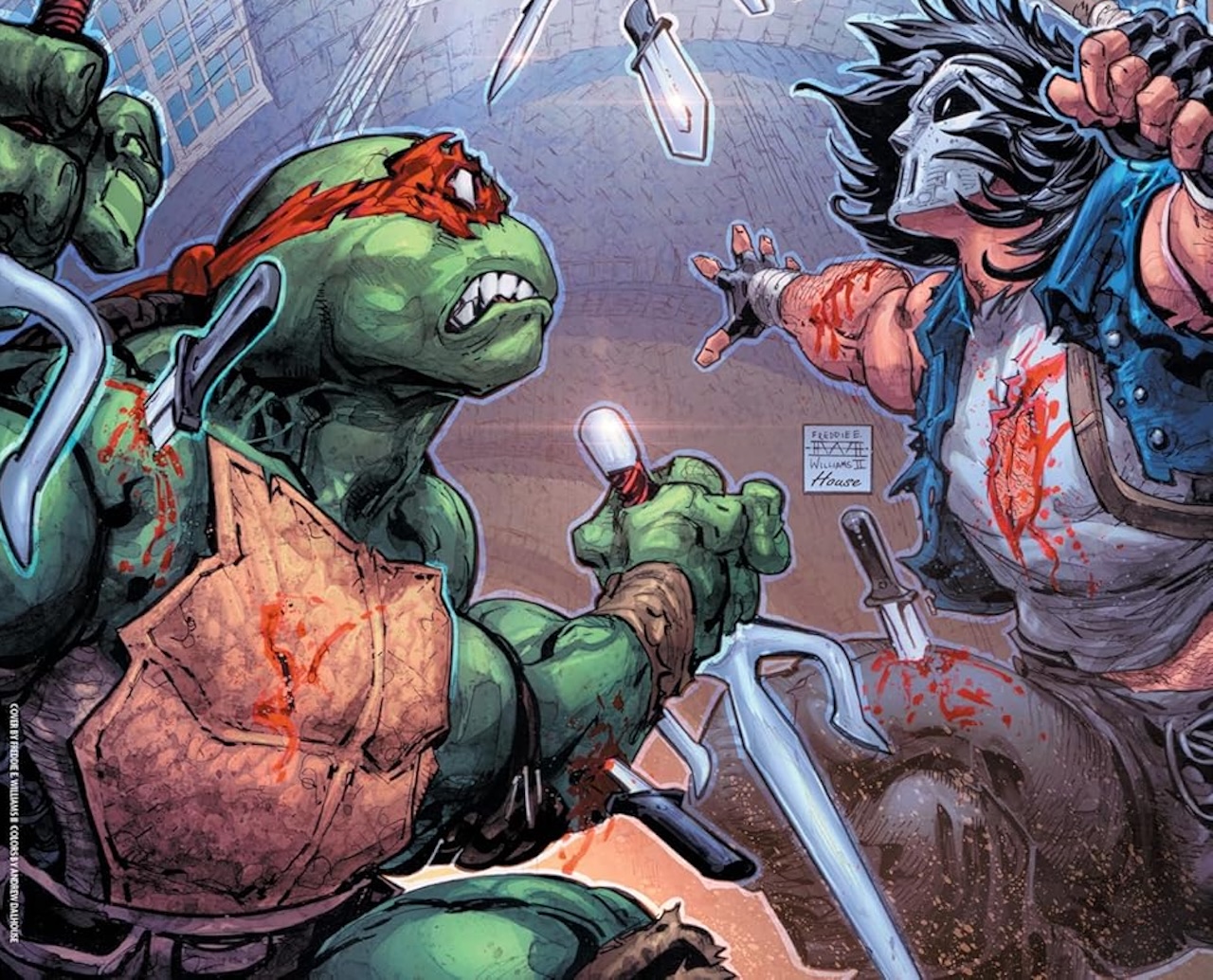

The first ever volume of IDW’s Teenage Mutant Ninja Turtles was called “Change is Constant,” a phrase that could be applied to Gene Luen Yang and Freddie E. Williams II’s current run. The dynamic between the Turtles and their father/teacher Splinter has been forever altered due to Splinter’s transformation into Ujigami, and his mission to kill anyone who’d do harm to his sons. It’s changed the nature of the war between the Turtles and the Foot Clan, since Karai is willing to resort to dark magics to gain victory. Teenage Mutant Ninja Turtles #16 once again puts the Heroes in a Half-Shell through significant change, especially when it comes to their dynamic.
That change comes courtesy of Michelangelo, and it’s here that Yang offers a deeper look into the self-proclaimed “party dude”‘s state of mind. Mikey, for once, is the voice of reason, yet he is constantly overshadowed by his brothers, leaving his inner monologue tinged with resentment. Yet in a pivotal moment, he shows that he’s more than a joke machine; in fact, Mikey is arguably the heart of the Turtles and keeps them on the right path. Yang deserves all the kudos for continuing to find new depth with the Turtles.
The battle between Casey, Splinter, and the Turtles also gives Williams the chance to really flex his artistic muscles. The opening page alone is worth the cover price, as it’s an immensely dynamic image featuring Splinter as Ujigami leaping from rooftops, hurling knives at Casey, who barely manages to dodge them. In the background, Raphael is racing to stop an already intense fight from escalating into murder. Again, this is a different response than people would expect from the always-ready-to-fight Raph. Luis Antonio Delgado drenches the scene in glowing whites and pale blues, creating a midnight hue that adds even more weight to a heavily emotional fight scene.

IDW
Keeping in line with the theme of change, Teenage Mutant Ninja Turtles #16 features a shift in art midway through, as Fero Pe returns to the Turtles’ ancient past. Pe draws the human Turtles in a way that straddles the line between humanity and their Turtle forms, with robes bearing each Turtle’s signature color. It’s a moment that goes all the way back to the beginning of the IDW run, and showcases how far the Turtles have come – and how much they’ve changed over the years. It’s also another way for Yang to emotionally gut-punch readers, but not every scene can be filled with ninjutsu and pizza.
In terms of the ongoing plot, we get more insight into Shinigami and Karai’s plans, and Splinter plays a big role in those plans; that’s saying nothing of the final scene, which features Casey in another moment meant to tug at the heartstrings. It also hints that more change is on the horizon for the Turtles, which is both frightening and intriguing. Teenage Mutant Ninja Turtles #16 is a major reminder that change is the secret ingredient that makes this version of the Turtles sing, and in a medium that often resists change, that’s a big deal.




You must be logged in to post a comment.