

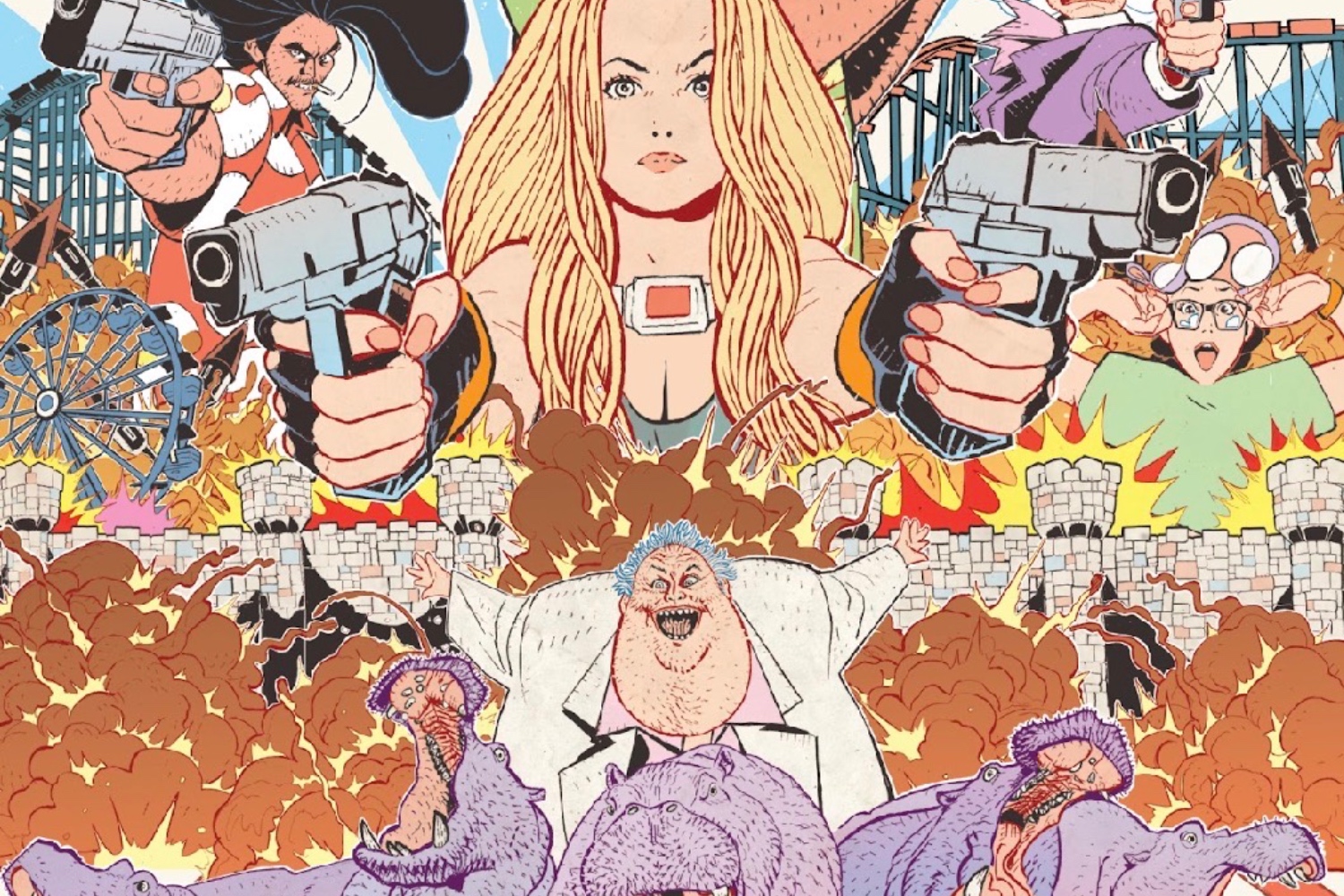

Obviously White Sky and The Florida Hippopotamus Cocaine Massacre are two very different books.
I mean, I assume White Sky won’t eventually feature drugged out, semi-aquatic animals, but who truly knows?
At least in this reviewer’s mind, they do share one thing in common: A narrow balancing act. The former title straddles a Last of Us-esque survival story with supernatural ghost story. The former, meanwhile, balances over-the-top ‘80s action with underrated but potent satire. But where White Sky #2 found ways to effectively maintain its own balance, Florida Hippopotamus Cocaine Massacre is having performance problems (even with the benefits of copious stimulants).

Courtesy of Mad Cave Studios.
Part of the “problem” is that Florida Hippopotamus Cocaine Massacre came out of the gate so dang hard. It was, above all, the premise from writer Fred Kennedy: A cop (Sencoza) and an FBI agent (Nebraska) must come together to take down a drug lord (Discau) after he escapes by drugging the hippos in his amusement park (that’s also being pummeled by a hurricane).
And that insanity was furthered by series artist James Edward Clark, whose rich, kinetic style is tailor-made for the very specific, very intense demands of this absolutely crazed tale. (If anything, the art was so crisp and engaging that it made our immersion alluring even with any other issues/concerns across this narrative.) But this speed isn’t always manageable, and Florida Hippopotamus Cocaine Massacre would clearly have to find a way to temper that without otherwise harshing its mellow.
In some ways, the book attempted to do just that by doubling down. In issue #1, I noted this device where all the FBI agents kept playing into the whole “disposable minion/I’m two days from retirement” trope by endlessly commenting about, say, a loved one waiting at home or a big anniversary coming up. Was it funny? Funk yeah. But was it also capable of being overbearing to the point of inducing projectile nausea? Funk yeah.

Courtesy of Mad Cave Studios.
In Florida Hippopotamus Cocaine Massacre #2, then, the creators not only give us more of this device, but the “verbiage” is even more ridiculous and funny, and that’s huge. It’s ultimately a testament to the team’s temperament and relationship to the audience — they’re not afraid to poke us with something they know is both a boon and a shortcoming, and in that way they’re riding the line perfectly as to entertain and upset the audience. And I can’t think of a better way bring us into a story that’s meant to be funny and dumb by also pissing us off with maximum efficiency and effectiveness.
I also think this solidly implemented device is perhaps indicative of the team’s larger use of satire across Florida Hippopotamus Cocaine Massacre. They’re obviously lampooning ‘80s culture in a major way — the bargain bin Nancy Reagan that intros/outros each issue is perhaps the best realization of how much they’re uplifting the era’s films/art (mostly of the action variety) and lambasting the feckless culture that made such art possible (for better and worse).
But issue #2 is where some of the modern-day relevance shines through. With overbearing cops pretty much everywhere, and a populace who is willing to run toward the murderous hippos, it’s hard not to see this as some spot-on commentary about the state of things in 2026. Still, it’s subtle enough, and we feel that connection and a sense of some lineage coalescing that ultimately meditates on American politics of the last 40-ish years in a way that’s delightfully underrated and sort of brilliant. Like, yes, all of it’s connected back to Ronald Reagan, but to explore this lineage via this lens is refreshing in every metric.

Courtesy of Mad Cave Studios.
If only that sense of true understatedness could have somehow been extended across other key areas of Florida Hippopotamus Cocaine Massacre #2. I mentioned earlier that issue #1 was all about emphasizing the kinetic might, and how we got into the actual story (the massacre) in a way that emphasized efficient world-building, deep humor, and proper character development. In issue #2, though, things feel slower.
Sure, some of that may have been helpful for the satire to take root. But mostly, we spent a lot of time with Nebraska and Senecoza arguing in a scene that offered some color (more commentary on policing and a weird but interesting back story for Nebraska that felt like a different, refreshing kind of insanity for this book so far). But it took forever to get to the actual part where they’re having to work together, and it felt like we could have easily cut three to four pages and still basically had the same experience. It’s a frustrating moment echoed when someone uses 15-ish words summarizing the gang’s current predicament for Nebraska in a moment of bizarre self-awareness that I found hella grating.
But if inefficient narrative structures were the worst offense, I’d actually be OK. Instead, it felt like once we worked through a bit of the truly important stuff, we should have been rewarded with more bonkers visuals. And, yes, a man did get his arm ripped off with so much blood that I squealed with joy. And also Clark’s style in general is just so cool that I’d stare endlessly at Senecoza’s hair, or just marvel at how the rain is depicted.

Courtesy of Mad Cave Studios.
Yet given that this is called Florida Hippopotamus Cocaine Massacre, I wanted more emphasis on the “Massacre.” And, not, like a OK-ish interlude about hippos that felt like social commentary but either wasn’t clear enough or not enough opaque to resonate. Yes, there are some shiny gems here — a flying kick by Nebraska is 12 kinds of cool and technically impressive — but it still felt like not enough. It felt more like “Florida Hippopotamus Cocaine Heated Disagreement,” and right when we needed to pop off with something more tantalizing, it all sort of ended.
Some of that may be more of the audience-centric poking that the creators are trying to engage in, and in theory I can respect that commitment. If this story is going to mean a damn, it has to be as much about the larger commentary about American ineptitude and foolishness as much as it’s just an excuse for bloodthirsty hippos. But the ratio felt off — if you’re going to rail us with more nuance and texture, they’ve then got to slam back on the gas and give us more gore and hijinks.
You can’t hold back till the future, because that goes against the very spirit of this book. And your commentary feels judgmental, and not based on a shared love of this storytelling tradition, if you can’t let yourselves and the audience gorge on sugary violence. It’s about, as I think White Sky totally nailed, giving us what we need, what we don’t need, what we need but can’t fully recognize, and having the courage to do all that with gusto, skill, and ample joy and connection.

Courtesy of Mad Cave Studios.
I absolutely think that Florida Hippopotamus Cocaine Massacre can get to a point where it’s even more effective. We’re only two issues in, and while I’d hope things might explode with more premature excitement, there’s ample time remaining. If we can keep what’s worked (the intellectual engine pushing this story with Prius-like quiet and integrity) and add more of what we want (gore as not just a reward but done so the story’s actually building in alignment with its intentions and energies), then things would be beyond copacetic.
Because this book truly is different — I’d just like to see that as apparently as a rampaging, drug-addled hippo.




You must be logged in to post a comment.