

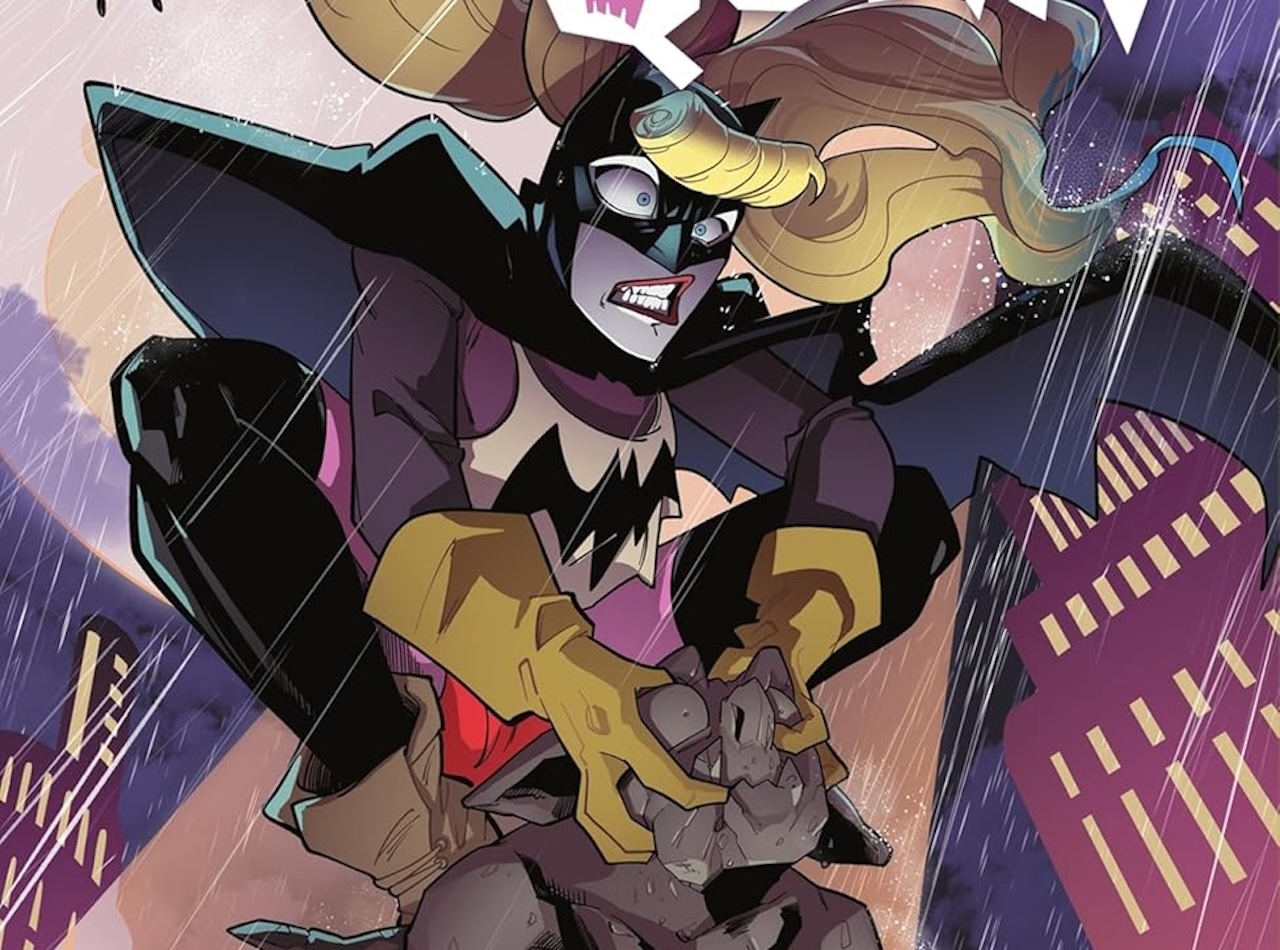

Imbued with DC K.O. energy, Harley Quinn gets a darker, grittier lease on life. Sporting a fresh fit accentuated by Batman’s iconic cape and cowl, our titular character seeks to demonstrate that it’s not who she is underneath but what she does that defines her. Embarking upon her new futile mission, it is clear Quinn is the hero Throatcutter Hill deserves, but not the one it needs right now. Because she’s not a hero. She’s a Silent Sentinel. A Hapless Harlequin…
“A Harq Knight.”

DC Comics
One part introduction to Harley’s new status quo, one part love letter to Frank Miller’s The Dark Knight Returns, Harley Quinn #60 demonstrates that Harley is the knife. Well, if that knife is made out of plastic and trying to saw through several feet of concrete. Elliot Kalan’s script does an excellent job riffing on The Dark Knight’s greatest hits while also maintaining Harley’s iconic sense of humor. Carlos Olivares’ artwork expertly conveys the kinetic energy of each action sequence.
Unfortunately, this issue spends most of its time exploring Harley’s new status quo without defining a clear conflict to drive the narrative forward. Thankfully, Kalan establishes a mystery during the book’s final moments that will bring readers back for more.
Opening with Harley’s Brooding Loner Inner Monologue Journal, we find BatQuinn perched above a television robbery in progress, waiting to “hit this scum hard and fast” because “soft and slow seems like a pointless way to hit someone.” Harley Quinn #60 is at its best when serving as a love letter to The Dark Knight Returns. Kalan’s use of misquotes evokes fond memories of Frank Miller’s seminal work while imbuing the grim nature of that story with Harley’s trademark humor. The writer’s work remains true to her character as she can’t help but infuse humor in every line despite the fact that her “grim, futile, mature, surly mission” calls her.
It’s hard not to smile when Harley proclaims, “You don’t get it, boy. This isn’t a mudhole. It’s a mudhole where I’m breaking your leg.” I think it is a testament to Kalan’s understanding of the character that he has Harley unabashedly commit to this new shtick. Harley’s dedication to this punchline could become borderline annoying, but Kalan gets a lot of mileage out of slamming the nostalgia button. Harley’s misquotes of famous Batman lines do an excellent job of demonstrating her fundamental misunderstanding of and slight irreverence for the Caped Crusader.

DC Comics
BatQuinn returns to these punchlines throughout various sequences to demonstrate her Batman-like estrangement from her friends and the newly appointed Mayor of Throatcutter Hill, Poison Ivy. Additionally, Kalan positions the newly superpowered Chicken Fingers as the Superman-like figure of hope against Harley’s BatQuinn as the grim herald of justice. Although Chicken Fingers encourages Harley to focus on the positive outcomes of her battle with the Penny Plunderer, in true Dark Knight fashion, BatQuinn can only focus on her failures as a Bat-Hero. The two characters’ new status quo promises conflict between these two friends as their ideals will inevitably collide.
Unfortunately, Kalan spends so much time establishing the new grim status quo with these punchlines that it is hard to get a sense of what the overarching conflict will be for this storyline. Thankfully, the writer remedies this with a reveal on Harley Quinn #60’s final page that will surely have readers grabbing the next issue to figure out how this reveal is possible.
“Don’t Expect a Witty Battle Cry.”

DC Comics
I would be remiss if I didn’t mention the art team on this issue. Carlos Olivares’ artwork does an excellent job conveying the kinetic action of each action sequence. Marissa Louise’s colors do a perfect job providing the gritty nature for this love-letter to The Dark Knight Returns. One of my favorite sequences is Olivares’ recreation of the “rain on my chest is a baptism” sequence. Olivares and Louise perfectly recreate this page with BatQuinn in such a way that I wish it was this issue’s cover. A special shoutout needs to go to Kalan for Harley’s chest joke that nearly ruined this moment, except that its timing felt perfectly on point for Harley Quinn.
The only gripes that I have with the artwork come from a panel in which it’s kind of difficult to exactly tell why Harley fell into the trash. Additionally, I will say that the panels in which you don’t see Harley’s irises through the Bat-Cowl are aesthetically more pleasing than those in which they are visible. However, that is a personal preference, as Olivares’ uses her eyes to convey emotion. Without illustrating the irises in her eyes, I am not sure that this would be as effective.
Ultimately, Harley Quinn #60 is at its best when serving as a love letter to The Dark Knight Returns. Elliot Kalan’s script does an excellent job riffing on The Dark Knight’s greatest hits while also maintaining Harley’s iconic sense of humor. Carlos Olivares’ artwork expertly conveys the kinetic energy of each action sequence. Olivares and Louise perfectly recreate the baptism sequence from Frank Miller’s seminal work with BatQuinn. Kalan spends most of this installment exploring Harley’s new status quo without defining a clear conflict to drive the storyline forward, but thankfully, he sprinkles enough breadcrumbs by establishing a mystery during the book’s final moments that will bring readers back for more.




You must be logged in to post a comment.