

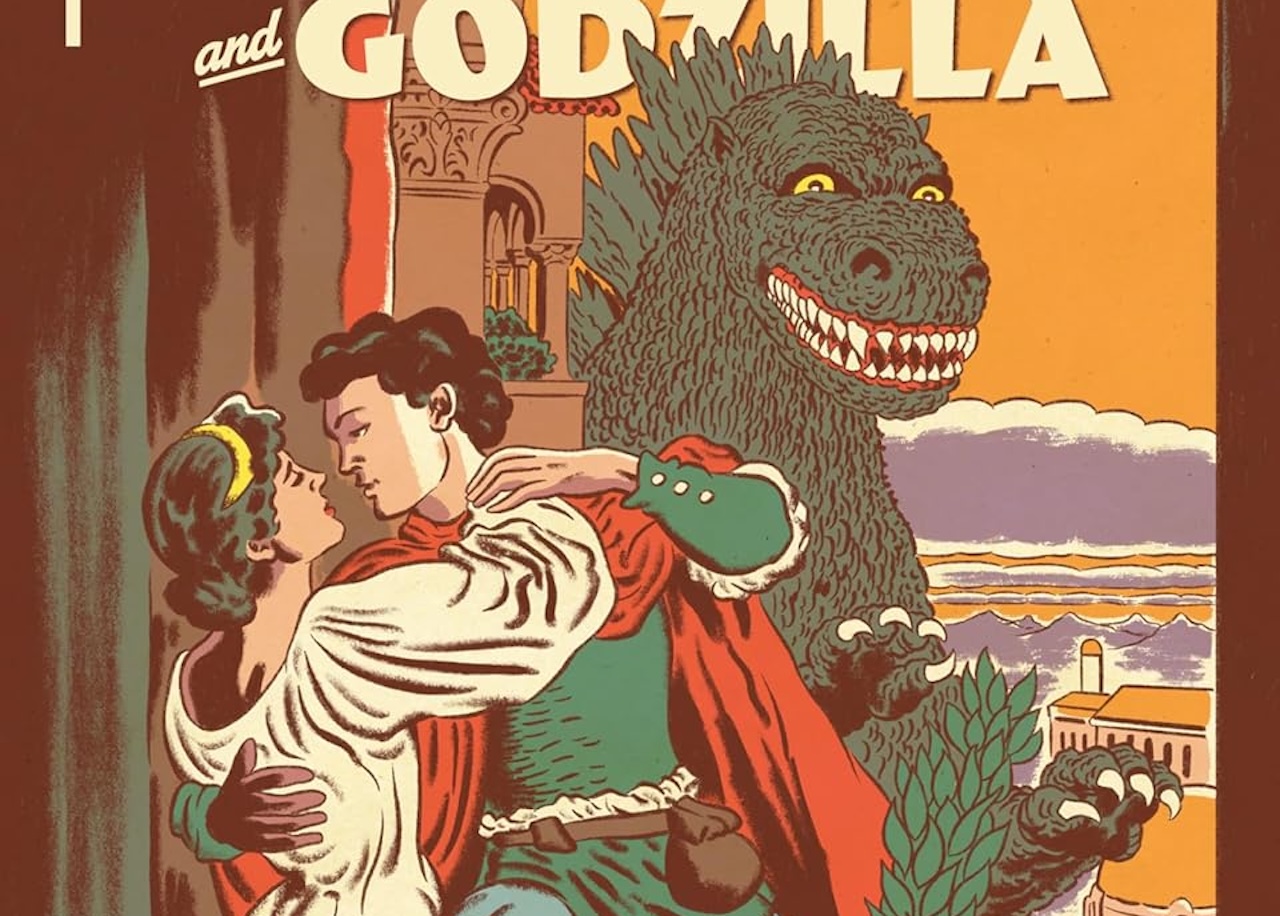

Tom Scioli’s Godzilla’s Monsterpiece Theater is a delight of a comic, combining inspired nonsense (In the Red Corner, Godzilla! In the Blue Corner, Jay Gatsby and the G-Force, including Sherlock Holmes, the Time Machinist, and Cyborg Jules Verne! From the skylight, with a steel chair, Dracula!) with beautiful, creative action and insightful riffs on The Great Gatsby’s title character. The newly launched Monsterpiece Theater Presents anthology takes its predecessor’s basic premise, Godzilla vs. classic literature, and narrows its focus. Where Monsterpiece Theater drew from a right proper mash of texts, each issue of Presents picks one great work for the King of the Monsters to rampage through. Artist Sean Peacock and writer Adam Tierney kick things off with Romeo & Juliet and Godzilla, which, wherein the young scions of two dignified Veronan houses find their love tested not only by their family’s feud, but by the fact that their city is regularly besieged by a giant radioactive lizard and a giant radioactive moth.
The best thing about Romeo & Juliet and Godzilla is Peacock’s art. His Montagues and Capulets are a vibrant, angular bunch, expressively stylized and full of character. Peacock’s Romeo is endearingly gormless, so lovestruck that he barely pays attention to Godzilla, curled up in his own world. Peacock’s Juliet is fiery and passionate, flinging herself into Romeo’s arms or drastic, disastrous action. The supporting cast are likewise strong, particularly a dashing Mercutio and a Tybalt so snide that his strut can only be called sneering.

IDW
Peacock does similar justice to Godzilla and Mothra. Godzilla is just as expressive as Peacock’s humans, particularly when taken aback by an unexpected challenger or rallying to strike back. Mothra, while a good deal more menacing than she usually is, looks good, and while she isn’t as overtly as expressive as Godzilla, her fondness for her fellow kaiju is endearing. Their mutual foe is a fun riff on Mechagodzilla, here not a weapon from beyond the stars forged from Space Titanium, but a wondrous wooden clockwork contraption.
In terms of action, Peacock acquits himself well on both the human scale, as seen when Mercutio and Tybalt take their ill-fated duel onto Godzilla himself, and the kaiju scale, as seen with Godzilla and Mothra’s burly, city-wrecking brawls with Clockworkgodzilla.
Visually, Romeo & Juliet and Godzilla is a ton of fun. Narratively, though, it’s disappointing. Tierney hews close not only to Shakespeare’s language, but to the structure of Romeo & Juliet. Godzilla, Mothra, and Clockworkgodzilla may be rampaging through Verona during the young Montague and Capulet’s courtship, but they have very little to do with each other, and the implications of their presence are largely ignored. This is particularly egregious in the case of Clockworkgodzilla, who is a Capulet weapon piloted by Lord Capulet. The Montagues do not have a steam-powered Jet Jaguar or family pact with King Caesar to counter it. Romeo & Juliet and Godzilla gives one side of a generations-long feud a superweapon, but sidesteps digging into the impact that would have on the story.

IDW
When the comic does deviate from Shakespeare, it’s either a fizzle or decidedly for the worse. A comparison between Godzilla and Mothra’s stable relationship and Romeo and Juliet’s tempestuous relationship doesn’t go anywhere beyond a cursory “Godzilla and Mothra’s love is healthier and less self-destructive than Romeo and Juliet’s.” The violent deaths that set the stage for Romeo and Juliet’s doom still occur, but in circumstances that either puncture the long-running feud by making Lord Capulet the one responsible, rather than any of his kin (making it less of a family feud and more the cruelties of one awful man) or outright undercut key character beats by turning character-shaping murders into accidental Godzilla casualties. It’s faithful to Shakespeare where it has space to run, but breaks from his text in ways that break its dramatic engine.
Worse, during Romeo & Juliet and Godzilla’s climax, what at first looks like a wild narrative break from the Bard that could match the original Monsterpiece Theater for creative, clever, character-informed zaniness turns out to be a leviathan of a red herring. The result is an airless story that feels less like a story about how the presence of Godzilla affects the fates and loves of Romeo, Juliet and their kin and more like an attempt at telling Romeo & Juliet around Godzilla that doesn’t succeed as Romeo & Juliet or as an interesting Godzilla story. At its funniest, it echoes Bambi Meets Godzilla, but that’s its best and only joke, and its repetition wears out its laughs.

IDW
Not helping Romeo & Juliet and Godzilla is the inclusion of the first chapter of the Scioli-illustrated-and-written Godzilla Meets Robin Hood and His Merry Band of Outlaws, which, like Monsterpiece Theater, deftly combines the texts it’s building from into a clever, coherent whole that uses the narratives and iconographies of its sources in a creative way. The sheriff of Nottingham is a petty tyrant who imagines himself the whole of the world. Robin Hood knows that the world is bigger than any one man, and that systems of power are more than one cruel lawman. Godzilla is the gargantuan proof of how much bigger the world is. It’s fantastic, and I cannot wait to read more of it.
Godzilla Meets Robin Hood and His Merry Band of Outlaws is excellent. Romeo & Juliet and Godzilla has wonderful art let down by a script that consistently fails to match its color and creativity and frequently undermines itself. Monsterpiece Theater Presents is a neat idea, but so far its predecessor series is a better place to start.




You must be logged in to post a comment.