


Per my clever little headline, Death Fight Forever #2 did, in fact, kick my butt, break my heart, and leave me screaming for me.
What was another in Andrew MacLean’s “simple but deceptive stories” (see Head Lopper), Bash Biggle and Marla Mendoza embarked on a painful but potent team-up to defeat Lord Slyther. Be it MacLean’s action-movie-meets-video-games framework, or the surreal and psychedelic art from Alexis Ziritt, the second issue felt like a big move for this absurd tale of revenge and leather jackets.
Now, though, Death Fight Forever #3 is potentially causing me another kind of pain: the kind associated with sudden change!
Because Ziritt has stepped aside, and now MacLean is joined for issue #3 by artist Al Gofa (Cry Punch Comics). On the one hand, I’ll miss Ziritt’s work — all that technical skill, cerebral tomfoolery, and distinct ’80s-inspired accoutrements were the absolute perfect choice for this story (that I, once more, described as “Double Dragon meets Contra meets Blood Dragon.”) Only now it’s more like “Double Dragon meets Contra meets Cadillacs and Dinosaurs,” and I’m not entirely mad about it, folks.

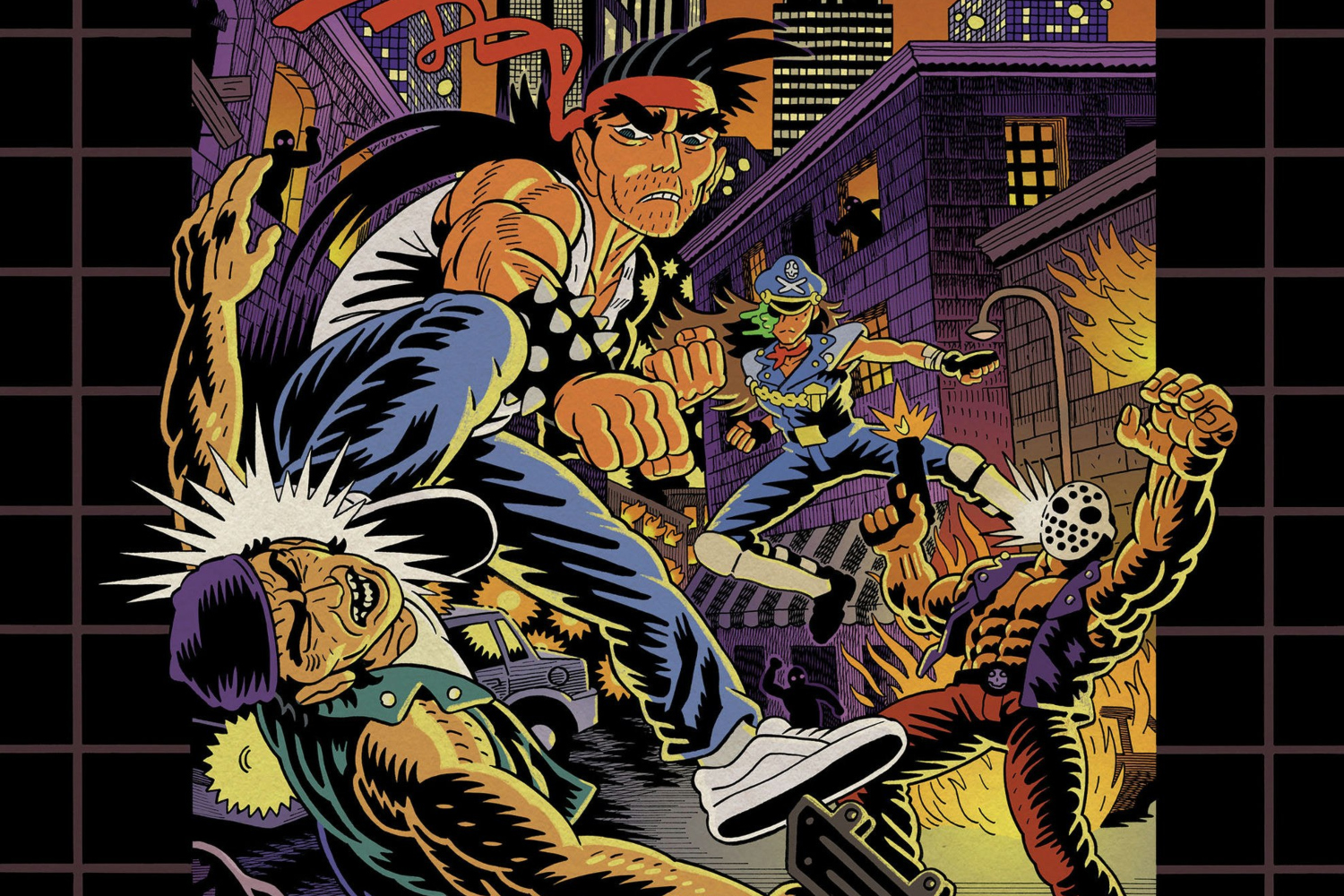
Variant cover by Jake Smith. Courtesy of Image Comics.
Because Gofa’s whole approach artistically does feel at least tangentially connected to Ziritt; there’s this exaggerated quality to humanity; a potent mix of grit with the lo-fi and absurd; and a tendency to go big with the colors and angles. So, while Death Fight Forever #3 doesn’t have quite that undercutting sense of elegance, Gofa’s skill and charm give us big shoot-outs between Bash and Marla and Slyther’s henchmen that feel different in the best ways. Truly, there’s a part where Marla is fighting out of her car that made me want to play this in some video game pronto.
It’s altogether more goofy and cartoonish, for sure, but in a way that feels like it’s still in on the joke regarding how this book regards just such nostalgia and brevity (i.e., with the proper mix of respect and disdain). It’s also more chaotic, and not only does that fit with the “theme” of this issue (it’s basically one long battle, and I love that focus as we make this “transition”), but there’s something that feels thematically significant. That as things get emotionally messy, and their work more consuming, that Bash and Marla are “letting go,” as it were.
That this new art style perfectly mirrors a sense of more overt joy and catharsis for the pair, and that where Ziritt’s art felt like a statement of elegance to augment the big, dumb story, that pretense is gone now. The pair very much are in the thick of their over-the-top hijinks, and the world around them is all the more dramatic, silly, surreal, etc. for that shift. It doesn’t make me miss Ziritt’s work any less, but it does make this shift seem all the more deliberate, and that helps ground and maintain my immersion. Gofa’s style is like a cartoon I watched alone on Toonami at 11 p.m. Friday night, and that carries so much emotional significance.

Main cover by Andrew MacLean. Courtesy of Image Comics.
At the same time, I wish more of that emotional power/resonance carried through in the story at large. I’d commented a few times in my reviews of Death Fight Forever issues #1 and #2 that for as much as this book is a showcase for more weird, wild storytelling for genre-drunk millennials, there was real heart and depth to it. Both Marla and Bash had experienced loss: She lost her identity (albeit as the lieutenant in an evil army of mutants) and he lost his brother (and sense of purpose). That made their bloody mission of vengeance seem even more potent, and that in the course of all this blood shed, they’d find themselves and each other.
However, we don’t get nearly enough of that resonance in Death Fight Forever #3. Yes, we get some important emotional beats/moments: Bash, for instance, is portrayed as being a least a little more capable (i.e., as a renowned lock pick artist), and that demonstrates that this dummy is much deeper than we’d expected (again, much like the story). And even Marla got to let loose a little and see the world through more of Bash’s perspective (in a fun way that might have involved armed robbery).
Aside from those, however, this issue felt like it lacked some of that below-the-surface emotional power and impact. That while this little team is growing closer together (and that will prove vital and interesting as they move nearer to Slyther), I still found myself wanting more at the issue’s end. To me, Death Fight Forever isn’t about exploding croc-men or chain guns in muscle cars; it’s about how an emotional state pushes you toward engaging/fighting/etc. those very things. From there, what happens when the blood lust is satiated — what kind of person are you left to live as, and what’s that done to help/hurt others and also the world in general.

Variant cover by Al Gofa. Courtesy of Image Comics.
I still think that is very much core to the whole Death Fight Forever “experience,” but I just think that it didn’t carry over as much into #3. Was the change in artist at least partially to “blame” for that loss? Sure, at least to the extent that this book is deeply reflective of its creators’ tastes and preferences, and that makes this roster change impactful for both better and worse. Is it also an issue that can be remedied pretty quickly? Sure, but Death Fight Forever #4 will also have a different artist, and that’s yet another layer and complication.
Ultimately, I have a deep love and abiding respect for this book. I get its mission, understand its references and “values,” and appreciate what it’s trying to on some many different fronts (and with such earnestness and dedication). No matter what shifts/changes may come down the pipeline, I think if Death Fight Forever can push even more emotionality amid the over-the-top action, then it’ll break my heart, body, and mind with even greater efficiency and lethality.




You must be logged in to post a comment.