

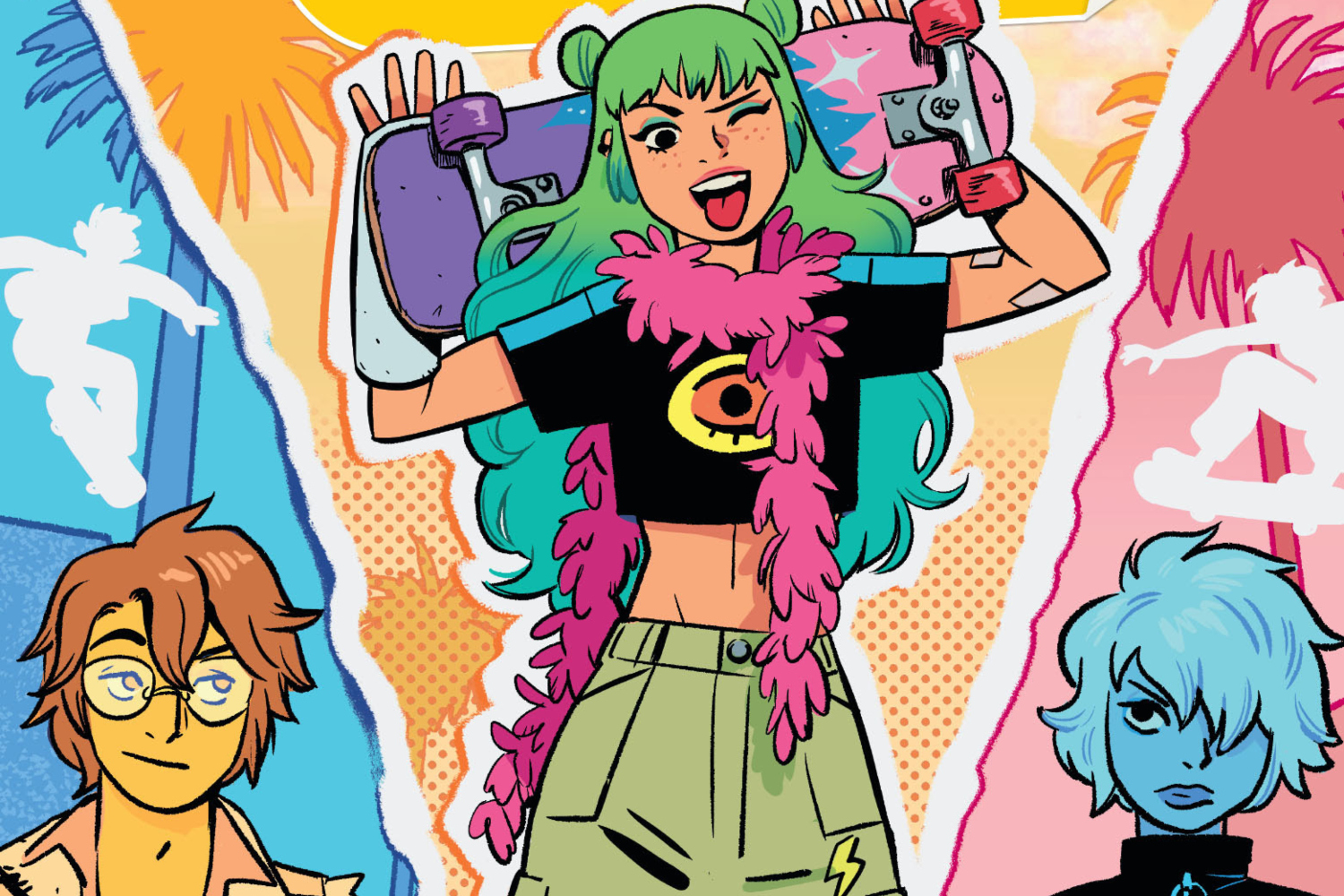

In the near-future Los Angeles depicted in Skate Ali, skateboarding is illegal. Fortunately, that does not stop a single soul — it only makes it more dangerous, more electric, and more essential.
Created by Sam Humphries, Kelly Sue DeConnick, and artist Natacha Bustos, Skate Ali is a high-energy sci-fi story about identity, rebellion, and the pull between isolation and belonging. At its center is Ali, a quiet loner who rides the line between staying invisible and stepping into something bigger than herself.
That tension is not accidental. In our interview, the creative team made it clear that it’s the beating heart of the book.
“I just think no matter how much love surrounds us, most of us often feel like an outsider,” Humphries said. “And that’s OK.”

Courtesy of Dark Horse Comics.
A World of Rebellion and Belonging
The idea for Skate Ali has been years in the making. Humphries and DeConnick first developed the concept more than a decade ago, revisiting it over time until the right moment arrived.
“This one goes all the way back,” DeConnick says. “It would go dormant and then resurface every couple of years like, ‘Hey… what about Skate Ali?’”
“The development of this book was off and on for years,” Humphries added. “I had a lot of time to imagine the world of Ali when I was supposed to be working on something else. All that world-building added up over time. I lived in Los Angeles for 25 years, and I’ve read into its history quite a bit, so I had a lot of fun developing its future as well. There are several key moments of Los Angeles’ past that I changed, which result in the Los Angeles of Skate Ali. Why did Los Angeles’ skate scene go underground? Why is there an old amusement park in Hollywood? How did the city succeed in banning skateboarding?”
What kept bringing them back was that emotional core. It’s a tale of a kid who feels completely alone, only to discover a hidden world operating just out of sight. That world offers connection, but also demands something in return.
“That tension between radical independence and the need for connection,” DeConnick said. “That’s the part that always stuck with me.”
For Humphries, the appeal goes even deeper.
“Skate Ali is a goulash of things that I love,” Humphries said. “But it’s also about found family, falling in love, and finding yourself through things that captivate you.”
“Sam is an absolute idea machine,” DeConnick said. “He always has been. And you know, we’ve both got 15-plus years of living and writing and thinking about living and writing under our belts now. We’re better writers than we were when we came up with Ali. It’s a better book than it would have been then. We worked together on this not because one of us filled in skill gaps for the other, we worked on it together because we were excited about the same things and we wanted to play.”


An Outlaw’s Future
The vivid futurism of this book stays with you after you put the first issue down. The Los Angeles depicted in Skate Ali feels lived-in from the first page, a neon-lit city shaped by history, culture, and control.
“I was there at the beginning with Sam—we built the original version of Skate Ali together years ago,” DeConnick said about her role in the project. “But I’m really here as a supporter now. What you’re seeing on the page is all Sam and Natacha and their team.”
A unique role, DeConnick explained, “I’ve stayed in the loop—I read drafts, I’m around if I can be useful—but I’m not in the trenches. I think of it a little like a non-writing EP role in TV. I’m cheering them on from the sidelines, and occasionally handing out snacks. And honestly, they don’t need me. They’ve got this.”
For Bustos, capturing that energy meant going beyond the tricks themselves.
“Skate culture is much more than just a sport,” Bustos said. “It includes graffiti, fashion, breakdancing, and music. I wanted to capture the energy, the aesthetic, and the attitude.”

Courtesy of Dark Horse Comics.
Motion, Style, and The Language of Comics
Bringing skateboarding to life on the page is no small task. It is a medium built on still images, trying to convey speed, balance, and risk. It’s an element that adds so much vitality and humanism to the experience. Bustos embraced that challenge through layout and emotion.
“By playing with the page and the characters’ feelings, I try to convey movement,” Bustos said. “Comics have a unique narrative potential that makes it possible.”
“Natacha—she’s one of those artists who makes it look effortless,” DeConnick said. “The cartooning is so clean it almost disappears, but you know there are a thousand decisions behind every line. She has this incredible instinct for what to leave out, which is such a hard thing to do well. There’s a confidence there, a clarity. You feel it on the page, and you feel it when you meet her. She’s a natural leader, and people really respond to that. When Matt and I were in Malaga last year we got to see her in her element. The professional comics community in Spain is hella impressive (as well as unreasonably attractive. WTF, Spain??) and they all adore Natacha. That tells you something.”
Bustos also drew inspiration from sports manga, where motion and impact are often heightened through visual storytelling choices. The result is a book that feels kinetic, even when the reader is standing still.
The Magic of The Rush
At the heart of Skate Ali is the “Rush,” a mysterious force that elevates skating into something almost supernatural. For Humphries, that idea was there from the beginning.
“It unlocked spectacle and fun,” Humphries said . “But it also let us explore the spiritual side of skateboarding. Self-expression, flow, freedom, community. Those are harder to show visually, and the Rush helps make them tangible.”
DeConnick connects the concept to something more emotional: Watching elite athletes push beyond limits can feel like witnessing magic.
“There’s this moment where it feels like the only thing holding you up is belief,” DeConnick said. “That idea that courage is a kind of magic. That’s what I connected to.”

Courtesy of Dark Horse Comics.
A Culture of Outsiders
Despite its futuristic setting, Skate Ali draws heavily from real-world skate culture. Not necessarily from firsthand experience, but from the feeling it creates. Humphries recalls a moment that stuck with him.
“I ate it hard skating in Hollywood once, and another skater I didn’t know offered me a hit off his blunt,” Humphries said. “I think that’s beautiful.”
It is a small moment, but it speaks to the sense of community that defines the culture. It’s a big, expansive group built on shared risk and shared understanding.
Bustos tells me she found her connection through games, music, and friends. Meanwhile, DeConnick found hers through watching athletes push beyond what seemed possible. Regardless, each perspective feeds into the book’s DNA.
Sticking The Landing at Last
The version of Skate Ali arriving in 2026 is not the same one first imagined years ago. It has grown, changed, and sharpened. Not only is that a sign of the deep collaboration of this creative team, and time itself is affecting our ideas.
“Initially, we mapped out 25 to 30 issues,” Humphries said. “What were we thinking?”
That long development period allowed the story to evolve into something more focused, with a clear direction and a larger world waiting beyond the first arc.
“Los Angeles is not the only city with underground skate clans,” Humphries said. “Ali is going to meet, or battle, all of them.”

Courtesy of Dark Horse Comics.
Finding Your Line
At its core, Skate Ali is about a choice. Stay invisible, or take the risk of being seen. It’s a sentiment teenagers will likely gravitate toward, but even adults in a post-COVID lockdown world can relate to as well.
Ali’s journey is not just about skating. It is about stepping into a world that demands courage, connection, and a willingness to fall.
And maybe, if you believe hard enough, to actually fly.
Skate Ali #1 arrives in comic shops on June 10. Like what you see here? Get your pre0orders in by Monday, May 4!



You must be logged in to post a comment.