

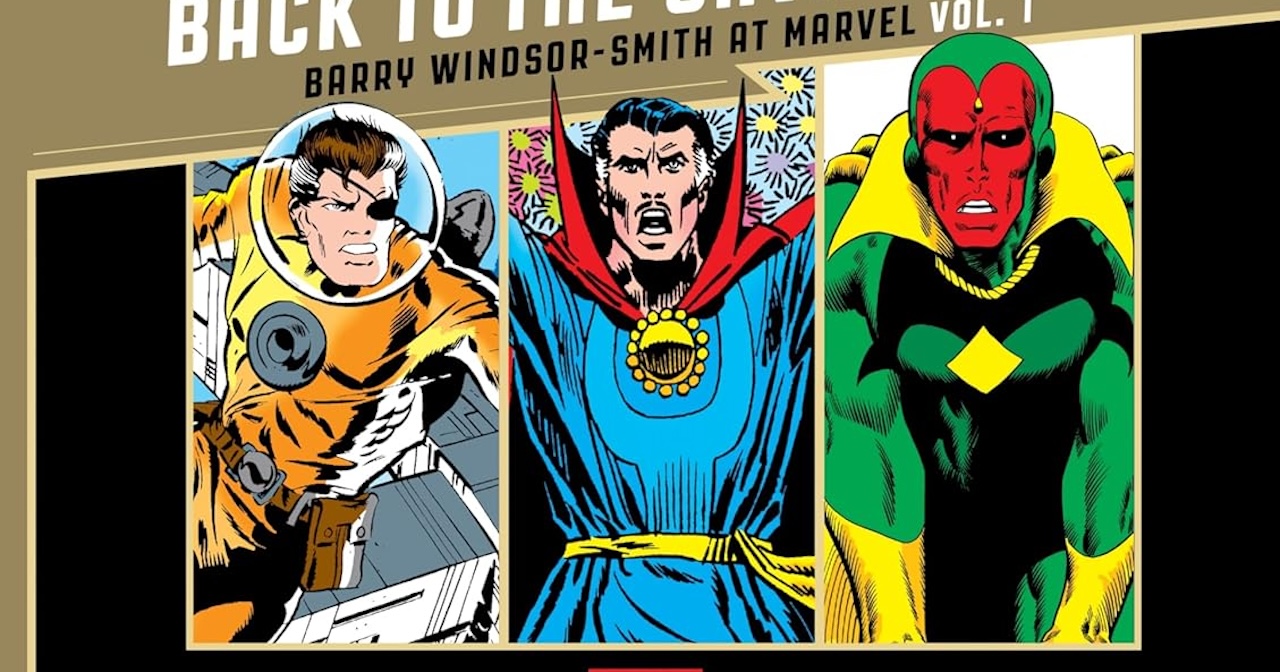

Barry Windsor-Smith is a legendary British comic book artist whose heyday back in the late 1970s and early 1980s left a lasting mark on the coming era of ‘superstar artists’ that would overrun the medium the decade following. After a massive run with Roy Thomas on Conan the Barbarian, Windsor-Smith had an iconic hand in key issues of Iron Man and Uncanny X-Men – his is the artwork that made both the Lifedeath issues so memorable.
But before he was a star he was just a nineteen-year-old kid from London, desperate to break into American comics. He worshiped Jack Kirby, whose massive amount of work Marvel work had slowly trickled to the UK by the end of the 1960s. A spur-of-the-moment, desperate trip across the pond led to Windsor-Smith and his friend Steve Parkhouse crashing on the floors of Marvel Bullpen staffers even as they got their first work in the business.

Fantagraphics/Marvel
Marvel Creator Collection No. 1 – Back to the Savage Land: Barry Windsor-Smith at Marvel Vol. 1 reprints a lot of that early work, from the artist’s first full issue (the fan-despised The X-Men #53 from 1969) through key issues of the 1970s (and two important issues of Iron Man from the 1980s). It isn’t an exhaustive collection of issues, nor is it an exact chronology. Instead, books have been selected that seem to best represent Windsor-Smith’s artistic development.
In his earliest work, he’d be hard-pressed to avoid comparison to his hero, Jack Kirby. The issue of X-Men that started it all is a clunky imitation of the King, with his squared-off figures and Kirby Crackle. Later, Windsor-Smith leans into a Jim Steranko influence, conveniently on Nick Fury: Agent of S.H.I.E.L.D. The influences start to loosen as the artist begins his early ’70s work on books like Avengers and Astonishing Tales featuring Ka-Zar. This era sees him establishing his own, freer pencils that lack the rigidity of the founding Marvel artists.
It takes a while – his most remarkable work here is from 1988 – but the journey is thrilling to see. The book truly documents a noteworthy growth of a prodigious talent, and it does so in glorious, over-sized reprints, drawing the art into clear focus. The book even reprints the work on tone-corrected pages, so even the colors by various collaborators pops in the accurate way.

Fantagraphics/Marvel
If this is what we can expect from further editions of the Marvel Creator Collection (and of the second volume of Windsor-Smith work), then we’re in very good hands. Fantagraphics has always been a publisher equally interested in the importance and history of the craft as they are with comics themselves, and books like this spotlight how important their work is.
A remarkable and academic look at a superstar artist (who became a star before the term had been coined), the book belongs next to your art books as much as it does next to your collected editions.




You must be logged in to post a comment.