

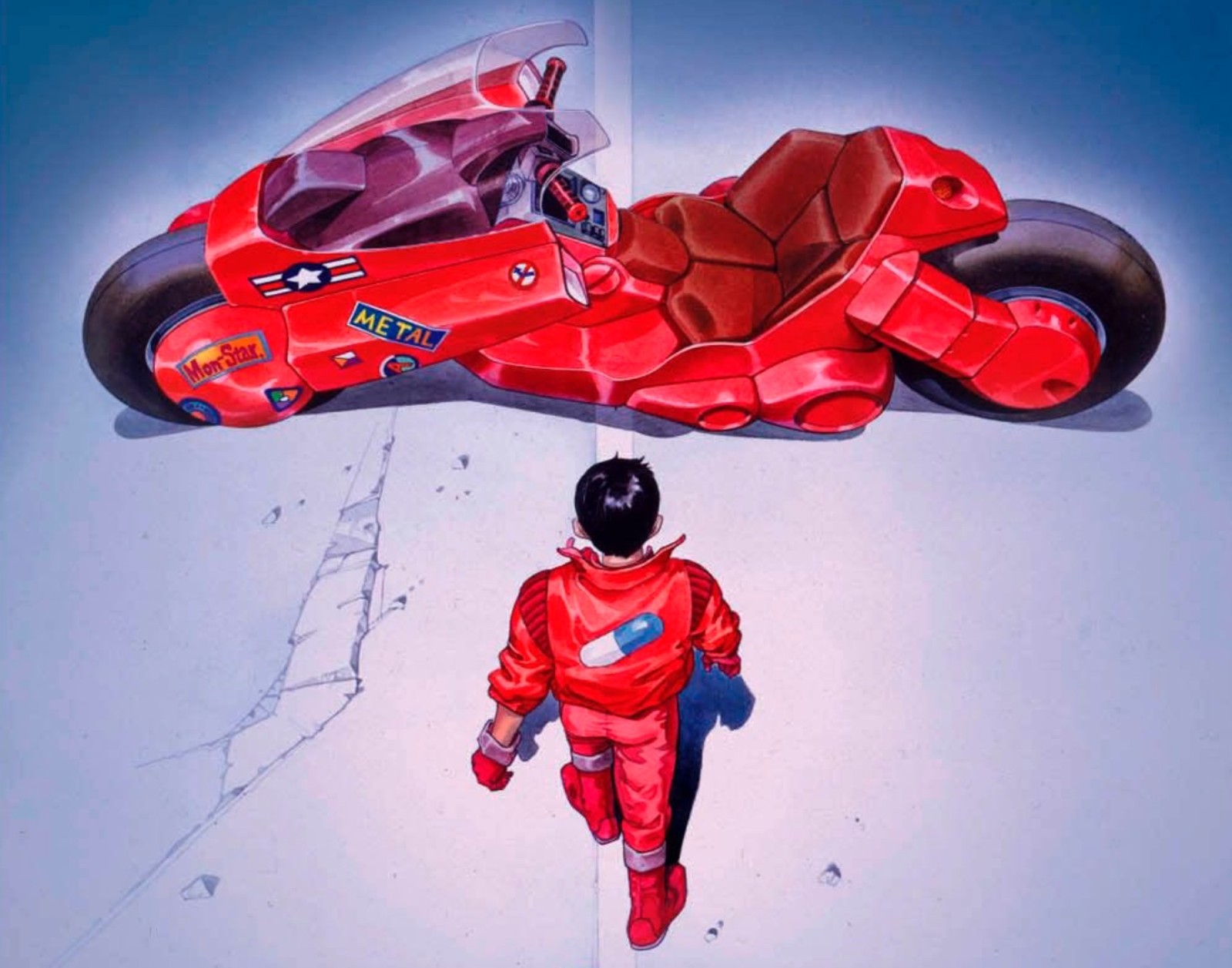

Last month, the British anime distribution company Anime Limited did a theatrical re-release of Katsuhiro Otomo’s 1988 anime masterpiece Akira. With ongoing cinema screenings, including IMAX, that present a 4K restoration of the film, not only did it make it into the UK Box Office Top 10, but this new reissue has earned more than the combined totals of previous re-releases. In this current age, where anime is becoming more and more mainstream with new movies and series inspiring new generations within the anime fandom, Akira is a film that continues to be revisited over and over, and this recent visitation reminded me of my own personal journey with this particular title and anime as a whole.
My first exposure to Akira was at a time when anime was a niche thing, when the now-defunct anime UK and US distributor Manga Entertainment was releasing home video versions of classics such as Ghost in the Shell, Macross Plus, and Ninja Scroll. Clearly too young to watch these titles, which reveled in mature content in a way that Western animation didn’t do much of back in the day, it didn’t stop me from being mesmerized by the level of visual storytelling that I wasn’t seeing anywhere else. Back then, Akira was just one of those films, yet, through multiple viewings and looking back at its development history and ongoing legacy, no other creation has had a greater impact on the world of anime and manga than what Katsuhiro Otomo achieved during the eighties.
Neo-Tokyo Is About to E.X.P.L.O.D.E.
Based on Katsuhiro Otomo’s six-volume manga, which began publication in 1982, the film, made six years later, depicts a dystopian Tokyo in 2019. During the opening set-piece, where biker gangs wage war in the streets of Neo-Tokyo, the teenage Tetsuo Shima suddenly acquires powerful telekinetic abilities after colliding with a child esper in a motorcycle accident. The story centers on his childhood friend, Shotaro Kaneda, and several others as they attempt to prevent Tetsuo from releasing the mysterious power known as Akira, which caused the sudden destruction of Tokyo in 1988 and triggered a third world war.
By the time Akira had its original theatrical release in Japan, the eighties had been a decade of many highs and lows. From Ridley Scott’s Blade Runner to William Gibson’s Neuromancer, we saw the rise of the cyberpunk subgenre, which you could argue originated in Fritz Lang’s Metropolis from 1927, whilst sci-fi authors like Philip K. Dick explored the impact of technology and drug culture, the neon-lit streets of Tokyo throughout the decades would provide a visual aesthetic for those aforementioned titles.
Cyberpunk would become a prominent theme throughout the eighties and nineties, with many dubbing the period “The Golden Age of Anime”. Due to Japan’s economic boom, many animators were given the opportunity to experiment with the films and original video animations being produced at the time, many of which would make their way into the West. However, compared to the anime projects from that period, and to our current idea of what defines anime – particularly with the rise of otaku culture – Akira is unlike any other animated production.
Using traditional cel animation, the film features more than 160,000 animation cels to create super-fluid motion as the characters ride high-tech vehicles in thrilling action sequences. Whilst obviously hand-drawn animation, it feels like you are watching live-action cinema, a platform that Otomo would tackle throughout his career. Since Neo-Tokyo is as much a character as the people that inhabit it, you can see its personality during the nighttime as the staff from Tokyo Movie Shinsha (now TMS Entertainment) used 327 distinct colors to animate the many lighting scenarios throughout the film’s two-hour running time.
Although you can watch Akira at home, witnessing the grand spectacle on the biggest screen is truly a cinematic experience, especially during its moments of mass destruction, which adds a thematic significance to Japan itself.
“Pandora’s Box they themselves had opened!”
Despite its distinct Japanese setting, Western influences loom large in Akira. Although this was an idea Otomo previously explored in Domu: A Child’s Dream, children with telekinetic powers in children’s hearts back to Stephen King’s fiction like Carrie and Firestarter, though Akira’s story of Tetsuo’s transformation from bullied biker to all-powerful god has become a major influence in subsequent sci-fi such as Chronicle and Looper.
Released during the Dark Age of Comic Books, with Watchmen and The Dark Knight Returns deconstructing our perception of superheroes, Akira puts its own spin on the power fantasy as Tetsuo revels in it, ripping a piece of red cloth and wearing it as a cape, evoking the image of a superhero. As for the cultists who worship the Akira name as a god of destruction that will liberate the people of Neo-Tokyo, they latched this idea onto Tetsuo, who is simply a tragic figure who has been given too much power. Although Akira evokes Cold War anxiety, like many fictions from that period, it also serves as an allegory of something that happened earlier in Japan.
From its cold opening featuring Tokyo being wiped out by an explosion, this film continues Japan’s own history with nuclear destruction, given the 1945 bombings of Hiroshima and Nagasaki. Throughout Japanese pop culture over the decades, the fear of nuclear war has been evoked in many forms of media, most notably in Godzilla. While the story’s science-fiction trappings of biker gangs and other parties opposing high-ranking government officials who exploit their power indirectly evoke what is happening in the West, Otomo specifically evoked the society of post-war Japan, where homes were rebuilt, but there was uncertainty about what the future would bring.
Considering how overwhelming the Akira movie is, especially on your first viewing, as a full-on assault of visual noise and sci-fi/political themes, you will have a better appreciation of its ideas by going back to the source.

The Birth of a New Universe
Originally published in Young Magazine by Kodansha, Otomo’s manga is a 2,000-plus-page sci-fi epic that was released before, during, and after the movie. Still happening to this day, where an ongoing manga series would get an anime adaptation, and yet, similar to when Hayao Miyazaki adapted his manga masterpiece Nausicaa of the Valley of the Wind into a feature film, Katsuhiro Otomo would make his directorial film debut by condensing his ongoing monochrome narrative into a two-hour colorful motion picture that he co-wrote with Izo Hashimoto.
While there is an air of familiarity from seeing the cast and locations, reading Akira is a different experience from watching it, and it starts with the art. There is a tendency nowadays to not just use cinematic techniques such as widescreen panels, which limits the diverse ways you could communicate when creating a comic book. Otomo’s art is incredibly cinematic, whilst pushing boundaries with what you can do in the realm of manga, rivaling the likes of Berserk’s Kentaro Miura and Dragon Ball’s Akira Toriyama, whilst owing a debt to French comic artists like Moebius, as seen in the architecture of Neo-Tokyo, which is a mixture of high technology and something organic.
Another key distinction the manga conveys more than the film is its use of silence. Due to the film’s pacing and running time, characters are always on the move and/or an explosion has to happen every five minutes, whereas the manga uses its length to spend time with people struggling in a city that is always at war with itself. If you thought the film was perhaps subtle as an allegory for post-war Japan, the manga aggressively drives home the point at the midpoint, when Akira triggers a second psychic explosion that destroys Neo-Tokyo, and the rest of the story shows how the surviving characters adapt in the aftermath.
It would be easy to dismiss the film as a bastardized adaptation of the superior manga, and no doubt Otomo himself may feel the same about the very film he directed. Going back to finish the manga was a way for him to redeem himself. But the movie is a beast of its own right, with original sequences referenced and homaged across multiple media. Another component that gives the film its identity is the score by the collective Geinoh Yamashirogumi, which draws heavily on traditional Indonesian gamelan music and incorporates elements of Japanese noh.
Plus, there’s this shot.

Good for Health, Bad for Education
Since a major theme of both the manga and the anime is drug abuse via pharmaceutical manipulation by the government to manage the psychic powers that Tetsuo possesses, I would argue there is no greater drug than nostalgia. While franchise filmmaking has always been a priority for achieving commercial success within the Hollywood system, our current climate has been littered with legacy remakes and live-action adaptations of animated classics, cynically evoking nostalgia.
When Akira had its initial US theatrical release in 1989, the same year Disney released The Little Mermaid, we had two movies with completely different approaches to animation aimed at different audiences. Three decades later, whilst The Little Mermaid (along with many other Disney classics) transitioned into live-action, Akira remains untouched, despite Warner Bros.’ many attempts to adapt it.
Even the anime industry is going through a nostalgic phase with new series based on classic manga titles that already got anime adaptations in the eighties, such as Urusei Yatsura, Ranma ½, and Fist of the North Star. Even Masamune Shirow’s Ghost in the Shell – best known for its 1995 film adaptation, which was the next big thing after Akira – is always getting adapted, including an upcoming series produced by Science Saru.
Apart from two video games, Akira hasn’t been much of a franchise, though in 2019 it was announced that Katsuhiro Otomo and the animation studio Sunrise would develop an anime series that would adapt the entire original manga. That said, Otomo is a perfectionist who can devote many years to a singular project, thus you never know if it will see the light, as we are still waiting for his next feature film, Orbital Era.
Whether or not we will see another Akira in the near future, its current status as both manga and anime is defined by Otomo’s singular vision, hard to imitate but influential across various media, and still finding its audience after all these years.
“TETSUO!!!” “KANEDA!!!”
Given the many characters that appear in both the manga and the anime, you can put your own perspective on what the heart of the story is. Upon revisiting the film during an IMAX screening, the emotional drive for me is seeing two childhood friends who have been there for each other without the guidance of adults and would rather rebel against the authorities and even rival gangs that try to suppress them.
As much as Kaneda and Tetsuo would fight each other throughout the film, which climaxes with a sequence that would rival 2001: A Space Odyssey’s “Star Gate” finale, Tetsuo vanishes to trigger the creation of a new universe while Kaneda mourns the loss of a friend he cared for like a brother. Through its two leads, as well as the various characters opposed to the bureaucratic nature of the Japanese government, Akira is about being an outsider, a revelation that would hit me personally. In high school, I was into anime, and despite being bullied for a number of stupid reasons, my position as an anime fan definitely made me an outsider. As the years went by and anime gained more popularity in the West, there was suddenly a sense of vindication, as if the intimate world around me was catching on to what had been a niche medium.
Akira is a timeless masterpiece that may speak specifically to Japanese history, but its themes remain relevant to everyone. We may not have had World War III, but, like it or not, we are living in a dystopia, and whatever uncertainty we may face, we can be like the rebellious citizens of Neo-Tokyo and survive whatever ordeal is thrown our way. A new world awaits, and we can rise with the sun to a hopeful future.



You must be logged in to post a comment.