

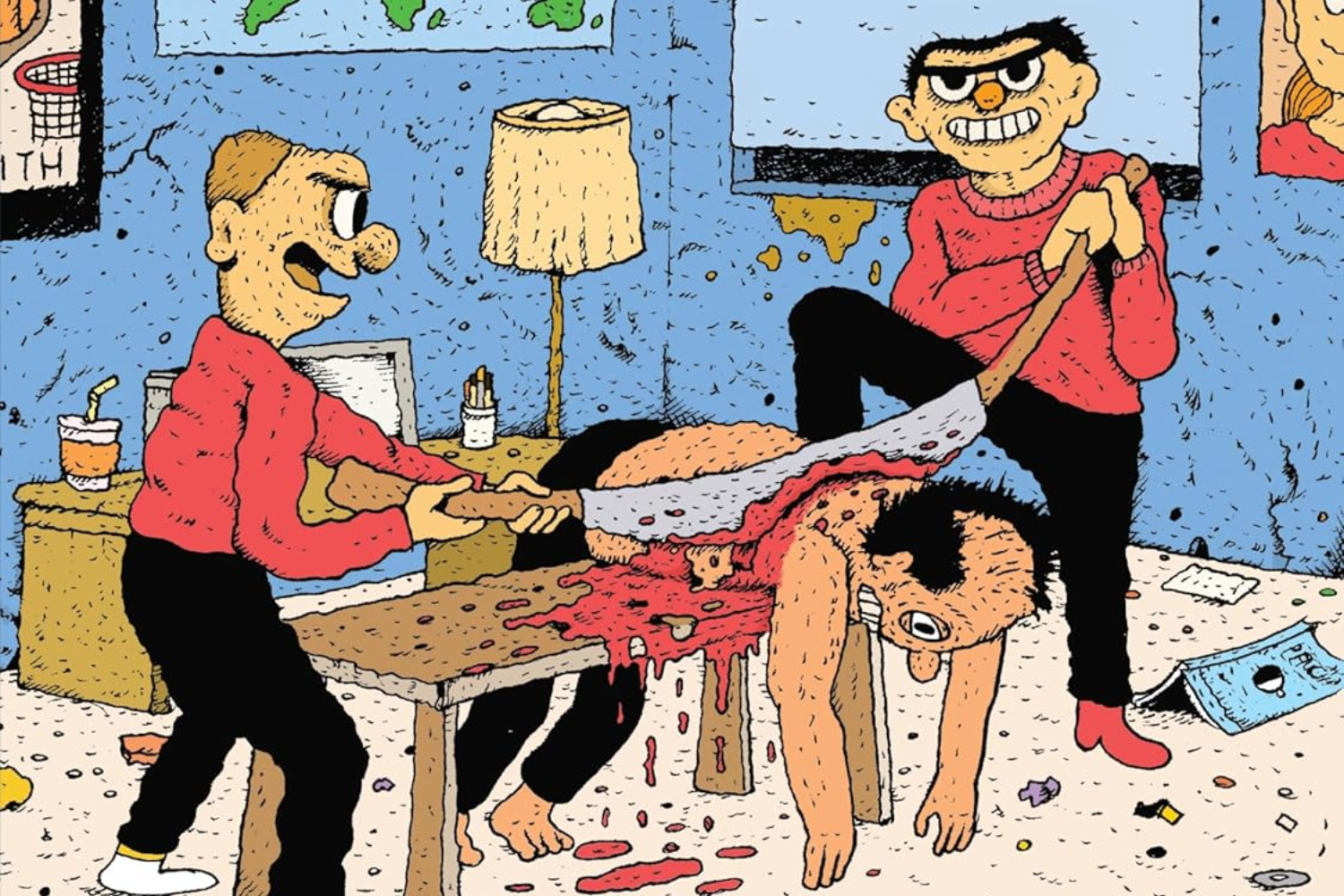

Nick Thorburn’s Pear Shape feels like the kind of comic you’d discover buried in a dusty stack at a record store. Which is rather fitting given that Thorburn is perhaps best known as the frontman of bands like Islands and The Unicorns (among other acts). It’s a classic gem from the very back bins, its pages warped by sweat and decades of bad decisions channeled into the very spine.
Due out June 16 from Fantagraphics, Pear Shape harnesses the chaotic energy of underground comix through surreal scenarios, existential spirals, grotesque humor, and sharp sociopolitical observations that feel both deeply cynical and oddly affirming. Structured as interconnected strips that bounce between absurd comedy, existential dread, and sociopolitical commentary, Pear Shape feels heavily informed by the raw spirit of classic underground titles while still carrying Thorburn’s own strange rhythm and sensibilities.
In speaking with AIPT, Thorburn opens up about the formative impact of Peter Bagge, R. Crumb, and other Fantagraphics-adjacent cartoonists. He also talks about how humor remains essential for processing the horrors of modern life, and how drawing became a creative fixation alongside his music career and composing. He also discusses his love of serialized comics, the evolution of the book’s recurring characters, and why he believes he has only begun to push himself as a cartoonist.
Now, let’s drop the needle on Pear Shape.

Courtesy of Fantagraphics.
AIPT: Pear Shape feels deeply rooted in the tradition of underground comix. What were some of your biggest influences going into this, both from comics and outside of them?
Nick Thorburn: When I was 14 or so, I got a proper dose of underground comix, which quickly became the methadone that helped me kick the superhero stuff. I think I chucked my subscription to Wizard around the time I discovered Peter Bagge’s Hate. I remember in grade 9 (what we call 9th grade in Canada), I was sent to the principal’s office for bringing an issue of Hate to school. That’s when I knew I was on the right track, and I never looked back.
When I was really young, I remember my dad’s friend Joe Bye had a bunch of old Fabulous Furry Freak Brothers comics lying around, and that stuff felt very illicit and enticing. We grew up in the country, and our neighbors would babysit us often while my mom was working as an ER nurse at the hospital and my dad was in school to become a fisheries officer. We lived in a rural area, as I said, and a lot of people who moved to the country in the’ 70s and ’80s were into the agrarian lifestyle and going off the grid. My dad and his friend Jack built houses side by side on a small parcel of land and we drank water from a well and had a party line. (I could pick up our phone at any time and listen in on neighbors having “sexy” conversation.)
Our neighbors, Lous and Bram (who babysat my sister and I when I was around three to six years old) didn’t have indoor plumbing — just a rickety wooden outhouse — so using the bathroom was something I dreaded when I was over there. It was dark, smelled horrible, and the walls were covered in crazy, scary, trippy cartoons that scared the shit out of me. It was probably just Basil Wolverton and Rick Griffin, but I found them terrifying.
Years later, Crumb brought everything full circle and blew the whole thing wide open for me. From there, it was Chester Brown, Seth, Joe Matt, Dan Clowes, Julie Doucet, etc. The classics, I guess. Basically, if it said Fantagraphics or Drawn & Quarterly on the back, I knew I was in good hands.
Lately, I’ve been enjoying Glen Baxter and this collection, Terminal Exposure, by Michael McMillan.
But if we really want to draw out the inspiration, I think one of the biggest influences for me was Archie Comics. My mom used to get us big stacks of Archie comics from the secondhand store. The one-page gags in those digests were likely the first place I was exposed to the playful, visual language of comics.

Courtesy of Fantagraphics.
AIPT: The book is structured as a series of strips across chapters, with each page feeling cohesive on its own yet unfolding a story over multiple pages. How did you approach building something that works both as individual pieces and as a larger whole?
NT: Initially, I just started drawing without any goal in mind. I let the process guide where the stories and characters would go. Often, it was to comment on something that had been bugging me, like the brain-rotted idea of “effective altruism,” but often I just wanted to put these people in a miserable situation and see what they would do.
As is often the case, a cohesive thesis started to emerge, and a narrative arc could be traced through the book. A few of the characters return throughout and intersect with the other stories in subtle ways, but each story can exist on its own.
AIPT: One of the most striking elements is how the art or color can shift within a single story after a page turn. What inspired that choice, and what does it allow you to do as a storyteller?
NT: It’s funny you mention that…I hate to reveal this, but I don’t think the shifting color palette was entirely intentional. I think I was acting on whimsy (as is often my approach to life in general), and putting down the colors that I liked in the moment. I didn’t consider how the whole thing would coalesce or if there would be any consistency at all. For the next issue, I’d like to “experiment” with having my color wheel remain a bit more constricted.
AIPT: The humor swings between absurd, dark, and sometimes genuinely unsettling. How do you think about crafting jokes in that space, and how do you know when something has landed the way you want?
NT: Comedy has always been a guidepost for me, and I’ve always liked how “gallows humor” can touch on grim themes with a softer touch. Humor is, of course, most successful when it arrives from an unexpected place, and a darker approach can provide an element of surprise. Similarly, absurdity is always helpful for subverting expectations.
I appreciate when morbid material is Trojan-horsed within the lightness of a joke, and it’s something I try to do with my songwriting as well. It can be a surprising way to make a point or convey an emotion, and I find this kind of humor can help make sense of the horrors of our world.

Courtesy of Fantagraphics.
AIPT: There’s a strong undercurrent of existential and sociopolitical commentary running through the book. Do those ideas come first, or do they emerge naturally as you’re building the strips?
NT: Usually those ideas come first, as I mentioned with my critique of effective altruism (in the story titled “Schizoaffective Altruism”), but sometimes it happens more naturally, as it did with Pear Shape’s de facto main character, Dunce Chumply. He starts off as a sub-literate idiot but gradually develops a heightened sense of empathy and humanity. By the end of the book, he’s become more thoughtful and ponderous about the state of the world, both far away (Gaza genocide) and up close (a woman in his neighborhood experiencing homelessness).
AIPT: You’ve had a long career as a musician with bands like Islands and Unicorns. Did working in music influence how you paced or structured Pear Shape in any way?
NT: Not necessarily, but as I said earlier, the approach to telling a story or making a point is sometimes similar. I do really think of these as two different parts of the same animal. My favorite thing is when someone gets into my drawing without any prior knowledge of my music. I like that the influences are distinct, but of course, everything is filtered through the same bile duct of the same animal (me).
AIPT: Were any of these strips created while you were on the road or in between music projects? I’m curious how your creative process shifts depending on where you are physically.
NT: There’s always a bit of overlap with the different creative projects, on account of the length of time required to finish each one. But when I’m on my “drawing jag,” it becomes the primary focus and fixation, and it’s what I am driven to spend every free moment on. I don’t really tour anymore, but when I did, drawing was a great way to self-regulate and relax while waiting to perform. These days, I always have a small pocket-sized sketch book on hand wherever I go. It’s as essential for leaving the house as my keys.

Courtesy of Fantagraphics.
AIPT: The book has this “perfect object” quality as a 64-page one-shot. Was it always your intention to make something self-contained like this, or did it evolve into that over time?
NT: Fantagraphics put out my last one (Penguins) in 2018, and I spent years agonizing over a follow-up. I knew the “right” thing to do next was a graphic novel or graphic memoir, but for the life of me, I couldn’t do it. I had a few false starts with a few longer story ideas, but I found myself bored and a little overwhelmed. (I so appreciate the people who can do that stuff well. Joe Sacco, Olivier Schrauwen, and Nick Drnaso come to mind.)
Last year, I came to peace with the realization that this probably isn’t the way I express myself, comic-ly. Once that became clear, I went head-on into the comic book.
My dream is for Pear Shape to be serialized, though — not a one-shot. When I sent the sample pages to Eric Reynolds (publisher at Fantagraphics), he proposed it as a one-shot, but I put “No.1” on the front cover anyway. The hope is for the book to do well and be given the opportunity to do issue number two. I know I’ve got more in the tank.
AIPT: Underground comix often push boundaries in terms of taste and subject matter. Were there moments where you felt like you were testing your own limits, and how did you decide how far to go?
NT: This is a great question, and I think it relates to my desire to do more books in this vein. I know there is so, so, so much more that I can do — visually, stylistically, and narratively. I don’t think I pushed my own limits nearly enough, and I would hope that I am brave enough to go further if given the opportunity. That said, I’m not out here trying to be the next Mike Diana. I’m just hoping to earn my keep in the comics realm.
Pear Shape will be released in comic shops and bookstores on June 16.



You must be logged in to post a comment.