

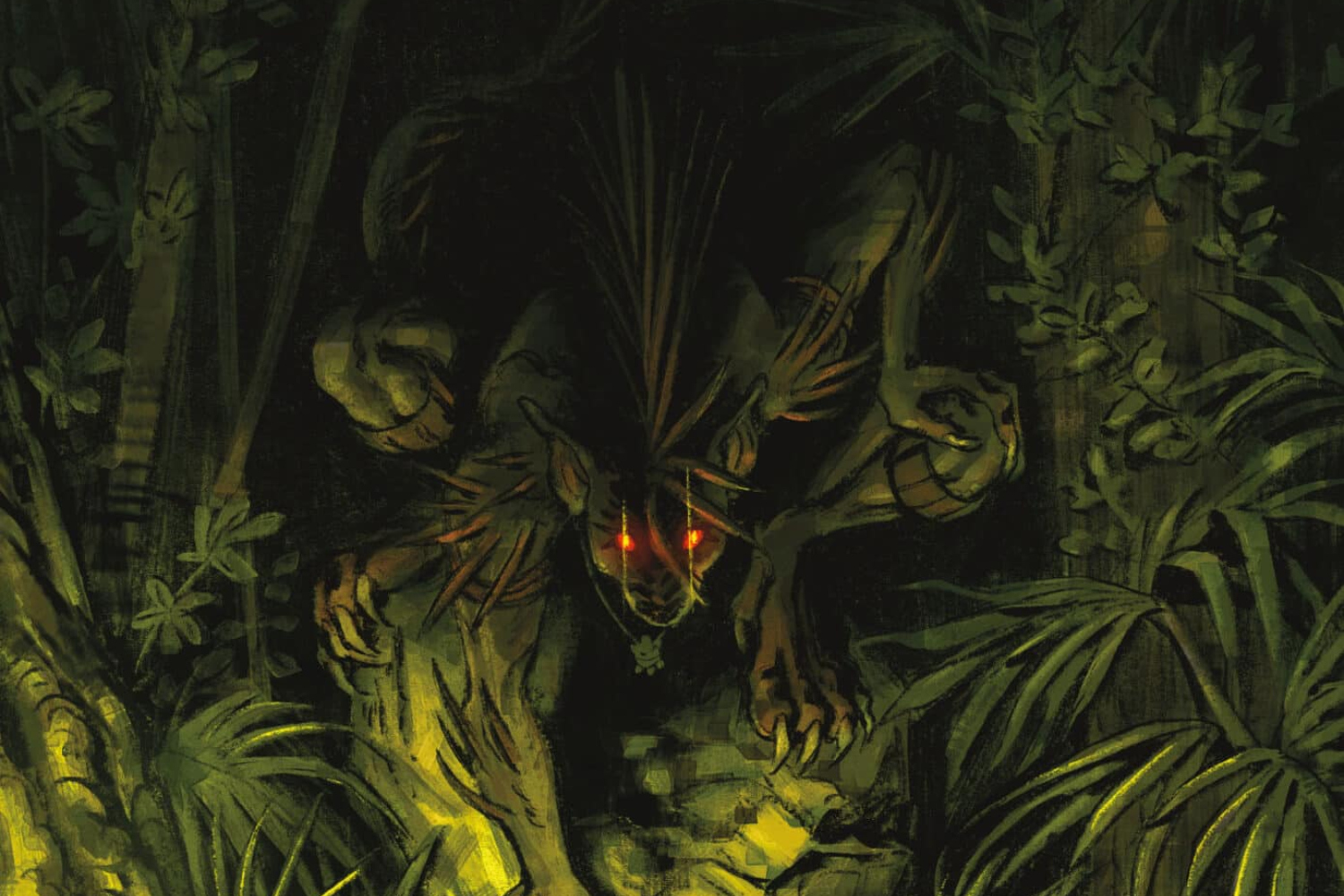

What do you need for a truly great monster story? A creature with sharp claws and an extra bloody disposition? Jump scares and viscera galore? Hapless victims ready to be eaten by the handful?
If you ask Julio Anta, all of that’s well and good, but there’s really only one “right” answer.
“I grew up watching all these like Universal Monster movies, all these creature features,” Anta said during a recent call. “The best ones were the ones that had really strong human characters.”
And when it comes to such expressions, the forthcoming The Beast of Borikén is deeply, unwavering human in all of its many-sided splendor and agony.
The Shape of Anger

Main cover by Daniel Irizarri. Courtesy of Dark Horse Comics.
Released as a True Weird title (the “line” from James Tynion IV and Dark Horse), Beast of Borikén takes place in a modern-day Puerto Rico. We follow activist Loli Flories, who is not only still reeling from losing her father during 2017’s Hurricane Maria, but is “fighting the over-development of the island by outside investors.” But Loli isn’t alone in said fight, as the Chupacabra emerges during a groundbreaking ceremony, setting both of them on a path toward the very heart and soul of Puerto Rico itself.
If you’re looking for sympathetic creatures from horror’s past that inform Beast of Borikén, you don’t have to swim very deep.
“One of my favorites is Creature from the Black Lagoon,” Anta said. “And my reading of Creature from the Black Lagoon is that it’s when an inhuman creature encounters humanity for the first time – that’s what I was riffing on with this story.”
For Anta and the rest of the team, it was about placing Beast of Borikén in the right context, and to connect their Chupacabra in a way that would expertly draw out important parallels.
“I wanted to take the Chupacabra on the same journey that the Gill-man goes on from Creature to The Shape of Water; he becomes just as human as anybody else,” Anta said. “I wanted to convey a righteous anger, a primitive anger.”
The creature’s not just angry, either. For Anta, he represents the true myriad of feelings that make up the complicated human experience.
“He can have the range of human emotions – sadness, anger, desire, and monstrosity – on his face,” Anta said. “So it was really important for me that it would be a creature that is righteously angry, but also that readers can empathize with and identify with, even in its monstrosity.”
All 500 Years

Courtesy of Dark Horse Comics.
The Chupacabra in this tale has a range that, in some important ways, bypasses that of even the Gill-man. Likely because our monster pal has some rather deep roots. Because while Beast of Borikén takes place in Puerto Rico right now, the Chupacabra has been grappling with these issues for centuries. The hurricane is, in some ways, only the latest wound.
“The whole conception of the history of this creature was that he has experienced all of these extreme events over the last 500 years,” Anta said. “The creature has existed from the time of the Taíno, the indigenous people. So he witnessed the Spanish invasion of the island. He witnessed the U.S. invasion of the island eventually. And now he’s witnessed all of these neo-colonial events. And one of the big ones was Hurricane Maria, which is obviously a natural disaster, but one that was exacerbated by events that had taken place on the island prior to the hurricane and then after the hurricane as well.”
Really, the hurricane is just a way to bring Loli into the fold, and to further “modernize” some of the very real issues Puerto Rico and its people have struggled with over the centuries.
“So this felt like a good flashpoint – the whole book is about how these two characters, Loli, our activist human character, and the Chupacabra, how they both experience these events together and then realize that they have the same enemy,” Anta said. “So the hurricane felt like a good moment to bring them together before they even knew that they would truly come together later on.”
Plus, the hurricane was very much a “come to God” moment for many people (both in and outside of Puerto Rico) to grapple with this singular history of destruction and dismissal.
“I know a lot of Puerto Rican friends in my life, and the hurricane was a radicalizing moment for them in that it showed them just how bad things really were on the island and how much the U.S. government, to which they are colonial subjects, does not care about them,” Anta said. “So it’s the Chupacabra, who for 500-plus years has experienced nothing but trauma and strife, and has encountered no humanity…having just encountered monstrosity in these humans. Until he meets Loli, who is in the same struggle that he is. They just might not have the same words for it or be able to communicate it.”
Obstacles and Romance

Courtesy of Dark Horse Comics.
That last bit seems extra significant. Because while there’s pain across the entire island, it’s not always so easy to see. And even if it all cuts to the core, it’s still not all the same. A young girl and an ancient monster will have to not only work together, but reconcile what their respective suffering looks like.
For the Chupacabra, Anta doubled down on the “primitive anger,” adding, “It’s like, ‘You have awoken me. You are just the next obstacle in front of me.’ When we learn his history, we start to understand. If you look closely at the creature, there’s bullet wounds on him. And you’ll later learn where those came from.”
The creature wants only one thing, and while it may take time to get it, Chupacabra certainly has the perspective to know what he can do in the face of these many, many trials.
“I think he’s just someone who is driven by anger, by pain, and by a desire to just be at peace,” Anta said. “So I don’t know if he’s an optimist. He knows that he is, in some respects, an unstoppable force – a force that has survived for 500 years just like the Puerto Rican people have, and that he will continue to survive whether he wants to or not. And if he’s forced to survive, then he will do everything he can to stop the people that are keeping him from his peace essentially.”
Anta said by issue #3 of the five-part miniseries, we’ll “see all of this history through the eyes of the Chupacabra.” And our monster friend isn’t just a representation of 500 years of anger and indignity. Anta explained that he’s very much a way to “show it without telling it.”
Added Anta, “Because this creature is designed to be so monstrously human in certain ways, but also still terrifying and a beast, I think that’s really just a testament to what [series artist Daniel Irizarri] did with the creature design – he is terrifying when he needs to be, but he’s also empathetic. He’s also someone that we can watch it all from his point of view. We can experience it the way he is.” (Anta mentioned that part of the creature’s design, like its necklace and loincloth, are based directly on the Taíno people.)
Really, that connection and immersion is what Anta took away from movies like Creature from the Black Lagoon. It’s easy to forget that these monsters are, in many cases, meant as an allegory for our own struggles with self doubt and getting lost in the shuffle of everyday life.
“I didn’t know as a kid growing up that they weren’t supposed to be super serious films. But they are to me,” Anta said. “I went to a screening of Creature from the Black Lagoon maybe a year ago at a theater here called Film Forum. And I was so annoyed by all the people just laughing throughout the whole movie. There are some silly parts. But this is a creature trying to survive while these other people come into his habitat and try to hunt him. And he’s also falling in love with this beautiful woman – this is a moment in his life.”
The Force of Hope

Courtesy of Dark Horse Comics.
For the mortal Loli, however, she doesn’t have 500 years to work through all of this pain. She is, as Anta said, “struggling against a very real thing that is happening in Puerto Rico right now all over the island.” But her pain is also undeniably personal, and when her father passed amid Hurricane Maria, Loli found herself grappling with a sorrow she couldn’t fully share or even properly contextualize.
“I think you really see it in her relationship with her mom,” Anta said. “I think sometimes when we experience these immense traumas, the people that we happen to be in that trauma with, sometimes it reminds us too much of it and it hurts too much.”
Anta added, “She doesn’t hold anything against her mom. I think she understands that she should not have gone out during the hurricane to try to get to the hospital. But I think that because she lives through that with her mom, the trauma that she built throughout that is also twisted, and it’s seeping into the relationship with her mom.”
In Loli, Anta said feelings both bright and gloomy “butt up against each other. The contradictions are what makes her who she is.” She “understands the historical context and the huge forces that they are up against. It’s a huge struggle, but she still has optimism.” It’s a moment perfectly encapsulated in her big speech in Beast of Borikén #1, where she tries to rally the troops just as ancient trees are uprooted by those nasty developers.
“She talks about those nights in Old San Juan. That’s in 2019 when Puerto Ricans rose up and essentially kicked the governor out and forced him to resign,” Anta said. “She talks about the Ponce massacre, when Puerto Rican independistas stood up and declared that they should be an independent state. And they still, despite a massacre, continue to persevere. She brings up all these moments where despite the huge towering people that they’re fighting against, there’s still hope.”
Added Anta, “There’s this quote that says that if you’re an activist, you need to possess a revolutionary optimism, which is an optimism that believes that things can get better and that things can change. So we also wanted to make sure that it’s respected, that struggle and what’s truly going on there.”
In The Monster’s Eyes

Courtesy of Dark Horse Comics.
Because, if you hadn’t already guessed, Beast of Borikén isn’t just about Loli and the Chupacabra. It’s about what’s happening this very moment in Puerto Rico, and how this development isn’t actually new but yet another thread in a long, terrible history.
“Now with this whole new version of colonialism on the island – you have Americans and Europeans coming onto the island to buy up land, to bribe officials, to let them build on protected lands,” Anta said. “There will be a lot more moments…where you go back and you see the historical aspect of the Chupacabra. And I think we did, in a lot of really unique ways, illuminate Puerto Rican history, and Chupacabra history, but in ways that really feel like it’s part of the story and not an interlude.”
And it’s not part of the story just for its sense of relevance. Rather, this moment in time is an opportunity for everyone to learn and grow and come together in a way that makes some larger changes increasingly possible.
“A lot of activists that I’m surrounded by, and a lot of my Puerto Rican friends, have seen their island be exploited,” Anta said. “They’ve learned the history of their island, which is a history that, especially if they grew up in the U.S., they certainly weren’t taught. And on the island, they haven’t been taught the full story, either. They start to see that this has been a long-standing system that has oppressed their people for so long. And now they want to do something about it.”
And while Anta himself is Cuban, he sees “a lot of similarities, both culturally but also in our colonial histories and interactions with the U.S.” Luckily, he had some help in “bridging the gap,” if you will, with Irizarri.
“One of the most important parts when I was having conversations with Tiny Onion [when] we were putting this book together was that the artist had to be from Puerto Rico. That was a non-starter,” Anta said. “Daniel is someone who lives in Puerto Rico and he experienced Maria in his own way as well.”
And across the board, Irizarri made sure that the book looked and felt as real and authentic as possible.
Added Anta, “Even when it came to the notes that he would give ahead of time to say like, ‘Hey, this hurricane, it hit in the morning. The sun was out. So it’s not going to be a dark storm. It’s going to be grayish. The water is still greenish and blue.’ All these things were super important.”
It’s about more than nailing weather patterns, though. Irizarri (who is joined by colorist Patricio Delpeche and letter Lucas Gattoni) put in so much work in nailing the very specific “amalgamation” that defines so much of Puerto Rico.
“In issue #2, Loli and her friend Bianca go to a botanica, which is like a spiritualist shop,” Anta said. “Like a lot of things in Puerto Rico and Cuba and the Caribbean, it’s a mixture of three cultures: Spaniard culture, African cultures from the enslaved people, and indigenous culture.”
@julio_antaDid you hear the news?? My next comic book series BEAST OF BORIKÉN debuts July 1st from @Tiny Onion and @Dark Horse Comics! If you enjoyed Home and some of my other grounded genre books, you’re going to love this one. My co-creator, Daniel Irizarri is killing it on this book. I can’t wait for everyone to read it and see the interiors. For now, check out Daniel, Naomi Franquiz and Max Fiumara’s beautiful covers and read more about the book below: In contemporary Puerto Rico, Loli Flores is a fierce activist fighting the overdevelopment of the island by outside investors. When a ground-breaking ceremony is violently interrupted by a supernatural force, Loli discovers that the stories of el Chupacabra are not just echoes from the past, but a brutal protector of generations extending back to the indigenous people of the island. As Loli uncovers the horrors firstand, el Chupacabra is on a parallel path with elemental destruction left in his wake.#comics #boriken🇵🇷 #horrorcomic♬ sonido original – Jhey :)
It’s a moment that doesn’t just look really good on the page, but has grander thematic resonance.
“At the botanica, [Loli and friends] speak to this woman who’s a spiritualist to try to learn more about the creature,” Anta said. “They’re like, ‘How should we move forward?’”
Added Anta, “And through the influence of these three cultures that have shaped Puerto Rico, whether for the good or the bad…these three cultures come together to reveal truths about the Chupacabra and to reveal truths about Loli and to reveal truths about what should come next. From there, what are our personal responsibilities in that moment when we’re faced against this corrupt real estate development project.”
Even just Irizarri’s inherently textured style does so many important things for this book.
“Daniel has this awesome style that is obviously so influenced by manga, but he also has really strong faces and cartooning,” Anta said. “You can see it in the colors, too, there’s just so much screen tone and so much manga influence there. This book could have been uncolored, and it still would’ve been incredible.”
But the colors do truly matter. There’s one scene at the end of issue #1 that explodes because of both inks and colors work in a truly singular conversation. It’s a moment that cuts to the core of this book with a sharp efficiency that’ll render you dumb.
“When you get to that final panel…so much of the story is in service of getting to this moment, that moment where they see each other in each other’s eyes,” Anta said. “He sees her pain – he sees all of it.”
The Many Faces of Anger

Courtesy of Dark Horse Comics.
For Anta, working with Irizarri isn’t just about getting things exactly right. It’s also about being as real as humanly possible.
“There’s a comfort when you’re writing a story that either you are from that place or just the artist is…where you don’t have to give a million pieces of reference,” Anta said. “You know that it’s just going to be done the way that is true to the story.”
And shining a light on the truth is, obviously, a big part of Beast of Borikén. Not just in how Loli or the Chupacabra feel, or what’s going on across the island. The book is very much interested in exploring activist “culture,” and the human aspect of fighting against injustice.
“There are the activists that are just ‘go, go, go,’ and they’re driven by anger,” Anta said. “Maybe the less charitable version would be ‘addicted to rage,’ and there’s always something that you could be angry about. I think that’s good sometimes to really harness that anger and rage and use it to push you forward. I think that leads to a lot of success at times when you’re doing this kind of work.”
But there’s another “option” to being angry, one represented by the aforementioned Blanca, who is both Loli’s friend and activist cohort.
“Bianca is…the other kind of person that oftentimes wants to really make sure that they protect their own peace and do what’s right for them,” Anta said. “It’s important to nurture ourselves because we have to make sure that we can continue going for longer. But people maybe don’t have time for that. Loli represents the urgency of what is happening on the island.”
Utlimately, Beast of Borikén will also function as a kind of “conversation” between these approaches. While Anta said that Loli will “hopefully come to understand that she does need to care for herself,” no one “side” of the activist “debate” is more right than the other approaches.
“We aren’t presenting that only one or the other is the most effective and would be the most effective in this scenario,” Anta said. “They’re all in conversation with each other. And as you read the other issues of the book, you’ll see that there are moments where, you know, the Chupacabra’s version of or its choice action is what helps them and is successful. There’s times when Blanca’s style is more effective. There’s times when Loli’s style is more effective.”
View this post on Instagram
And part of the larger “conversation” across Beast of Borikén is inevitably representing the other side’s POV. In the first issue, we meet real estate mogul Simon Hunt, who is the main driving force of development across the island. In almost any other story, it’d be easy for Hunt to become this ridiculous, over-the-top, and super satisfying caricature of colonial greed and stupidity. But the Beast of Borikén team position him a little more seriously, and the book’s all the better for it.
“No bad guy is the bad guy in their story. He is a guy who, if we take his word for it, and I do, he loves Puerto Rico,” Anta said. “To him, this is his little slice of paradise. Whether or not it is misplaced or it is sinister, he sees himself as someone who can bring jobs to this place. He loves the island and he thinks that what he’s doing is good. And he doesn’t truly understand the implications of building these luxury developments and pricing people out.”
Anta said that Hunt, who is representative of a post-COVID surge of transplants who don’t pay income tax, is basically doing this as “a post-semi-retirement gig.” Which means that while he’s quite guilty of ignorance and greed, there’s complicating, still human factors to his arrival. He is someone who, at the absolute very least, sees Loli and her work as quite important.
“I think he respects Loli even as she’s in opposition to him,” Anta said. “We learn in their first scene together that she’s opposed him at a lot of different junctures. They know each other pretty intimately. But I think he respects her because there’s a similarity between them. They’re both fighters. They both have deeply held beliefs.”
Added Anta, “There are very few people who are just evil because they’re evil. Even if we don’t agree or understand, they have a point of view, and I think it’s important to represent that. Even if it’s just simply so that we can make the better point, and point out that this is not the right way. He doesn’t think he’s evil; he thinks he’s just in his paradise.”
Onions of Similar Sizes

Variant cover by Max Fiumara. Courtesy of Dark Horse Comics.
As much as Beast of Borikén humanizes Chupacabras and land developers alike, there’s someone else who is grappling with their own humanity across the book: Anta himself.
For the writer/activist, this is a return to comics’ direct market. His last trip to this side of the pond was Home, a 2021 Image Comics series (alongside artist Anna Wieszczyk) about a young Latin boy seeking asylum who suddenly gains superpowers.
“I took a bit of a left turn after Home and started working exclusively in the graphic novel market, writing for young adults in middle grade, making books that I’m super proud of and that mean just as much to me as Home does,” Anta said. “This is my first time coming back to single issues, and writing particularly for adults.”
And, at least on some level, there are connections between Home and Beast of Borikén.
“All of my books are hyper-grounded,” Anta said. “They might have one thing that is supernatural or one thing that’s different. Obviously, it was the superpowers in Home, and here we have a Chupacabra. If you remove the supernatural aspect, it still works. It’s still a character-first drama.”
But their connection goes even deeper when you look beyond mere supernatural happenings.
“Home, to me, is a story of a kid with no agency, finally having the power to do something,” Anta said. “Everything in his life that leads to the first issue is totally out of his control. And now that he has these powers, the question is, ‘What do I do with that power?’”
Added Anta, “I think the inverse is almost true with The Beast of Borikén. You have this character who has almost infinite power. He has survived for 500 years. But now with all this power, he doesn’t want to do anything with it; he just wants peace. He doesn’t want to be using his powers.”
That idea of power — having it, not having it, recognizing the difference, acting accordingly, etc. — feels important in understanding Anta in the context of this book and his larger bibliography. Because while he never intended to stay away from the direct market for this long, working with Tynion and Tiny Onion was ultimately the thing that brought Anta back into the fold.
And, yes, Beast of Borikén is “very different from a typical Tiny Onion book. But ultimately it’s the same in all the ways that truly matter. It’s about recognition (of self and circumstances), and also celebrating that sense of understanding.
“I write books about things that I care about, and things that matter to me. I think James does that, too,” Anta said. “The things that we write about are oftentimes pretty different. But I think there is that connective tissue we both have – those very unique points of view in the comics market.”
Added Anta, “I think it’s true of James also, but all of my work is self-generated. None of my books come from a publisher coming to me and saying, ‘Hey, what’s your take on this?’ Even Blue Beetle that I did with DC, that came from me. I think that there’s a similar sort of DIY spirit behind what both James and I do.”
A Gaggle of Chupacabras

Main cover by Daniel Irizarri. Courtesy of Dark Horse Comics.
Part of that self-generated aspect is that, much like Anta’s other projects, Beast of Borikén has a certain shape to it. Whether you eventually like it or loathe it, the book has this clear and abiding message.
“This is definitely a decidedly different book with a very strong political perspective, I think. It has a real point of view,” Anta said. “It’s not like, ‘These things happen to make up your own mind.’ You’re going to know what I think when you read it, and I think that’s probably the most important thing to me in all the work that I do.”
And if you make it to the end of Beast of Borikén #5, there’s plenty of other things that you’ll inevitably learn. Like the singular history of Puerto Rico, and how the nation’s struggles are alive and well to this very day. How said struggle has informed a rich and powerful people who fight for what matters most in life. Even how to operate as an activist and still be a person; the way the political and the personal are always connected; the importance of rage and focus in fostering real change; and the way we affirm life through these trials and tribulations.
But perhaps the most important lesson of Beast of Borikén? A monster isn’t just teeth and claws, and they can be truly, deeply human if we just regard them that way.
“Without spoiling too much, it’s when he wasn’t the only Chupacabra on the island,” Anta said of the creature’s happiest moments. “We’ll see what happens to the other Chupacabras he was surrounded with. But I think that’s when he was the happiest, when he was in community. Not just with others like him, but with the indigenous people on the island.”
The Beast of Borikén #1 is due out July 1 via Dark Horse Comics.



You must be logged in to post a comment.