


Fair warning: spoilers for Until Then ahead.
Until Then, Polychroma Games’ 2024 coming-of-age/quantum physics and time-shenanigans-heavy science fiction adventure title was a damn fine game. Its protagonists were lovable and dimensional, with moments of grace and venality alike that consistently rang true. Its art was reliably striking. Its narrative skillfully combined coming-of-age and science fiction to push both in fun ways. In contrast, some of the minigames interspersed throughout the main game could be frustratingly finicky; Until Then as a whole was an enjoyable, memorable, moving adventure.
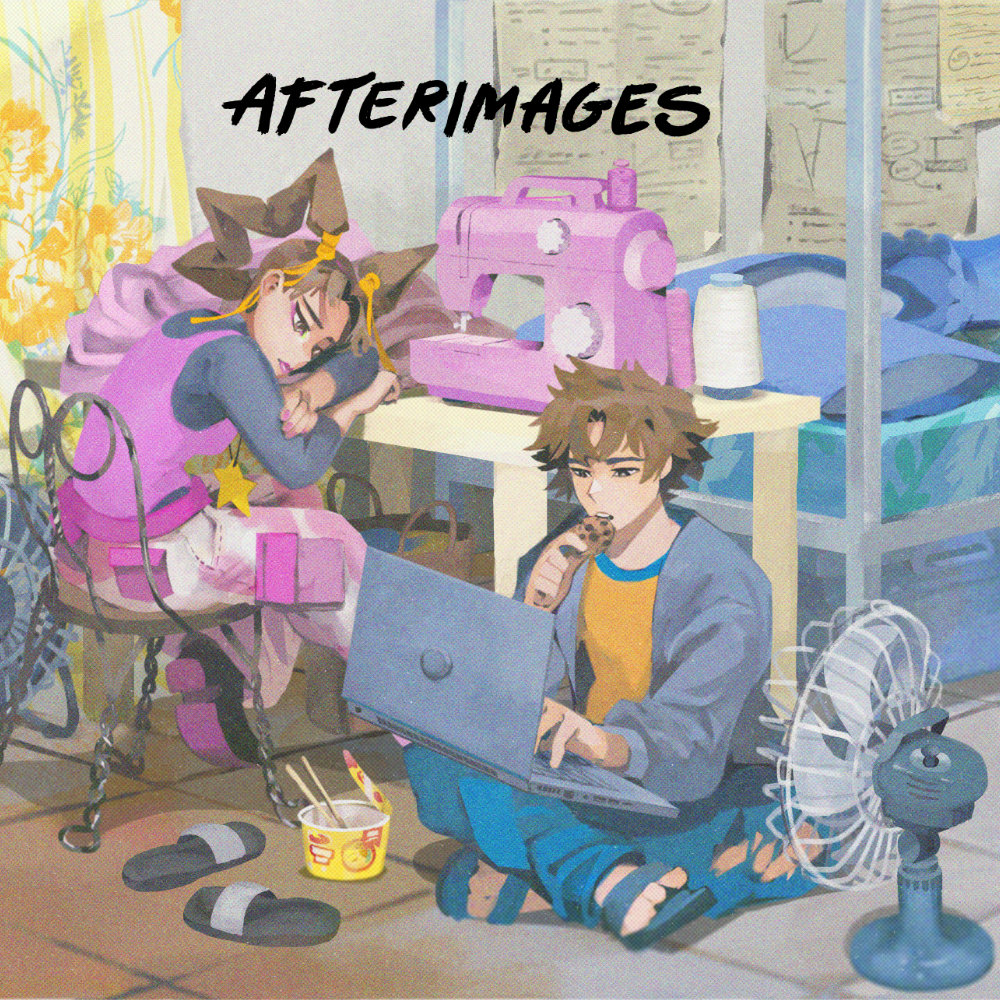
With Until Then: Afterimages, the Polychroma team returns to the world and characters of Until Then with two new stories. One is superb and the other, with some caveats, is quite good.
The first of Until Then: Afterimages’ stories, “Homecoming,” is set in 2021 and focuses on colorful, bubbly artist Sofia Rubio, a supporting character from the main game. She’s returned to the Philippines for the first time since she moved to the United States to settle her late grandmother’s estate.
The second story, “Sparks,” is set in 2018 and focuses on Until Then’s protagonist Mark, a former slacker turned high-achieving university student. He’s become vice president of his school’s troubled engineering club, which is trying to rebuild its reputation after a disaster the year before. As Mark wrangles a concert that will make or break the club’s reputation, he grapples with his attraction to the club’s president, the driven Desiree.
From a game design standpoint, Until Then: Afterimages sticks closely to Until Then’s template. Players control Sofia and Mark as they navigate through different screens and engage in dialogue with other characters. At certain moments in the story, the two will sit down and use their phones. Sometimes, they’ll use the internet and social media, letting the player explore in-game websites or react to and comment on other characters’ posts. Other times, they’ll text with friends and loved ones.

While the player cannot directly control what Sofia and Mark say during these conversations, they can shape their tone and focus. Several minigames offer a change of pace. “Homecoming” uses different minigames as set pieces, while “Sparks” features a single recurring minigame. Structurally, “Homecoming” is the stronger of Until Then: Afterimages’ stories in both narrative and gameplay.
Its tight focus on Sofia’s depth and dimension as a character who was already interesting and likable in the main game. Its supporting players, most of whom are new to Afterimages, are skillfully drawn and bounce off of Sofia in neat ways. Her girlfriend Alissa, for instance, knows most of her history but not all. She knows that Sofia has a late first love named Cath, but not the details of their relationship. When the trip stirs up Sofia’s memories of and questions about Cath, Alissa has to manage a bundle of emotions as complex as Sofia’s own.
Sofia was not expecting to be hit so hard by these memories, and she’s also dealing with grief, mixed feelings about her return home, and a creative block. There is a lot she wants to say, but she does not know how to put it into words. Alissa wants to be there for her beloved, to help her through a night of the soul. She’s also frustrated by the limits of what she can do from a distance, and by Sofia’s longstanding reluctance to talk about Cath at all. The care and tension in Sofia and Alissa’s relationship, along with their shared passions and many differences, are delicately crafted and ring true.
Indeed, “Homecoming” as a whole is an excellent character study of Sofia, up to and including its minigames. The standout among these is an elaborate baking sequence in which the player must carefully manage their time, space, and tools to make cupcakes. It’s tricky and chaotic, especially when a tight timer comes into play, and succeeding feels good. Outside of being a well-made bit of gameplay, the baking sequence gives players a chance to experience Sofia’s creative abilities firsthand. The comparative intensity of the timed run, meanwhile, makes the nighttime sequence that follows, where Sofia gets caught up in her memories and feelings, feel all the more strikingly still. It’s a very fine piece of game craft.

“Sparks,” by contrast, is the more structurally and narratively ambitious of Until Then: Afterimages’ stories and boasts the expansion’s best individual moments, but as a whole it’s a shaky experience. It jumps between Mark’s perspective and that of another key returning character. Both of their stories are in conversation with their development in the main game. It introduces a large supporting cast, many of whom are newcomers. Its recurring minigame is, by design, frustrating. When “Sparks” hits, it’s a home run. When it strikes out, it’s often painfully close to working.
Part of what made Until Then’s time shenanigans enjoyable was that they gave Mark a chance to develop in different ways. Mark lived through a bittersweet coming-of-age in one timeline. In another, he experienced a calamity that left him a self-isolated obsessive.
“Sparks” introduces another permutation of Mark, one who has not faced his past so much as let it fade away. He cannot change what’s happened, so instead he focuses on finding the right words, the words that will lead to the best result possible. He’s still the good-hearted guy he was in the main game. But he lacks the wisdom he’d gain in other timelines by facing and accepting his past, and that has consequences. When “Sparks” explores the fallout of Mark’s actions, or the development of his relationships with Desiree and a returning character from the main game, it’s consistently interesting and thought-provoking. When “Sparks” tries to give its wider ensemble space to shine, it stumbles.
Mark and the other returning character had the entirety of Until Then to establish themselves. Desiree gets enough focus to develop a full, satisfying arc. The other members of the ensemble do not, and while they’re consistently well-designed and interesting, “Sparks” doesn’t have the space or time for them to emerge as more than intriguing sketches. As a result, multiple major character and story beats don’t quite make the impact that they could, and the parts of “Sparks” that focus on the ensemble feel overstuffed and underdeveloped. None of “Sparks” supporting players are bad characters; they’re just thinly drawn in comparison to the main game’s crew and “Homecoming”’s tighter cast.

“Sparks”’ recurring minigame is built on a neat marriage of narrative and gameplay that is undermined by poor hit detection. Throughout “Sparks,” Mark tries to find the right words to say, whether he’s selling red velvet crinkle cookies or making an announcement that will have seismic consequences for his club.
The game takes up the challenge Mark faces in doing this and literalizes it for the player through the minigame. Text boxes containing options for what Mark can say twist and twirl across the screen, and the player must throw darts to strike a phrase and make Mark say something. The phrases are evasive, and wrong-answer boxes are often larger than right-answer boxes and prone to getting in the way.
Finding the right words is hard for Mark, and literally hard for the player. The trouble is that some of this difficulty is due to the darts’ hit detection rather than to the boxes’ evasiveness. Multiple darts might strike the correct box, yet none of them register a hit. Conversely, even a bare smidge of contact with the wrong box can register as a direct hit. It’s irritating and immersion-breaking, and the shakiness of the game’s design stands out all the more when compared with the well-realized baking sequence in “Homecoming.” It’s a neat idea, but it isn’t well executed, and the fact that the game recurs repeatedly only makes it more frustrating.
Still, “Sparks”’ core story is strong, and at times impressively bleak. It doesn’t wallow in misery for misery’s sake; it uses Until Then’s science fiction elements to explore failure and the fallout of bad decisions made with the best of intentions. The result is a thorny, thoughtful piece of character work that adds new layers to Mark’s development in Until Then proper. It’s very, very fine writing.
In the end, “Homecoming” is a superb character study and “Sparks”’ best moments shine bright despite its overstuffed cast and frustrating minigame. If Until Then: Afterimages is the end of Polychroma’s work with Until Then, it leaves off on a high note. If Until Then: Afterimages is followed by further stories with this cast and world, then the bar for those stories is set high.
Until Then: Afterimages is available on Steam, PlayStation, and Nintendo consoles. The publisher provided a code for this review.




You must be logged in to post a comment.