

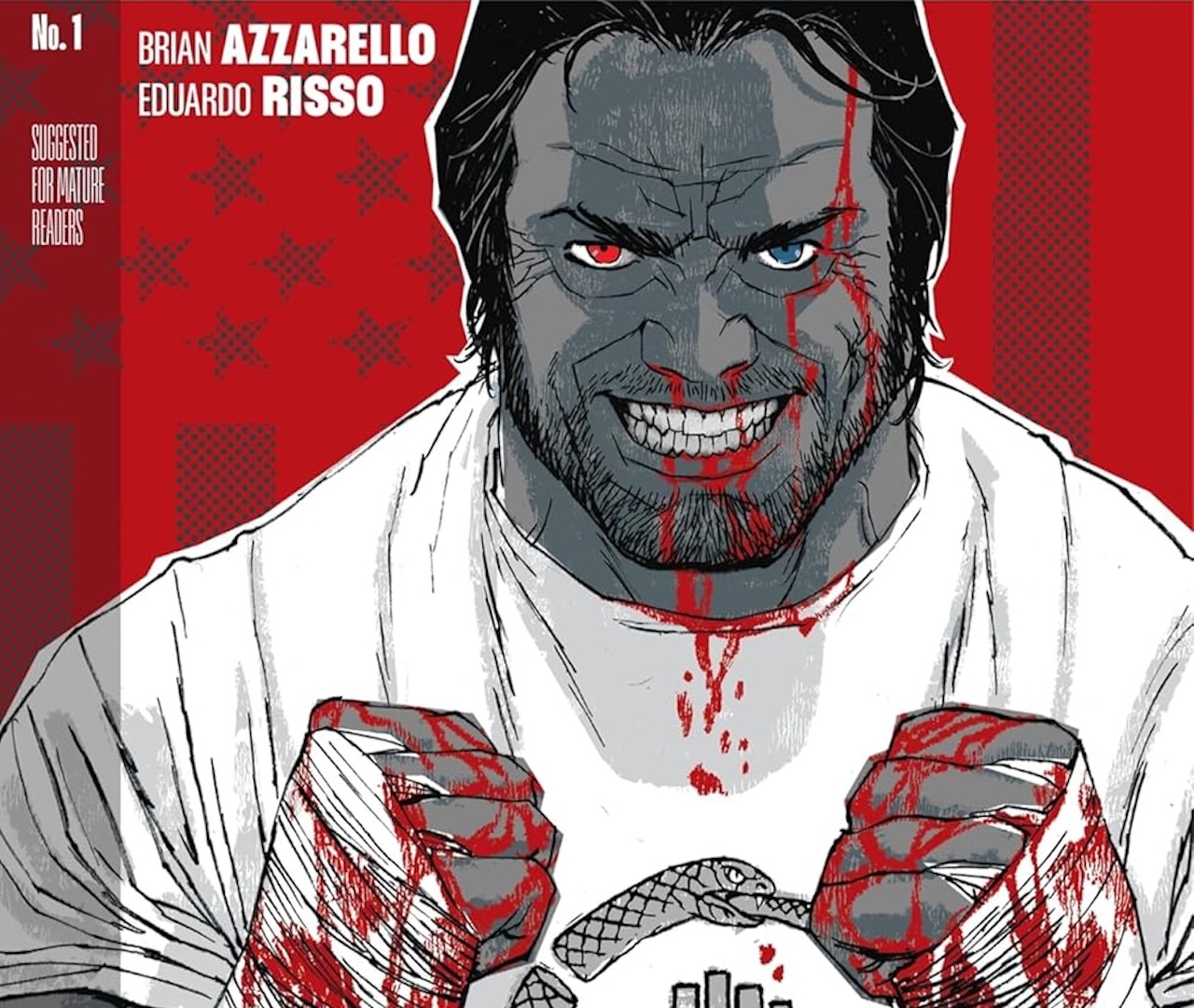

It was April 2009 when the final issue of 100 Bullets was released, but in comics, never say never. 17 years later, Brian Azzarello and Eduardo Risso return to the iconic crime comic under the Vertigo label and glorious black and white. Secret organizations and untraceable bullets aside, Lono was always the purest form of what this series was about: pure violence, appetite, and chaos unleashed. He returns in 100 Bullets: The US of Anger in a story that feels aptly timed, given a need for action in America.
Needless to say, 100 Bullets: The US of Anger is political from the jump, with burning cars and a Black Lives Matter protest sign lying on the ground. A caption reads, “We’ve lost control of our country,” and I think many will relate to that. A montage of violent protesting, police firing guns, and young hooligans with bats and crowbars are swinging away at glass. The 1992 Los Angeles riots come to mind, given the looting and chaos in the streets.
The story shifts to four boys looting a jewelry store. Enter Lono, who appears out of nowhere and asks to watch them commit crimes. Soon, we learn he’s really there to get a gun from one of the kids, which raises the temperature in the room. The actions of Lono seem to escalate the situation for everyone, especially for cops who come onto the scene and learn the hard way what it’s like to be near a force of nature like Lono.

The art is going to be a major selling point for many.
Credit: DC Comics
Intercut with Lono’s scenes are two podcasters, likely right-wing extremists, since they have skull tattoos and an American flag augmented with skulls. We meet them intercut with scenes of protests as they speak about how the American Revolution and Constitution are lies, and the real people who run America are part of a cabal. It’s clear Azzarello is playing with the truth machine here, and even these podcasters probably don’t believe what they’re saying; an all-too-real element in today’s society. Paired with the acts of a bigot woven into this plot, one can see that Azzarello is pointing out the actions and anger many feel are fabricated and meant to enrage and elicit a reaction. Thus, manipulation of the American people has been a tried-and-true element since the founding of America.
All those conflicting sides and meanings amount to a first issue that feels as chaotic as what it’s trying to say, for better or worse. It’s a difficult topic, admittedly, but I found myself pondering what it means for the plot, for Lono, and for the larger purpose of this story, especially given that the commentary is so on the nose. Still, the atmosphere of America and the world Lono is navigating is as evident as a crowbar to the head, establishing its purpose.
Art by Risso is as good as ever, with Lono coming off as a force of nature at times. The young hooligans he interacts with bring many human elements to the book as they go through shock, feigned aggression, and fear. Many will liken the art to Frank Miller’s Sin City, as the play of black and white shifts to draw the eye and create stark contrasts. Color does get used for things like blood and sound effects, making those elements really pop.
If 100 Bullets was an epic dark morality tale, The US of Anger is a nihilistic look at the state of America today. 100 Bullets: The US of Anger #1 proves that Azzarello and Risso haven’t lost a step. Returning to one of their most iconic creations, they deliver a story steeped in fear, rage, manipulation, and violence that feels unsettlingly relevant. Lono remains a force of nature, while Risso’s stark artwork gives every page a sense of danger and inevitability. The issue’s political themes can occasionally overwhelm its narrative momentum, but there’s no denying the power of its atmosphere or the confidence of its creative vision. If the original 100 Bullets examined the machinery of power and revenge, US of Anger opens by staring directly into the chaos of the present day.




You must be logged in to post a comment.