

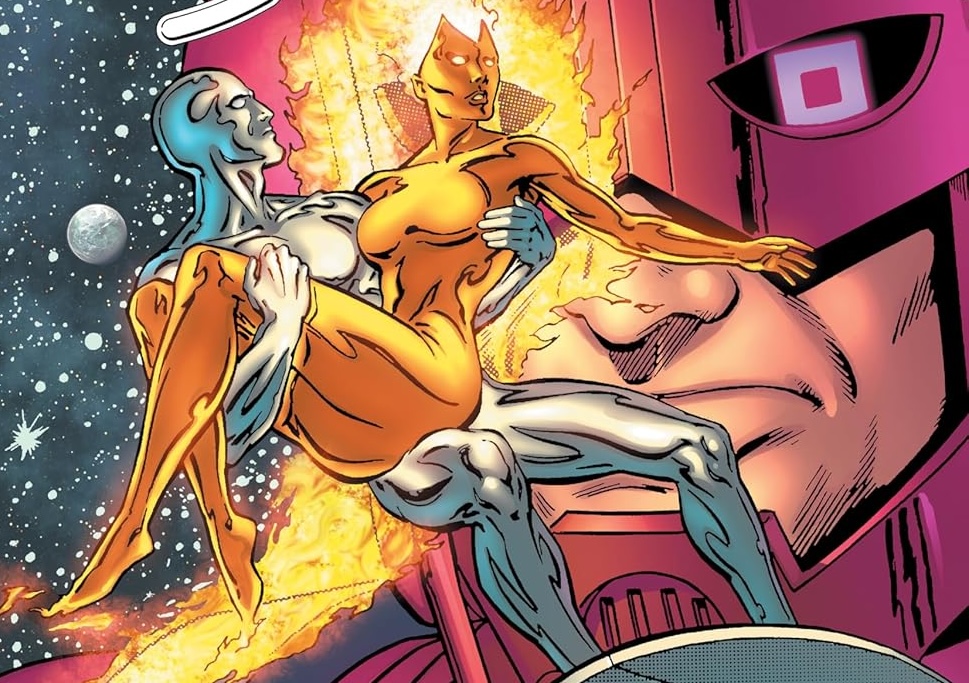

A lot is going on in Silver Surfer Epic Collection: Freedom, which collects the first 14 issues of the character’s 1987 series.
The Surfer had been exiled on Earth for nearly two decades, trapped behind an invisible barrier placed by Galactus after the Surfer’s betrayal. That’s two decades worth of Surfer stories devoid of space travel, cosmic exploration, or furthering the Marvel Cosmic narrative (he mostly bummed around with the Defenders and moped on mountaintops).

Marvel Comics
With the help of the Fantastic Four, the Surfer crosses the barrier (with an almost tragic ease), and that establishes the Surfer’s footing for the rest of the series’ 146 issues. No longer plagued by ho-hum, terrestrial conflicts far beneath his power level, the stakes of Surfer stories were now virtually limitless.
Writer Steve Englehart decided to ease into the vastness of opportunity; nearly half of each issue is more dedicated to that classic Avengers fodder, the Kree/Skrull War, rather than the Surfer’s own exploits (he mostly bums around space and mopes over women). It’s dramatic subject matter, to be sure: the Skrulls, no longer able to shape shift, have split into warlord-led factions, and remain embroiled in high-stakes cosmic espionage.

These goobers.
Marvel Comics
More exciting than any of that is a simmering subplot centered on the somewhat hokey Elders of the Universe – the Grand Master, the Collector, and their various single-minded “brothers” – some of whom are introduced in this volume. What appears to be a disposable distraction conceals the much more exciting seeds of the Marvel Cosmology.

Marvel Comics
Through a bit of cosmic gambling, the Elders have conned the embodiment of Death so that none of them can die. In the Marvel Cosmos, Death is counterbalanced by Eternity; everything in the universe exists in the space between the two. The Elders have learned that Galactus – who survived the collapse of the last universe and is the only being older than the Elders themselves – exists as a sort of cosmic balance between the two, the fulcrum upon which the teeter-totter of existence perches.

If anyone wondered, the plural of Galactus *is* Galacti.
Marvel Comics
Their plan is to murder Galactus; they believe that by doing so our whole fragile reality will collapse. Without the ability to die, the Elders would become the Galactus of a new universe – beings raised to godhood by the nature of surviving the collapse (and then witnessing the rebirth) of reality.
This is all heady stuff – much bigger stakes than the Kree/Skrull conflict and Silver Surfer’s dating woes. But here’s the kicker: to commit their existential murder, the Elders are gathering the Soul Stones. The stones, which wouldn’t be known as the Infinity Gems for several more years, were much less developed in 1987. They hadn’t been given their individual aspects (Mind, Reality, etc). They had only been gathered once, by Thanos, back in 1977’s Avengers Annual #7 and Marvel Two-In-One Annual #2, a full decade before this volume of Silver Surfer.
The Infinity Stones would be much better developed later, first in Jim Starlin’s Thanos Quest and then in the pages of this volume of Silver Surfer. But the Elders returned them to the cultural memory, illustrating their impossible power by suggesting that they could not only kill a god but also restart reality.
Steve Englehart stayed on as the writer for a few years after the issues collected in Silver Surfer Epic Collection – Freedom, playing more with the Kree and Skrull and dabbling here and there with existential entities like the Living Tribunal, but ultimately the series would come to be known for Jim Starlin, Ron Marz, and Ron Lim’s time on the book – which relied heavily on those damn stones. The book would take on a singular drive, leaving behind the issue-by-issue adventurism presented in these 14 issues.
Freedom, then, exhibits stories that are just that: free. Stories that allowed the Surfer to reach his wayfaring, space-exploration dreams after decades of being trapped on Earth and before being subjected to the whims of Thanos. The artists, Marshall Rogers and Joe Staton for the most part, capture the vast emptiness of space so well that the reader can understand those dreams, that yearning. It’s an adventure comic, in these issues, even if it rarely feels to be centered on Surfer himself.




1 Comment
You must be logged in to post a comment Login