

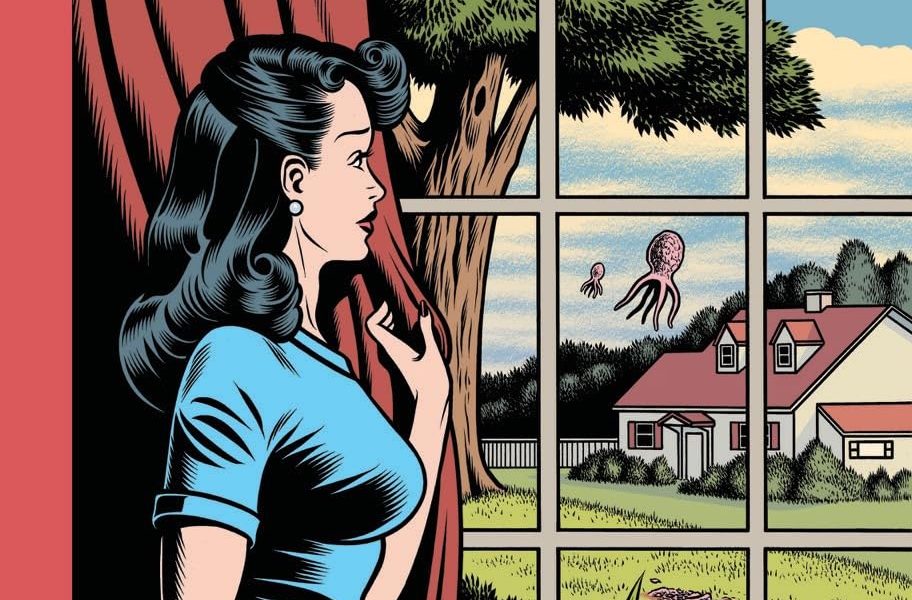

There’s a deep, nostalgic love for comics in Charles Burns’ Kommix, which sees the indie comics legend creating dozens of covers for imaginary vintage comics and magazines.
Burns, whose work has long been coveted by small press aficionados and championed by indies like Kitchen Sink Press and this volume’s publisher, Fantagraphics, is a creator who has long appealed to the literary-minded and high-art approving side of comics fandom. Black Hole, begun in 1995, has long since been touted as a crossover masterpiece, finding its way onto the bookshelves of readers who might turn their noses up at the four-color fare of comics shops.

Fantagraphics
But Kommix isn’t catered to that crowd so much as the faction of fans who are collectors of the obscure and oblique. Rummage-sale hunters looking for dusty, basement-kept piles of Fangoria back issues or dented, post-war tin toy robot. An art book rather than a graphic novel, Kommix imagines titles that might be unearthed in an estate sale or junk shop, the sorts of comics that most comic collectors would deem valueless, unworthy of bagging and boarding. Some of these comics – Teen Diary, Throbbing Heart, Unwholesome Love – would never cross through the CGC facilities. A non-existent retro horror magazine in the vein of Famous Monsters of Filmland promises to be ‘all about teenage romance, mystery, and excitement!’.

Fantagraphics
The titles skew more risque – Sex Decoy might be a low-budget porn mag, or it might be a high-concept art comic. Others have elaborately lettered, non-Roman alphabet titles, their countries of origin unknown, perhaps unreal. These books promise the most outre of interior content: grotesquely mutated people, apocalyptic lovers, alien boarding school students.
This sort of grotesquerie bleeds into the ‘normal’ books. A worm-like creature suggestively oozes on a cover of Diary Secrets.

Fantagraphics
A few of these titles repeat throughout the book, giving the viewer a sense of their larger imagined significance. A Tin-Tin-influenced character finds himself in tragic adventures again and again. The most stylistically singular title, Huss, showcases the mundane and the horrific with equal frankness: here is human intimacy and here, also, is body horror.
That frankness becomes hilarious on a couple of magazines that are very clear about their proposed content. An issue of Vagina Beauty features a young woman emotionlessly flashing her pubic hair to a man outside her window. Drug Buddy’s cover features a portrait of a young man who is almost the prototypical ideal of the kid everyone buys pot from in high school.

Fantagraphics
All of these covers are illustrated in Burns’ immaculate, precise pop-art style, which gives them a sort of legitimacy – that Burns has perfectly long-emulated the sort of streamlined commercial illustration of the post-war years makes even the most absurd magazine here somehow viable. These are comics and magazines you might believe you’d find in those rummage sales, gorgeous and forgotten gems of an age where there were hundreds of competing magazines, most of them trashy.

Fantagraphics
What Kommix presents isn’t one of Charles Burns’ deep, emotional narratives, but it is nonetheless a somehow intimate window into some proposed protagonist. This is someone’s collection, carefully cataloged and presented to the viewer. These are the things that are important to someone, and that someone is deeply (and rightfully) proud of what they’ve gathered. It is a collection that the right kind of viewer might aspire to themselves.




You must be logged in to post a comment Login