

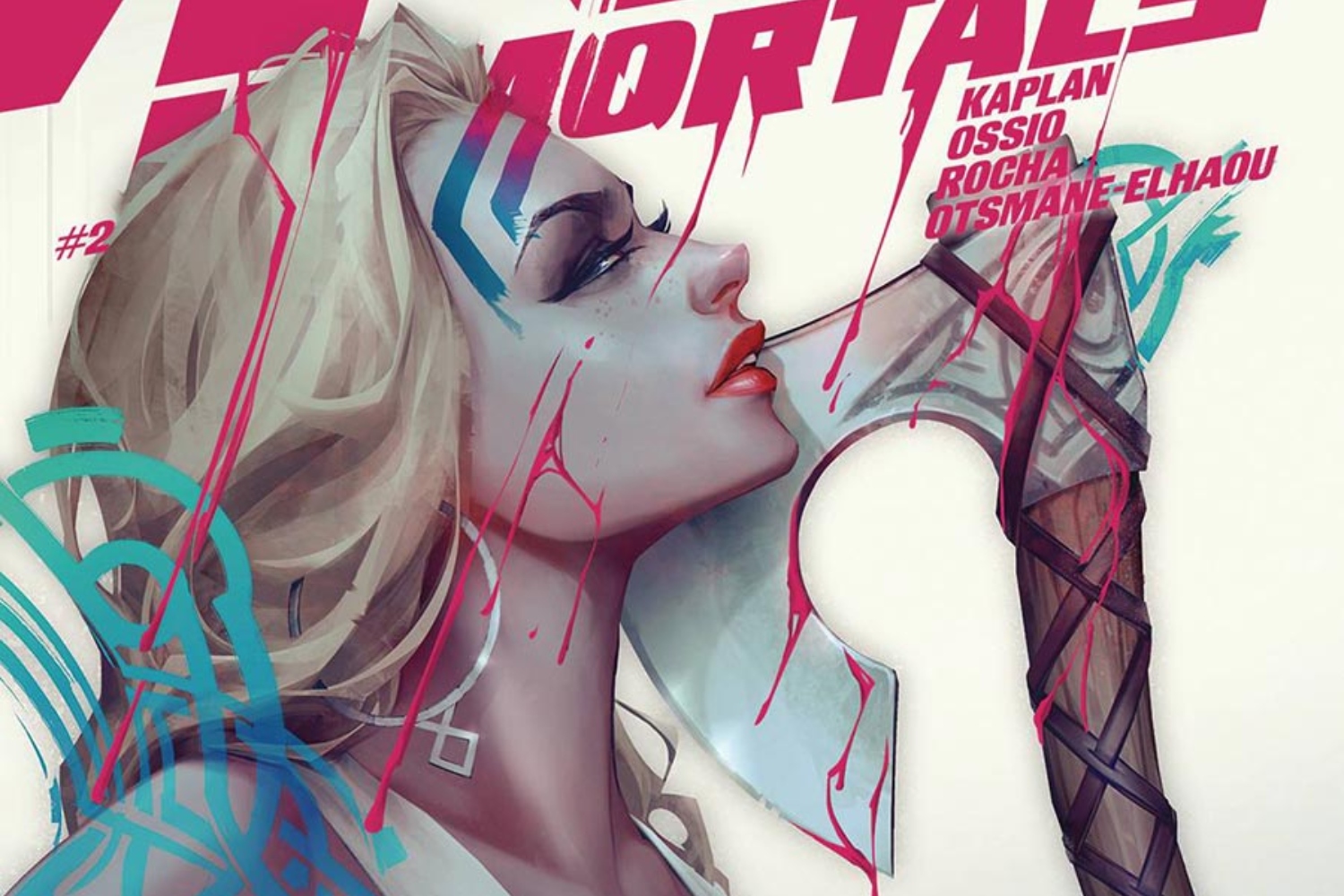

If issue #1 was the first step of a thousand-mile journey, then Kill All Immortals was clearly off on the very best foot. That debut had the bloody action, deep family drama, and conceptual layers it really needed to shine. But it would really be the rest of the series that would prove if this “Succession with vikings” story could have the stamina and endurance for the long haul. Lucky for us, Kill All Immortals #2 is another solid sprint toward some deeply compelling storytelling terrains.
Perhaps the biggest reason for Kill All Immortals‘ solid success thus far is the pacing. Writer Zack Kaplan wastes no time following the reveals of issue #2, with Frey and Owen having to hit the road to escape her bloodthirsty family.
From there, we get some really important highlights pretty much back-to-back. The biggest is how the family became immortal — without spoiling it, it’s quite novel and very much geared toward playing with and extending the ideas of family, generational trauma, and even resource-hoarding that rest at the center of Kill All Immortals. We also get some really great one-on-one time with Frey and her “little” brother, Thorvald/Thor. It’s a chance for these two to connect in some really profound ways and to start hinting at the larger thread of this whole story: what do you really owe your family and your past, and can you overcome things for something new? There’s this perfect mix of love and tension between Frey and Thor that makes their dynamic really interesting.
Each of these big events/milestones in issue #2 are balanced with enough room to percolate but with a clear eye for time and efficiency. So much so, in fact, that Kaplan leaves a lot of the character development to the art team (artist Fico Ossio, colorist Jordie Bellaire, and letterer Hassan Otsmane-Elhaou). Which is to say, we learn so much about these characters in how they move and operate within the larger world, and that’s such an important decision.

Courtesy of Dark Horse Comics.
Frey has constantly battles her origins/nature, opting instead for a life of quiet peace over bloody boardroom takeovers. In a clash against her family’s men early on in the issue, Frey (who mentions maybe being a tad rusty) fights like someone who has forgotten her bloody beginnings. There’s little mistakes and quirks that she exudes (getting caught by someone, or letting herself get hurt knowing she’s immortal) that tell us everything we need to know about her. This disconnect she’s experiencing, and how she’s sought only to lead a much different life. Or, her hesitation in returning, and that tinge of weirdness she may feel when she’s still actually quite good at killing. Add in her fluidic movements, and Frey is a creature battling because she must, and doing so in a way that has her trying to do her best to keep herself whole in this mighty struggle.
Similarly, a little later on in the issue, Thor and Frey battle it out. As you’d expect from someone with a name like Thor, this big brute uses a mighty hammer to dispatch his enemies. There’s this power and intensity that he exudes in every swing, and he uses his immense size and weight to intimidate and overwhelm. At the same time, through his actions and some effective dialogue with Frey, we learn of Thor’s gentle heart and his desire to leave the hammering behind. As such, his whole battle posture isn’t just about strength and domination; he may also love and show emotion the same way. He may overpower even things he loves, or bash awkwardly at his dreams/things he wants. In that way, Thor is quite endearing, and we see this gentle soul battling it out to try and do better and be a well-rounded person. It makes for a nice parallel to his sister, who engages in violence from a different perspective, even as they’re both clearly in conflict with themselves.

Courtesy of Dark Horse Comics.
And the fact that so much of these insights and general character studies happen visually is so darn perfect. It speaks to the roles that everyone plays: Kaplan offers a kind of structure and shape, and everyone else gets to fill it in. It’s a way to take all of these ideas and threads and let them play out in a way that not only makes sense to the characters — they are brutal warriors, after all — but that’s also the most compelling and entertaining to readers. It also means that no matter how bloody things get — think huge jets of blood and limbs being removed — it’s always colored/tinged with deep emotionality. That makes it so that we feel the blow of every hammer/axe, and that all this bloodshed is in the name of exposing everyone’s layers as well as to drive conflict around their ultimate struggle for purpose and clarity. (The family may want blood and riches, and Frey seeks freedom, but that’s basically what it all boils down to: peace of mind.)
This level of cohesion and collaboration makes the story run like a Viking longship, and Kill All Immortals manages some big things in a tight timeframe. In turn, a lot of that “efficiency” makes it so much easier to care for these characters, offers ample room for robust dissection and reflection regarding story events, and really lets the violence be so much more (even as it’s still this red-hot rush that you need to keep interest and foster some added momentum).

Courtesy of Dark Horse Comics.
If there’s a downside to this approach thus far, some of the stuff with Owen in issue #2 felt a little iffy. After a solid showing in issue #1 of Kill All Immortals, this chapter saw Owen feel more like a sidekick, with nary the wit and chutzpah he displayed against Frey’s family. All of that could just be the focus of the story so far, and there’s clearly room for Owen to shine later. But it did briefly make me think that this book’s many goals (exploring the billionaire class, telling a pointed family story, being a globe-trotting action story, etc.) may be too lofty. That, or we may have to let some of those aspects take a backseat as the story really builds.
But none of those really reach the level of actual concerns, and I still generally believe that Kill All Immortals #2 is this massive success. There were huge battles with big, emotional stakes; lots of great lore and worldbuilding; some important revelations; and just this succinct, deliberate approach that made it feel all the more exciting to consume. I hope issue #3 can keep up the same pace — if it can, then Kill All Immortals may have the wind to truly go the distance.




You must be logged in to post a comment Login