

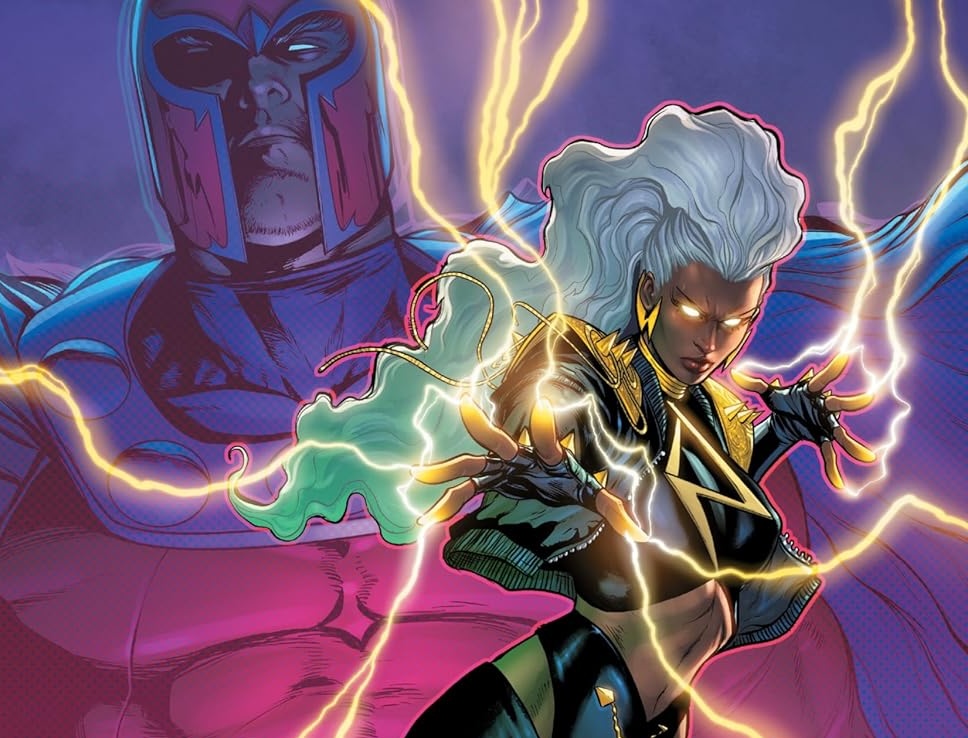

Death in comic books has always been a transitionary state, guaranteed to be temporary no matter how severe the killing stroke or how narratively poignant the death scene. No good hero or villain can ever be left to rest in peace; there’s money to be made.
Perhaps a part of the Krakoan Era was meant to mock this revolving door approach to mortality. The resurrection protocols, put immediately into place when the story began, made any gruesome fate trivial, forgotten as soon as it was committed to the page.

Marvel Comics
When Magneto died during the events of A.X.E., the implication was that he would not return. His was a sacrifice meant to matter – he was a martyr, heroic in his passing. He would be the one resident of Krakoa (or Arakko) for whom mortality would remain a fixed state, transforming him into a symbol of Krakoan virtue: Magneto died so mutants could live (forever).
It’s strange how quickly and easily he returned from the grave. Just over a year after his death came Al Ewing, Luciano Vecchio, and David Curiel’s Resurrection of Magneto miniseries, and our characters barely bat an eye as they overcome mortality. The announcement of the series immediately deflated the initial story’s sense of importance, undermined the dramatic resonance of his sacrifice, and felt to be just another sad signifier of the coming end of the Krakoan Age.
It’s a testament to the creators that Resurrection of Magneto feels more significant than A.X.E. – his resurrection is more compelling than his death.
No small part of what makes the book compelling lies in writer Al Ewing’s continuing exploration of the abstract and infinite aspects of the Marvel Universe, which has been running through miniseries across the breadth of Marvel’s various properties. In books reaching back at least to 2016’s The Ultimates 2, Ewing has been prodding at the fabric of the universe. We’ve been shown small glimpses of what lies beneath reality, and we’ve seen what exists above – or just outside – of it.

Marvel Comics
In Resurrection of Magneto, we’re shown what lies behind the curtain of death. Not all death, to be sure – Magneto’s afterlife has been custom-crafted, and the way by which Storm pierces the veil to reach him is far different than how any other hero has accomplished the same feat.
In typical Ewing fashion, Ororo’s journey – through a massive portal in the underwater basement of one-time Ultimate and Defender, Blue Marvel – leads her into the metaphysical world of the abstract. In the ‘Well Beyond the Worlds’, we are given a glimpse at a sort of symbology of the capital-A ‘Abstracts’, those cosmic forces which oversee reality. Beings like the Living Tribunal, Death herself, and forces like Fate, float beneath a cosmology of Infinity Gems; this is a realm where all things are distilled to their most symbolic truths.

Marvel Comics
In keeping with the Krakoan Age standards of visual beauty, Luciano Vecchio presents our heroes with just that sort of symbolic clarity. We’re given lush, iconic versions of our heroes — here is a Storm to best all Storms, a Magneto as dramatic as any Magneto. The strange, the monstrous, and the nostalgic are all given such detailed care that the artwork begins to feel more real than the story itself.
Magneto’s afterlife is an actual Hell of his own making. Left forever to read over the names of those whose deaths he had a hand in, he blindly runs his fingers over a sort of Vietnam Memorial of magnetism. Being Magneto, this is perfectly fine for him.

Marvel Comics
The journey to resurrection – from Storm’s insistence that he just come back to life already to facing a version of himself he no longer claims to be – feels a bit rushed. Being mired in the metaphysical means that there seem to be no concrete steps to rebirth, and his journey is made muddy by monologing self-talk; he accounts for his sins by explaining that he’s over it. Might as well just own them.
Most frustratingly, Magneto’s return is not shown to have as immediate a dramatic purpose as his death. In what feels like a tacked-on fourth issue, he is shown to do what the X-Men have always done: rescue mutants and fight sentinels. The conflict is an assured victory, nothing but his ego is at stake; the world does not tremble before him, nor does it remark upon his return.
Ultimately, Resurrection of Magneto is stylish and conceptually compelling but emotionally empty. It has all the presence of a bit of narrative housecleaning: with Krakoa ending, the creators had to tidy up their mess before the new guard came on board. This book is the quickest, cleanest route to that end, and the larger Krakoa story is done a disservice by that rush. The promised temporary nature of comic book death has been made so brief and unremarkable that it feels more obvious than ever.




You must be logged in to post a comment Login