

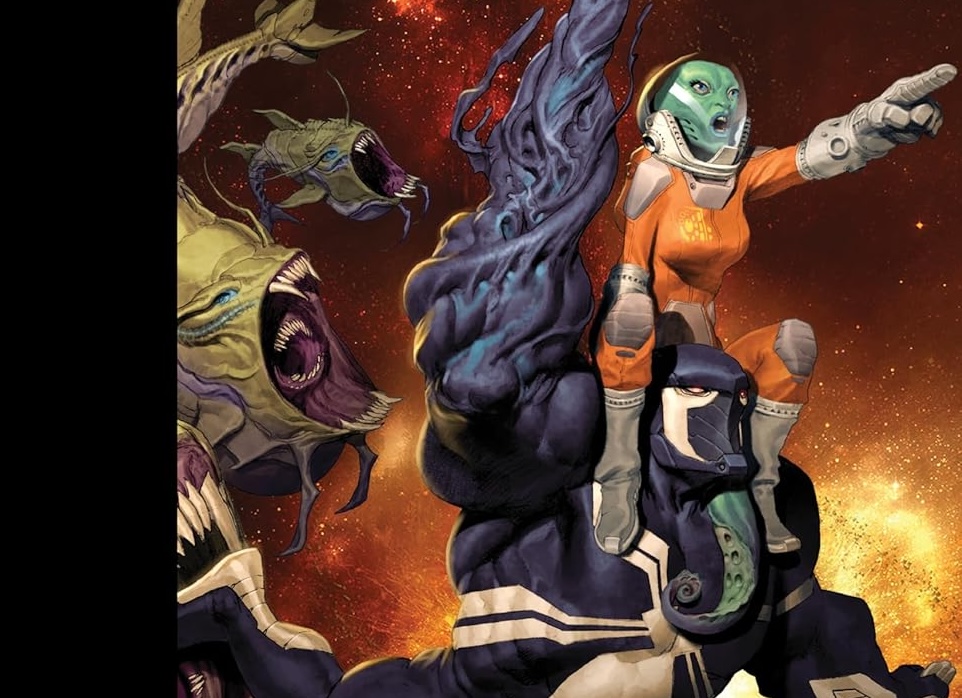

I don’t think it’s an exaggeration to say Venom is one of the most recognizable Marvel characters today. Thanks in part to his incredible design, a series of epic storylines featuring the character, and a successful film series, even casual comic fans likely have a perception of what a Venom story should look like. So, with the release of Venom Modern Era Epic Collection: Space Knight, these spontaneous readers might find themselves confused by the interpretation of the iconic figure in these pages. With that in mind, it’s a series of comics that has some interesting concepts and worth picking up, minimally to see how versatile the Venom character has been applied in Marvel comics.
Collecting the dueling storylines from Venom #36-42 and Venom: Space Knight #1-13 (the whole run of this series), the story follows Flash Thompson as he takes on the role of Venom and battles underworld threats in Philadelphia before embarking on a new mission as a Space Knight. As he navigates his responsibilities, Flash confronts his past and faces challenges both in space and on Earth. His journey culminates in a confrontation with Spider-Man during the events of Civil War II.

Marvel Comics
The issues collected in this Epic trade were rather surprising, and a peculiar direction to take Venom during the soft reboot of the Marvel line in the mid 2010s. It still carries many of the hallmarks Venom fans could appreciate, but at its core, this feels like a completely different character that has a Venom membrane applied to help sell issues. With Cullen Bunn’s run ending in issue #42, it feels like a substantial and rushed heel turn to finish Andi’s time with the symbiote to get the space adventure of Space Knight into gear. Obviously, many characters have worn the Venom symbiote, this book demonstrates that Marvel sees the costume as a phantastic visual and financially sound property, rather than a specific type of character.
It isn’t bad that Venom has been given such different types of stories to play part in. I loved Robbie Thompson’s idea of Flash and the symbiote being sent to space on behalf of the Avengers to work with the Guardians of the Galaxy; that’s a fun premise! Add to that the beautiful pulp-inspired airbrushed art of Airel Olivetti, and I was able to enjoy what this book was going in concept. The stories themselves just felt far too safe in their execution for such a grand concept, but there was a marked improvement in plotting and storyline as the series reached its final issues. Gerardo Sandoval’s pencils in the final issues reminded me of the twisted and anatomically nonsensical art often found in the incredible Sam Kieth Venom books from the 1990s, which was great to see. I also find Venom comics are at their best visually when its artists are allowed to go hog wild with their character contortions and body horror.

Marvel Comics
Marvel has stepped up their supplemental offerings in their recent Epic Collections, and this book is no different. There are the ubiquitous variant covers, a large handful of penciled and inked pages, and an assortment of design sketches. I especially appreciated the afterword from both Bunn and Thompson included at the end of the book. Even for fans with a strong understanding of Marvel history and its publishing cycles, to have these final expository thoughts from each writer really helps give context for these books. It also reflects how thoughtful and excited these creators were in crafting their narratives.
If you just watched a Venom movie and pick up this book for more of that character, this title may come as a head scratcher. Yet, for Marvel fans open to different ways to use this iconic anti-hero, Venom Modern Era Epic Collection: Space Knight is an interesting narrative detour that provides some enjoyable character moments and action. It’s not a definitive Venom storyline, but it’s worth a read.




1 Comment
You must be logged in to post a comment Login