

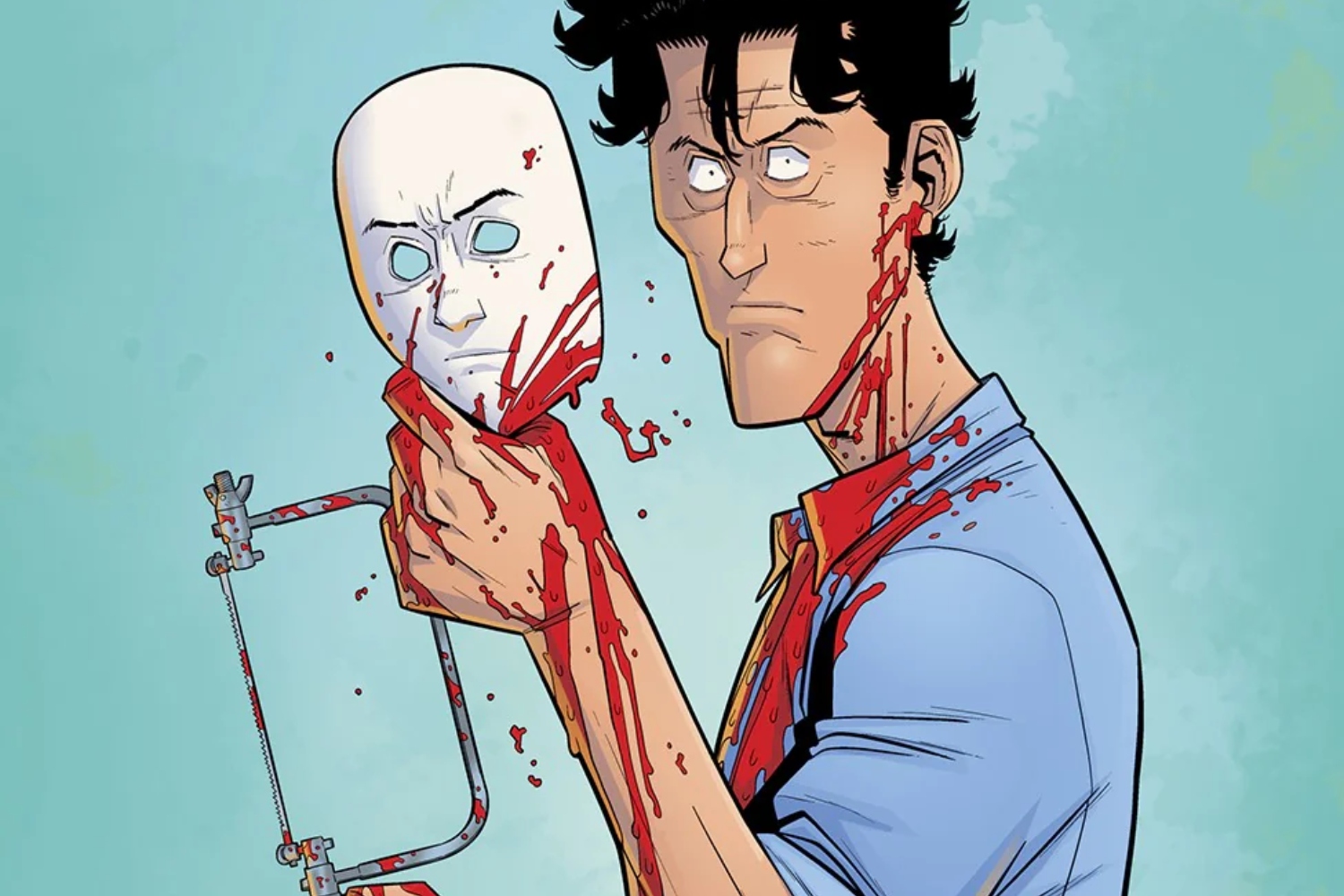

Across its first two issues, Plastic: Death & Dolls has maintained some rather lofty goals: to humanize its deeply unwell lead, Edwyn. Issue #1 was a perfect balance between celebrating and condemning Edwyn for this really potent character study. Issue #2, meanwhile, doubled down on that approach, and we really saw the complexities of Edwyn and this whole enterprise.
Issue #3 of Plastic: Death & Dolls may not be quite as intriguing and thoughtful on the surface, but it’s nonetheless a vital step in this book’s massively important storytelling crusade.
If Plastic: Death & Dolls has been about really humanizing Edwyn, then issue #3 perhaps shows the “downsides” of that process. And by that I mean, we’ve already gotten a lot of insights about Edwyn — why he is the way he is (a clearly special needs kids who remained isolated and disconnected) and how that forged a man with a twisted moral code (one we fight to relate to through our own disgust and apprehension).
But issue #3 maybe focuses on the “negative” sides of this process, and we see how Edwyn deals with the anxiety when he can’t help those he loves or how he responds when things don’t go the way he had intended. (The art team — artist Daniel Hillyard, colorist Michelle Madsen, and letterer Ed Dukeshire — have such a novel visual device for tracking Edwyn’s anxiety and feelings.) It’s basically a child lashing out (albeit with a hacksaw), and we’re meant to see that whatever upsides Edwyn may have (loyalty, consistency, a twisted moral compass, etc.), he’s ultimately this chaotic murderer.
But then, writer Doug Wagner’s narrative prowess really delivers as we get the right amount of extra strategic flashbacks in this issue. And this time around we see some vital things, like the emotional connections Edwyn has with his saw; how he was taught about death by his mom’s feckless lover, Cassidy; and even the uncertainty he experiences even walking through the world. But these aren’t meant to just elicit sympathy and make us forget about what Edwyn ultimately is (a “bad” man).

Main cover by Daniel Hillyard and Michelle Madsen. Courtesy of Image Comics.
Rather, it’s a reminder that this whole process is hugely complicated, and there’s so many ideas, energies, and layers of history building to whatever rests within Edwyn. To say he is a good man gone bad or vice versa, or that he’s just the end result of decisions made outside himself, continually ignores all of this vital context. Just as Edwyn struggles with feelings and tension in this issue, so too are we made painfully aware of the sharp unevenness of this whole process. It’s not just that it’s hugely complicated, but grappling with these themes is continuous.
And it should be — we’re trying to quantify something as nebulous as the human mind/spirit, and it should be a thing that affects us as much as the character in question. Be it with a fictional psychopath or an actual person in our actual lives, the discomfort and awkwardness here is a powerful reminder that morality is not something to be trifled with so casually. That we can’t make overarching, rapidfire decisions — what we may think is clearly the case for something could be more complicated than we could ever truly imagine.
Plastic: Death & Dolls has used an issue that may doesn’t feel immediately compelling to remind us that how we read and interact with people needs to be fluid, and assigning blame or uplifting instead are real acts with actual consequences. We have to be committed not to making assumptions but seeing the full picture of a life and weighing that with nuance to really understand people in a way that transcends “they’re cool” or “they’re weird.” Every one of us contains multitudes, and cracking that is a thing that takes the kind of work that makes us continually second guess the world and even ourselves.
As much as the storyline and dialogue makes this really abundant (there’s heaps of great context in how Edwyn talks with others about death or folks deemed “runaways”), you can’t forget the art. The “anxiety” device I mentioned is really great, and this issue treated it with the intensity and power necessary to give us this immediate and visceral snapshot of Edwyn’s inner life. But there were a few other features of Plastic: Death & Dolls #3 that require our careful dissection.
Chief among them is Edwyn’s continued murder spree across this issue. By now we’re almost desensitized (or is it just me?) with Edwyn’s expert use of a hacksaw. But here, the placement of some murders, as well as the framework from which they emanate, offers a couple valuable insights. For one, we see that they’re not just Edwyn’s reaction to indecency, but his near-addictive need to engage in these bloody acts, and how they offer him not just control but a form of release or horrifying engagement.

Variant cover by Daniel Hillyard and Michelle Madsen. Courtesy of Image Comics.
They’re a moment, if you will, to grapple with parts of himself and his history (the saw belonged to his grandpa, FYI) and just feel these things and ideas that he’s mostly disconnected from. Add in a certain level of grace and visual prowess to these killings (they’re almost beautiful and poetic in scope), and they’re about as honest a version of Edwyn as we could ever get. A chance to cut through (sorry) all the walls and feelings and see him in his purest form — something that is scary, yeah, but also deeply honest.
It’s just another layer in this story’s ongoing interest to show Edwyn’s complex nature, and how our own role in making moral or emotional decisions is a process that looks, feels, and sounds appropriately complicated and a thing never to be taken lightly. That our interest and compulsion in this series maybe isn’t indicative of our own issues (but perhaps it is), but rather that it’s hard to experience life with such a deep-seated binary.
Even if we know killing is wrong (duh), there are connections to these acts that affirm our very big, very multifaceted humanity in ways we can’t always see and can never truly deny. The storyline makes great decisions to delve into these bloody truths, but it’s the art that does so in a way to bring us in even closer to these ideas, and to show us how much skin we have in the game of sorting out light and dark and the lifetimes it takes to really understand the beast that is modern man.
Even if you think Edwyn is a monster — and that’s made even easier than ever after issue #3 — you can’t deny the chutzpah of this ongoing Plastic story/series. It makes the immoral rather exciting, and the good and decent a little hazy or uncertain. In short, Plastic, and this latest series especially, confronts us with this extra sharp knife of truly meaningful fiction.
It hurts, it feels good, and you have to mostly wriggle around in that uncertainty. There’s no real relief, but take solace in the fact that it just means you’re alive. And I can’t wait to see what more wonderfully twisted lessons await in Plastic: Death & Dolls #4.




You must be logged in to post a comment Login