

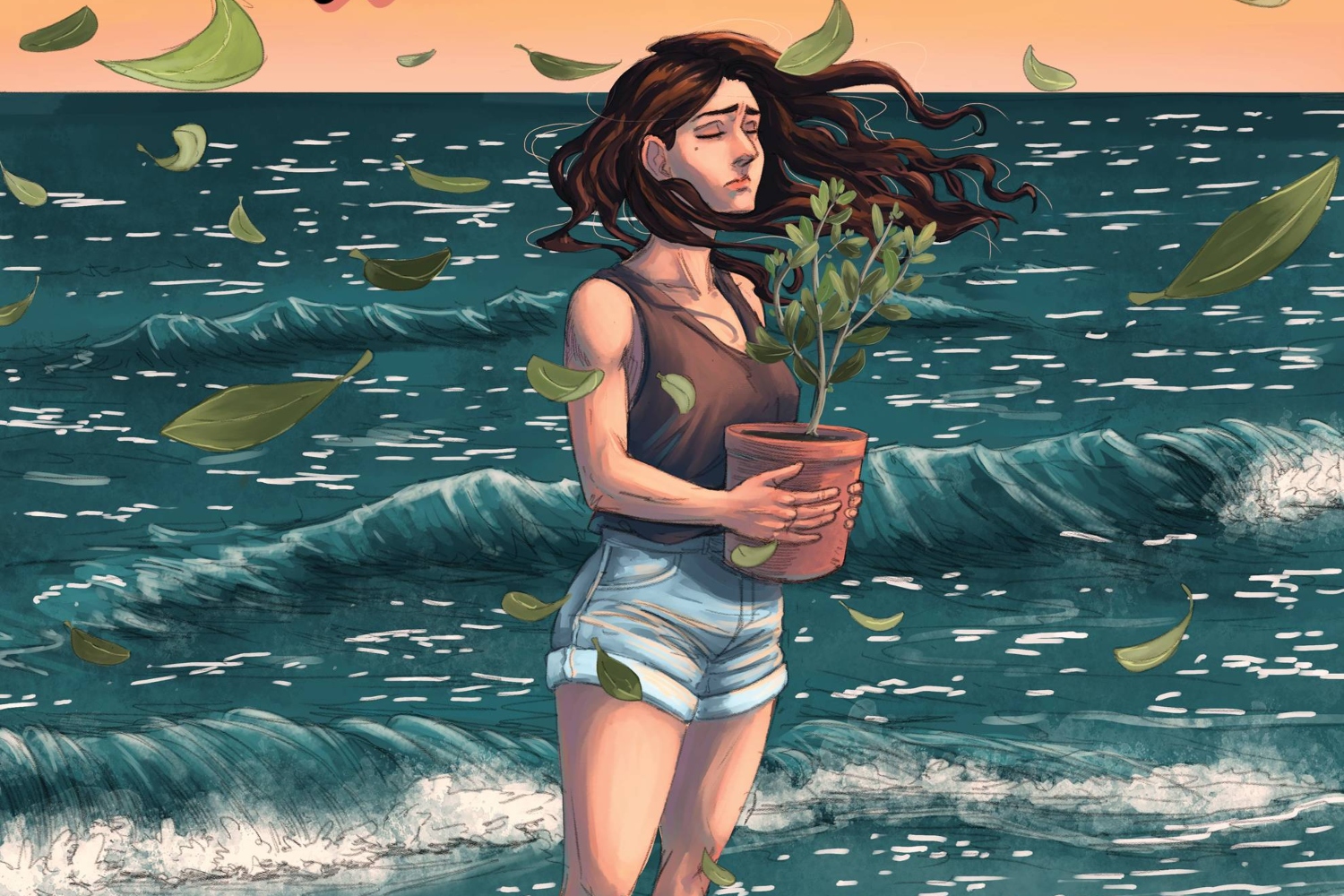

Love can take you to some very weird places. In the case of Lilia, one of two leads in the recently-released Tunis to Sydney OGN, that’s Australia but also the very depths of grief.
Tunis to Sydney (from writers Meriam and Christian Carnouche and artist Sam Rapley) picks up right after Lilia’s parents have died. Joined by her Aussie husband Bill, she returns to her native Tunisia to make arrangements and to begin grappling with this massive life event. But what happens next is this existential whirlwind as Lilia “confronts a cascade of profound questions” about “grief, resilience in the face of loss, and the complexities of human relationships.” (There’s a slight hook involved that adds to Lilia’s journey, but we’ll let the creators break that down.) No matter where you live, and who you’ve loved and/or lost, Tunis to Sydney will move you with its gripping portrayal of the way grief crystallizes life and connects us all in its scope and power.
Tunis to Sydney is out now via Fairsquare Graphics. To get a better understanding of the book, we got the chance recently to speak with both Meriam and Christian Carnouche all about the many layers of Tunis to Sydney. (The couple answered collectively, and so we’ve chosen to represent that in the interview itself.) That includes how the story pulls from their own life as a “transnational couple,” the emotional end goals for the story, the ups and downs of writing/working together, their collaboration with Rapley, and the role nature plays in the overarching narrative.

Courtesy of Fairsquare Graphics.
AIPT: What’s the elevator pitch for Tunis to Sydney?
Carnouches: Tunis to Sydney is a slice-of-life graphic novel about home, belonging, and grief, and is the story of Lilia, a Tunisian swimming coach living in Sydney with her Australian husband. On returning home to Tunisia after the death of her parents, Lilia’s grief pushes her to smuggle a baby olive tree, owned by her parents, and a symbol of peace and healing, back to Australia, triggering a dramatic situation that will change her forever.
AIPT: Tunis to Sydney isn’t based on your actual life experience (i.e., a sudden family death), right? Is it then touching on some greater anxiety or worry perhaps?
Carnouches: Thankfully, we haven’t lost our parents, but the story of Tunis to Sydney was inspired by us having lived overseas for so long, far from both countries where we grew up, not to mention the constant fear hanging over our heads that we may lose a loved one at any moment. Not only would we have to process the trauma, but how would we feel about missing out on their last moments, and not being able to say goodbye to them in person? It did actually happen to Christian not long after he moved to The Netherlands, when one of his closest family members was terminally ill and ended up passing the day before Christian was scheduled to fly home to see him. Although they spoke on the phone literally seconds before he died, it still haunts him that he wasn’t able to hold them as he said goodbye.
It was through mapping Lilia’s journey of trauma, guilt, acceptance and forgiveness that we seemed to find some comfort in our situation, and we hope it will have a similar effect on anyone who reads the book.
AIPT: Similarly, how much of Bill and Lilia are actually you in Tunis to Sydney? Is there a “math” for depicting reality and embellishment?
Carnouches: This is a great question, but a tricky one! It really just flowed naturally as we started plotting, and I guess our own experiences heavily influenced this process. We started off with the core idea of Lilia wanting to bring a baby olive tree back to Sydney from Tunis, and we built the story from there. The whole quarantine interdiction scene was inspired by Meriam’s first trip to Sydney in 2010, where she was confronted by quarantine officers after unknowingly smuggling two oranges into the country. And the scene where Bill and Lilia are riding a tandem bicycle, and Bill is embarrassed to be seen on it, this totally happened to us!

Courtesy of Fairsquare Graphics.
Even though it is without doubt a work of fiction, and Lilia and Bill are not meant to be us, there are quite a few similarities to our own situation, and not just because they are a Tunisian-Australian couple, but particularly because we have both lived and worked overseas for a long time, first in Europe, and now in New York City. And for us, this really is the main theme of the book: Lilia’s struggle to find home and belonging, not just because she is a foreigner, but because she grew up in a culture so different to that in Australia.
Thinking about this question a bit more, although Bill and Lilia have very different personalities to us, there is a kernel of truth in the tension they have because of Bill being a bit of a “goody-goody” when it comes to rules… Also, both of us grew up in countries where the ocean/sea play such important roles in our day-to-day lives, which is why we feature some of our favourite beaches in the story, not just in Sydney, but in Tunis and Djerba.
AIPT: You yourselves are a “transnational couple.” What issues or opportunities does that unique aspect bring, and how does that appear in the book?
Carnouches: We love that we are transnational couple because it makes things interesting! We do, though, have a country in common, which is France, as Christian’s father is from Marseille, and still lives there, while Meriam went to a French high school and lived in Paris for a long time. We’re not sure if this mutual connection made things a little easier, but it definitely gave us an initial connection. When you think about it too, we were also dealing with differences in culture, ethnicity, and religion. Although some small things were complicated early on, it was not really much of an issue for us, maybe because so many of our friends are transnational couples as well, so these types of relationships were quite normal. There is one thing though that Christian will never understand about Tunisian culture, and it’s that the “evil eye” is real! (the idea that a malevolent/envious glare will bring about a curse). As time has gone on though, many of our ideas and traditions have begun to align, and we’d like to use the best parts of our respective cultures to create our own little bubble for our daughter to grow up in. She is American/Tunisian/French/Australian so she might share some of our own challenges when it comes to working out where she belongs!
We didn’t really explore the differences in our nationalities in the book, and to be honest, Lilia and Bill seem quite at ease with each other’s cultures, which is not something we planned, it just happened to go in that direction as we were scripting.
AIPT: Building off that last question, what are the challenges of writing/working as a couple? What about some perks or benefits?
Carnouches: Great question, but honestly there weren’t too many challenges, and in a lot of ways it is easier to collaborate with a partner, than with another creator in the industry, who you may not know on a deep level. We get on extremely well, and although we have quite different personalities, we have similar values and we have a respectful relationship, and this carried over seamlessly to our collaboration. And we have learnt that it’s fine to disagree with each other, and more than that, that it’s important to express how we feel, which helped us get through the writing without any major dramas.

Courtesy of Fairsquare Graphics.
We had also worked on a short comic together previously, House of Cracks, which we co-created along with Dev Pramanik and Tríona Farrell back in 2021 and published in Christian’s Murky Waters psychological horror anthology, so we already had a good idea about the type of stories that we both wanted to tell, and how best to collaborate. We still can’t believe that we managed to create this beautiful book together with the creative team. Not only do we have something wonderful to show our daughter when she grows up, but we feel that all the research we did about Sydney and Tunis helped us learn even more about each other’s home and culture.
Of course there were some disagreements about plot points, character arcs, and other creative decisions, but in the end, we always managed to agree on the way forward without the other being resentful. The most challenging thing was probably finding the time where we could both sit down together and go through the plot, or the story, or even the art. We are both busy with work, and we got even busier when our daughter was born, so we did a lot of this work separately, and would only really sit down together to go through our ideas. And there ended up being quite a few long breaks in work, meaning this book took longer than it would’ve if we were writing it alone. Thankfully Sam, the artist on the book, was very patient and easy to work with, not to mention his art being the heart and soul of Lilia’s journey!
AIPT: What was it like working with Sam Rapley? What did their work do in terms of supporting and empowering this story?
Carnouches: Sam was the perfect collaborator. We were lucky enough to have found him on Twitter through #portfolioday, and after he drew a couple of test pages, there was no doubt that his fresh and unique style was perfectly suited to our story. It’s hard to believe that Tunis to Sydney was Sam’s first full-length book and that he is a self-trained artist! He was also super easy and reliable to work with, and emotionally invested in the story, so we felt like it was a true collaboration, rather than a simple work-for-hire, as can be the case sometimes. We were lucky to have found Sam, and we know it sounds corny, but we couldn’t imagine Lilia being drawn by anyone else.
We scripted quite a few silent scenes, mostly involving Lilia processing her grief, as emotional beats that let the story breathe a little and allowed the reader to take the time to reflect on Lilia’s journey. Sam was brilliant at capturing these quiet moments and dialogue wasn’t required to convey Lilia’s feelings. She’s mostly a quiet sufferer, and Sam’s ability to communicate her emotions, mainly her sadness and regrets, was just wonderful. He also did a great job with the flashbacks, which play a key role in illustrating Lilia’s journey, and he doesn’t just draw them in an aesthetically pleasing way, but manages to transition these scenes back to the present with an emotional punch.

Courtesy of Fairsquare Graphics.
We found his sweeping splash pages, like Sydney Harbour from above, Marsa Plage in Tunis, Lilia soaring like a phoenix to the surface of the ocean, and Lilia finding her mother’s greenhouse, just stunning. Sam could also draw nature effortlessly: oceans, below the sea, sand, soil, gardens, and plants. Whatever we asked him to draw, he did effortlessly and with his own spin.
We knew it was going to be a risk working with an artist who was not from the region, but we were both so impressed by how well Sam drew the Tunis scenes. A lot of research went into his work too. Tunisia, and North Africa as a whole, is such a melting pot of history and cultures that we thought that a non-Tunisian might struggle to recreate the city and its peoples. And that scene where Lilia is lost in the souk, we really don’t know how Sam pulled it off! Meriam was also impressed by how well Sam drew Arabic script and jokes that Sam has now earned his degree in Arabic script!
AIPT: Nature plays a big part in this book, like Lilia’s plant-smuggling and her love of the ocean. What do you think you’re trying to get at in terms of that focus?
Carnouches: Nature plays a huge role in Tunis to Sydney and we’re happy you noticed! Two earthly elements are integral to the story: water and soil, and we weaved these motifs into Lilia’s journey. We intentionally made Lilia a swimming instructor as a means of reinforcing her connection to the sea, and the idea of playing with and creating tension between these water and soil elements was linked to the concept of planting one’s roots, with the baby olive tree coming to symbolise this. Lilia literally wants to re-plant the North African roots of the olive tree in Australian soil, which she thinks will help her not only finally accept her husband’s country as her own home but allow her to carry a little piece of her parents with her. When her efforts are thwarted, the water becomes her place of belonging as it is familiar and comforting, a bit like home, and no matter where she goes, it will always welcome her into its arms.
AIPT: The family traditions are rooted in the culture of North African Muslims. What is compelling or novel about these traditions, and do you think you’re exposing a wider audience to these unique perspectives?
Carnouches: Family is undoubtedly important in all cultures, but in Arab and Muslim cultures there is quite a bit of focus on duty and responsibility within the family unit, including looking after one’s parents in their old age. For example, it would be almost unthinkable for Tunisians to place their parents into a nursing home, and multi-generational living is very common, especially when parents reach old age. Lilia, who is an only-child, moving so far from her parents and her home was a huge decision for her, and one that she has never quite come to terms with, meaning that the death of her parents deals her a double blow. Her guilt is twofold: she moved across the world from her family, and she was not there for them before they passed. How does she reconcile this perceived failure with being able to move forward with her life in Sydney?

Courtesy of Fairsquare Graphics.
We also wanted to tell a story about a Muslim-Arab woman that wasn’t a story questioning the place of women in society, which is what a lot of western audiences have come to expect from stories from the region. Tunisian women are also famously fierce and independent, and we wrote Lilia as an example for the world to see this strength. Also, there are simply not enough Arab or Muslim voices in Anglophone comics, nor do a lot of people know much about Tunisia, or even North Africa. Meriam has to constantly explain where Tunisia is, what languages they speak, and why she is from the African continent, but not black. Hopefully Tunis to Sydney will play a small role in bringing a sense of Tunisia in its diversity and culture to the world.
AIPT: The settings are just as vital (maybe more so at times) as the people. Was that a conscious decision? Can a place be like a person (or maybe a substitute instead?)
Carnouches: We hoped to bring the cities and their people to the forefront of the story to highlight the differences in the two worlds that Lilia straddles: the bustling and hectic Medina versus the relaxed beaches in Sydney’s eastern suburbs. We also used certain locations as both emotional and physical anchors for Lilia and we featured places that were meaningful to us. We also thought this would help give our audience a better sense of these two worlds. We definitely agree that sometime places play such an important part in a story that they become characters themselves, and we feel this was the case in Tunis to Sydney. The title alone shows the reader how important these two cities are to the book!
AIPT: Do you have a favorite moment, page, or panel from the book that speaks to its message or sense of heart?
Carnouches: It’s difficult to pin the book down to a favourite moment, or even a scene that captures the heart of the book, and that’s because Tunis to Sydney is not only tackling the theme of home and belonging, but it also deals with grief. There is, though, a scene that we feel speaks to the tension that can develop between a couple when one of them is processing loss, and the other is doing their best to support them, but there is a communication disconnect. There is a brief scene on page 105 where Bill tries to talk to Lilia after she has returned home from a failed attempt to purchase a baby olive tree to replace the one in quarantine. She is angry at him for not supporting her, while he is lost about what more he can do. We’ve had our own similar situations, so it feels very real, as it probably does for a lot of couples.

Courtesy of Fairsquare Graphics.



You must be logged in to post a comment Login