


To some extent, The Butcher’s Boy run has leaned into and away from certain horror archetypes. It started as a fairly familiar story — sexy, angsty teens go on a road trip to a deserted mining town only to face a kind of cannibalistic threat — but it also made decisions to grow beyond that (like the use of time-hopping and a generally novel narrative structure).
But like any great horror property, all that really matters is the ending (and the sheer amount of blood, of course). And the fourth and final chapter of The Butcher’s Boy climaxes with some familiar turns and also even more novel storytelling techniques for a bloody satisfying finale.
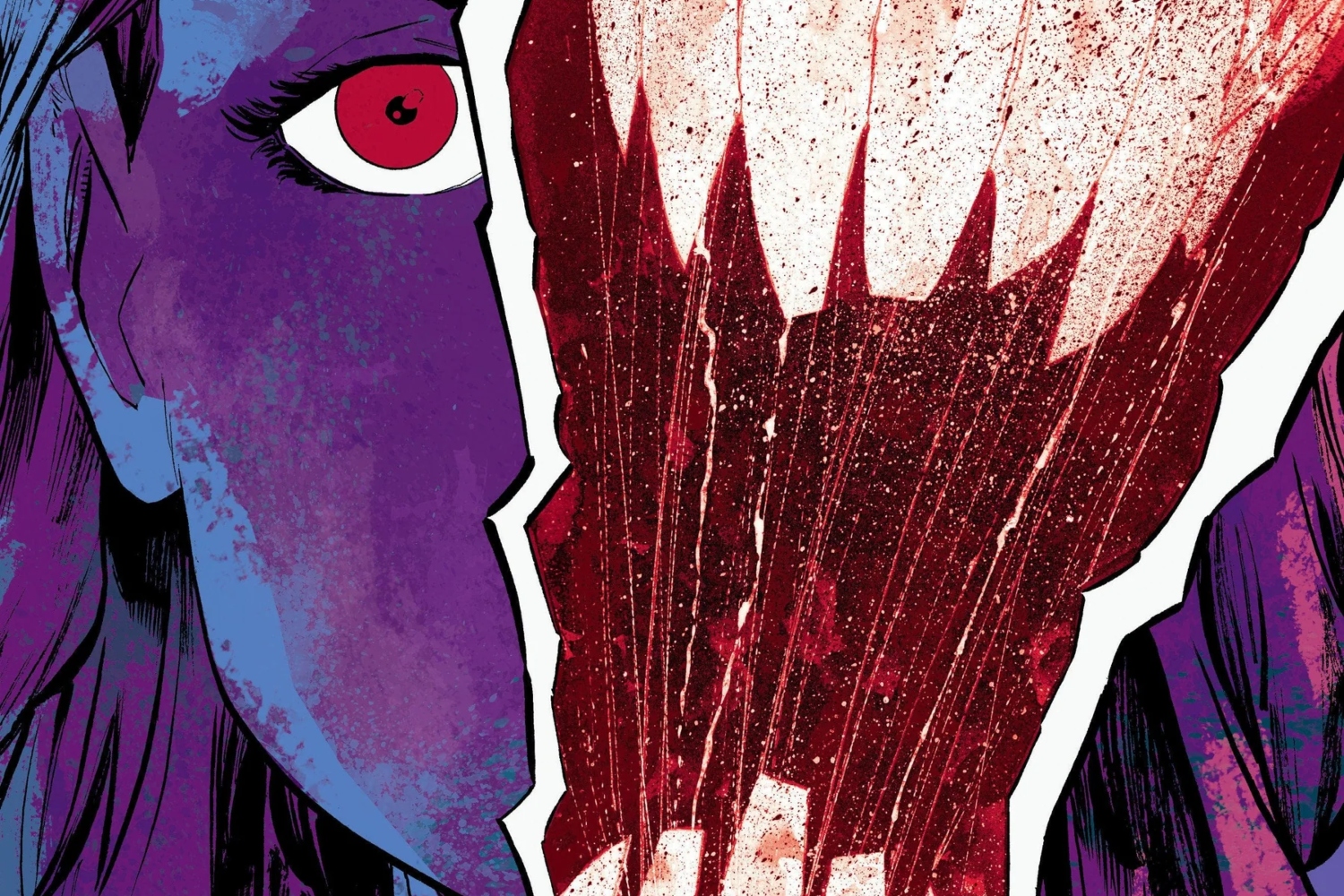
Perhaps the most interesting development of The Butcher’s Boy continues to be the art (from artist Justin Greenwood, colorist Brad Simpson, and letterer Pat Brosseau). Across the first three issues of The Butcher’s Boy, the trio have given us lots of blood-soaked action, deep humanity and emoting, and a generally tense and unnerving atmosphere as the teens uncovered the terrible secret of La Perdita. In issue #4, there’s enough of that — including some great monster transformations and people being pulled apart — but the real pull is less any grounded horror and more of the cosmic variety.
Namely, as The Butcher’s Boy has hinted at the true story and lineage of the actual Butcher’s Boy, there’s been a slow development of Lovecraftian imagery and visuals. That reaches an apex in issue #4, and the more sublime and psychically unsettling tidbits really achieve a few different things. One, they’re a nice counter to the grounded horror, and I love the interplay as much as these two “sides” remain wholly cohesive. Two, it elevates the story in a way that plays up the more psychic and/or emotional aspects that you wouldn’t get in a straight slasher flick — it’s a realization of this story’s true core done through a familiar trope/archetype (that’s actually interesting). And, third, after all the grit and gore of the first three issues, it’s just nice to see the art extend with new colors and energies to keep us from over-eating on all that bloody horror.

Courtesy of Dark Horse Comics.
Were there some downsides from a visual perspective? Sure. Because of the focus primarily on the present — as Shyla dealt with The Butcher’s Boy and the true fate of her friends — we didn’t get much of the time-hopping. And from a visual sense (but also very much a narrative one, too), that device was a great way to play with ideas and concepts and to get us thinking about how deep this story goes and how it’s informed by the friends’ relationships long before the trip actually began. And while I’m all for dragging out the suffering, there’s moments in this issue that involve a lot of “filler,” like Shyla hiding and weird close-ups, that didn’t really do that much for the story.
I would’ve also liked to see more of the memory that plagues Shyla, but that could’ve been a smart enough storytelling choice. (And if not, booo.) But while these were mostly minimal, they exemplified a tendency of this issue: to do great, inventive horror but also to lean into things too much and allow some hacky devices or slower, less unique pacing hamper the flow. But with all of this blood and horror, you might not have noticed these issues all that much.

Courtesy of Dark Horse Comics.
However, if we’re just thinking of the narrative as a whole, then that’s where the larger concerns really emerge. Again, the first 75% of The Butcher’s Boy was pretty good about making novel decisions (the group’s multifaceted dynamic, the nature of the Butcher Boy’s lore, etc.) with the rest leaning into those “stereotypical” decisions (the horny teens, the Evil Dead vibes, etc.) But issue #4 is where (courtesy of writer Landry Q. Walker) we see the “math” start to come slightly undone. For one, we really don’t have that much story left in front of us, and so things just sort of coalesced as a pretty standard horror story. Additionally, there’s quite a bit of exposition in this chapter, and that just feels like an awful trope to tumble into as well as feeling bloated at key points.
Even still, there’s some elements in issue #4 that actually leaned further into familiar horror ground but did so because they make the most sense or because they’re the most entertaining. (Emma’s whole depiction was nearly at this “level,” but she feels just a little too stereotypical.) It’s mostly about/around Shyla — in issue #3, it became clear she was the focus, and in issue #4 she goes all Final Girl on us. Has it been done 1,000 times? Yes, even as Shyla does make sense thematically and emotionally (she’s been the glue of the group for better and worse).

Courtesy of Dark Horse Comics.
But it ultimately becomes about servicing the character, and to explore her inner workings and lend her the courage and insight to make meaningful personal changes. Not only that, but it’s this decision that feels like a payoff to the more deeply emotional aspects of this story and a chance for there to be even more humanity under all that gore. Maybe it’s not the most groundbreaking personal insight, but it’s well earned, and a way to use a proper trope (the Final Girl) in a way to further a character and comment on the scope of horror itself.
Is some of that perhaps countered slightly with a mostly teaser-happy ending? Maybe, but it goes deeper still. The very end cements these characters as part of a larger story, and one that’s repeated over the years. Hey, does that sound at all familiar, horror devotees? So what we ultimately get is a framework for The Butcher’s Boy, and how it’s a self-aware, vaguely meta link in this massive chain.
And while it can only do so much in that framework, The Butcher’s Boy was inventive and compelling enough to feel like a proper accomplishment. Maybe not the big, bloody surprise we all wanted, but something that’ll gut you all the same.



You must be logged in to post a comment Login