

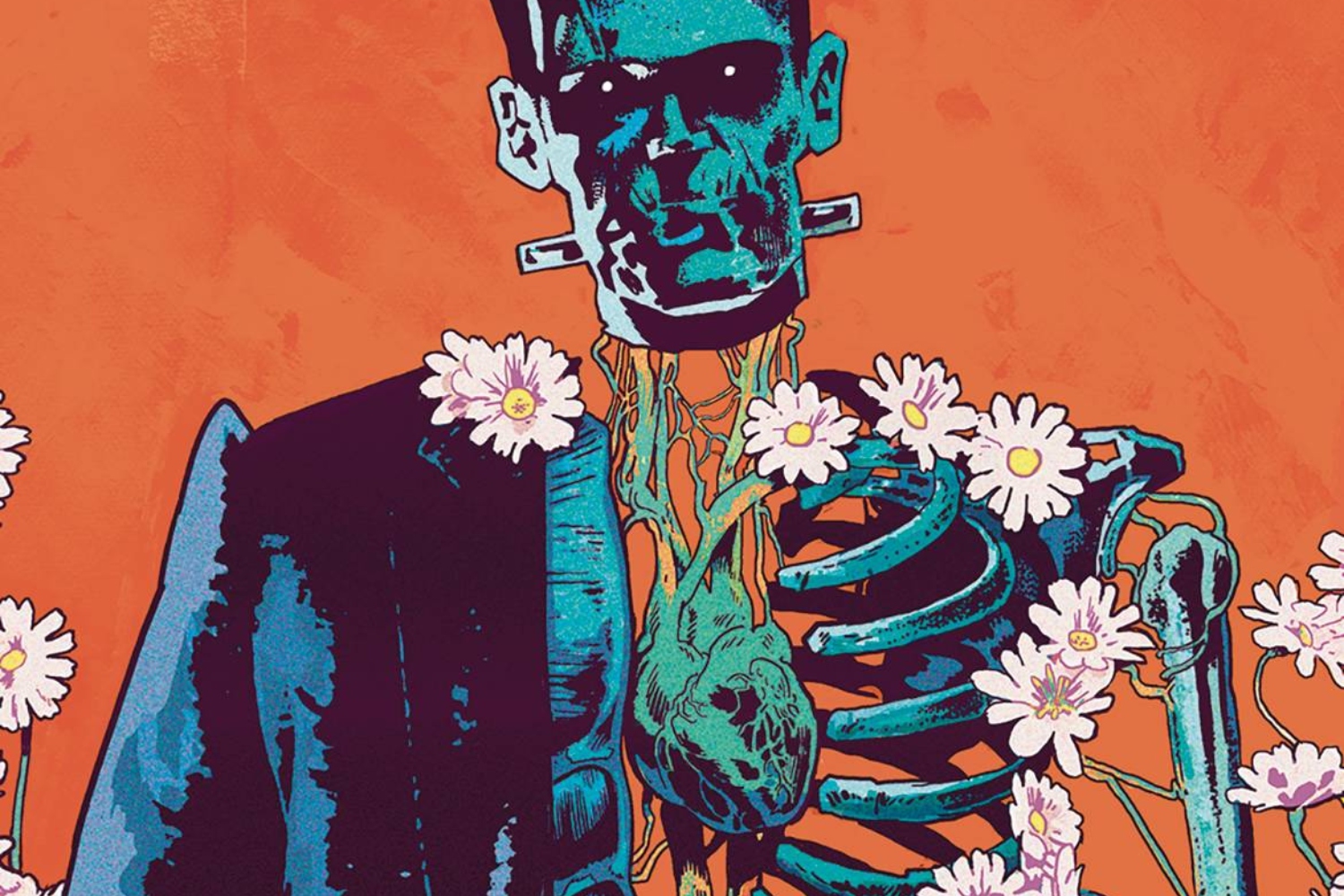

I’m a big fan of Universal Monsters, but so far the comics at Image/Skybound have told an uneven tale. Dracula (from James Tynion IV and Martin Simmonds) was this sensual and powerful retelling of the vampire’s core narrative. However, Creature from the Black Lagoon (from Ram V, Dan Watters, Matthew Roberts, and Dave Stewart) was mostly good if a little uneven in its efforts.
But now we arrive to Universal Monsters: Frankenstein, in which writer-artist Michael Walsh (The Silver Coin) offers up “an electrifying new vision of the horror classic.” So, is Frankenstein another win for the Universal line, or was this monster better left a lifeless mound of body parts?
And while I need more story to truly tell, there’s certainly the spark of a truly lively story.
Perhaps the biggest sign of Frankenstein‘s initial success lies in some of the little details. It seems as if Walsh is fully leaning into the 1931 Frankenstein film (as evidenced by the general aesthetic but also the use of Fritz over Karl or Ygor). And that flick is arguably the most well known in the Frankenstein canon, and that will facilitate a lot of emotional connection even from people with a tertiary love of horror/the creature.
But Walsh isn’t just re-creating a Frankenstein flick; he’s adding to the legacy with a novel new spin. Namely, we see the story play out as focused on a new character, who is connected to the proceedings through a most unlikely device: “one of the body parts used to create the unforgettable monster.”

Variant cover by Joshua Middleton. Courtesy of Image/Skybound.
I don’t want to spoil who the character is, and what said body part may be, but there’s a few big takeaways. One, the body part itself is really interesting, and has a lot of thematic power even if it’s not at all what you may expect. Secondly, it humanizes Frankenstein’s monster in a similarly novel way, and speaks to this idea of how much of who we are is in our bodies or maybe just the mere association of our physical forms. And, lastly, the whole device possibly adds a new layer to the already sickening efforts of Dr. Henry Frankenstein, and further blurs the line between extra motivated scientist and crazed body-snatching supervillain.
Now, yes, these tweaks have a heap of potential as they play out across this four-issue run. At the same time, there’s some threads and tidbits here that do give me actual pause. For one, the depiction of Dr. Frankenstein and Fritz feels a little one-sided (despite the aforementioned layers/blurring), as if they’re simply playing the role of over-exaggerated bad guys. When, as I recall from the 1931 movie, there was at least a slightly sympathetic quality to the “good” doctor, and having that missing so far makes me think we’re sacrificing one interesting character for someone new and untested.
Similarly, I wonder how much of this story can really fill four issues, and if we may be stretching a two-issue (or even a one-shot) tale a little too far. Again, the whole approach is very exciting, but if my readings of the Universal line so far are any indication, doing too much with these monster tales might take away from their inherent force and power. That said, it’s still super early on, and I can move past these given the potential of Frankenstein. But it wouldn’t take much to really diminish this monster’s larger value as this potent exploration of our basic humanity.

Incentive cover by Christian Ward. Courtesy of Image/Skybound.
If there’s at least one area of this book that shines regardless of narrative devices and/or execution, it’s the art (with Walsh joined by colorist Toni-Marie Griffin and letterer Becca Carey). If you’ve read Silver Coin, Walsh’s line work has that same deeply haunted power here — he gives us just enough detail, and balances light and dark, to create these deeply unsettling locations and people.
Walsh’s covers, even, do a really great job of encapsulating the balancing act going on across Frankenstein; it’s about life and death, humanity and monstrosity, and beauty against decay. It’s not quite as obvious within the book itself, but this is a world that has lots of textures and shape to it, and there’s practically a pulse beating throughout. Whether it’s the still sorrow of some decrepit graveyard, or the mad fury of Frankenstein’s laboratory, every new set piece has its own unique feelings and sense of history.
A lot of that is Griffin’s color, which picks the right shades (like a vivid pink sky, which touches on the peculiarity of this place) while very much respecting the singular line work from Walsh that provides so much structure and lays the groundwork for our movements into these unnerving landscape. It’s a place that’s very much real and accessible — even Carey’s letters have this wonderful organic quality — that’s then filled with terrors and horrors alike.

Incentive cover by Francesco Francavilla. Courtesy of Image/Skybound.
That dynamic, then, forces readers to carry themselves/their humanity into this story and then work out how it feels to have it tested so thoroughly and completely. The story very much brings us to the table to get at ideas of who we are and what that means after death. But it’s really the art where we see these ideas come to life in a way that forces us to ask basic questions about what is technically “living,” how our connections to people are shaped by the world, and even how humanity isn’t just for humans.
Are there some downsides visually? Sure, I think the design of Frankenstein’s monster is a little too direct (even as it makes sense to maintain that iconic visage and its connections to the 1931 film). But, again, that’s mostly a small issue, and the creature works because he balances so many ideas and perceptions and that singular look has so much power. And that’s really why Frankenstein #1 is a success enough: there’s a presence and energy working toward something new even as it clearly honors the past.
Whether that new framework can ultimately prove compelling remains to be seen, but the fact that Walsh and company are going for it is what matters already. This series should say something new about this archetype, and even if that insight is ultimately half-cocked, it’ll have some value for recontextualizing this story for our modern times. It’s my hope the story can really do what it intends and not just shuffle into a good enough retelling.




You must be logged in to post a comment Login