

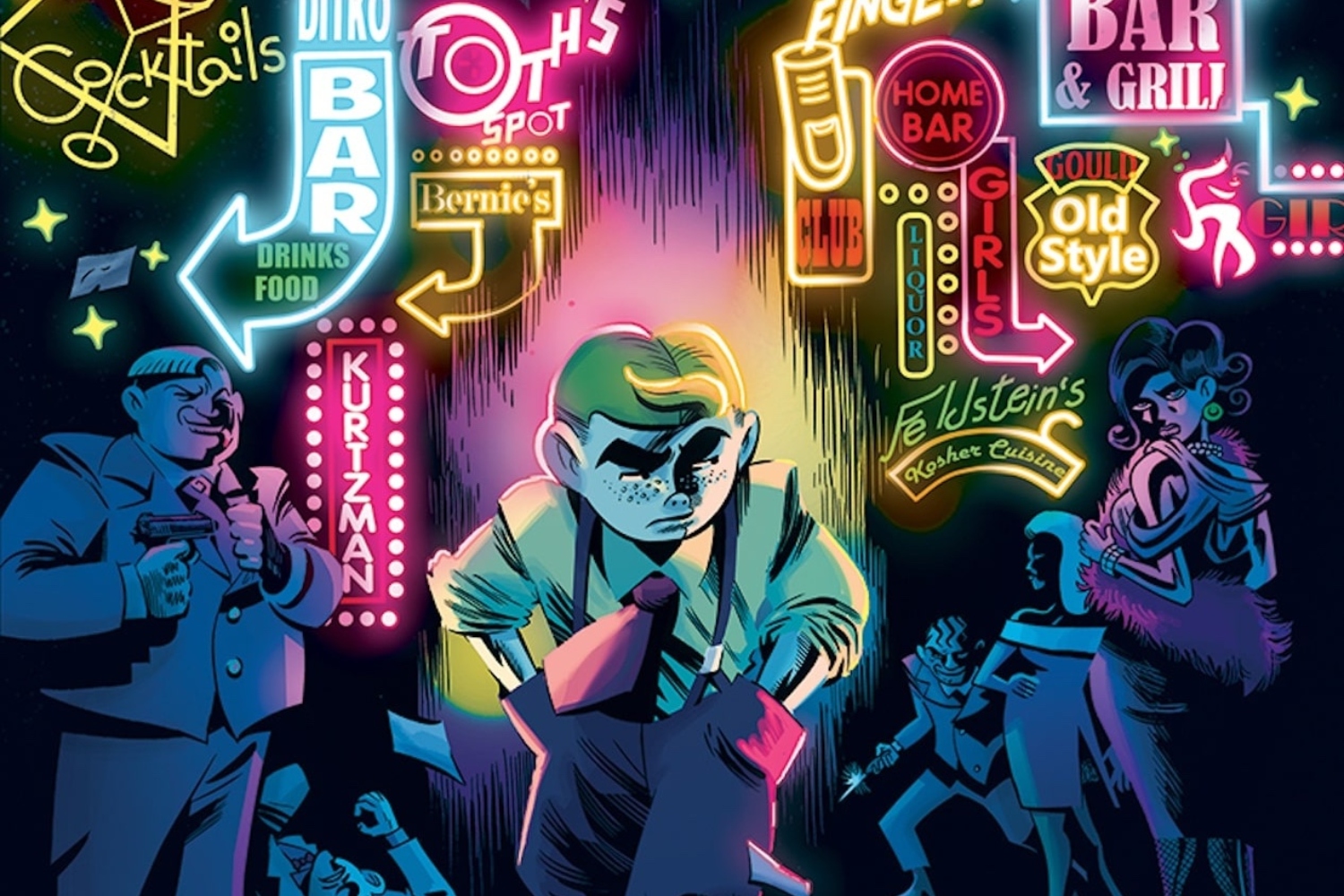

A few months back, we told you that Vault Comics had acquired the licensing rights to Kid Maroon. Created and drawn by the infamous Pep Shepard, Kid Maroon is perhaps the single greatest underground comics character in history.
Or is he?
Because thanks to some deep dives and mostly legal interrogation methods, we “discovered” that the “world’s only hard-boiled boy detective” is actually a modern comics creation from the team of Christopher Cantwell and Victor Santos. And that this series — in which Kid Maroon battles the twin terrors of vice and corruption as well as growing up on the mean streets of Crimeville — is the perpetrator of the greatest hoodwink in recent history.
Or is it?
Because we could just be Pep Shepard detractors. Or, we somehow have access to an alternate universe where Kid Maroon actually is a modern-day comic. Maybe this is all just a giant ruse to comment on our post-truth existence and the subjective nature of reality?! Either way, Cantwell has heaps to say not only about Kid Maroon, but the book’s bizarre “creator,” meta writing and self-awareness, where our good detective lands on the “spectrum of boy heroes,” writing for his own children, and other thoughtful topics and tidbits. Wherever and from whomever this book emerged, Kid Maroon is the best kind of pulp and a testament to the power of truly lively storytelling.
Kid Maroon #1 is due out November 6 (the FOC is Monday, October 7).
Or is it…

“Helmer Cahoon Manga” variant cover. Courtesy of Vault Comics.
AIPT: Where did the idea for Kid Maroon and the “involved” backstory come from? Is this your meta-tinged reaction to comics publishing, marketing campaigns, etc.?
Christopher Cantwell: When I was a kid I saw an Unsolved Mysteries episode — I think the 1989 season — that delved into the mysterious disappearance of cartoonist Pep Shepard.
That said… Kid Maroon is a character that’s been in my own heart as a writer for 20 years. When I was fresh out of college I was living in a studio apartment off Melrose in Los Angeles. I had very little money. I remember not having a full eight quarters to wash my clothes in the building’s machines and crying. But I was still writing and if anything sometimes I’m trying to recapture the raw… whatever… of what I was doing back then. The first thing I wrote in Kid Maroon’s voice was a letter back to his parents expressing regret for divorcing them after events involving his younger partner Billy Beans and his nemesis Hodge Hoskins.
I actually wrote a novel in 2006 about Kid and Billy and Hodge and an older woman Kid was attached to named Willoughby. By then I was living on Venice Beach and had a mattress on the floor and was collecting unemployment. But there it sat until now. But the crystallization was there from the beginning. The novel was unpublished but a firm in New York wanted me to turn it into a YA thing. That missed the whole idea of what I was writing. So I didn’t, and languished as an unknown writer for another 6 years.
AIPT: Similarly, did you have more or equal the amount of fun in dreaming up the story surrounding Pep Shepard as the story/series?
CC: I feel like this question is an insult to Pep Shepard and his legacy. But I’ll indulge you here. Who among us in the deepest end of the comics-loving ocean doesn’t ruminate on the struggles of our biggest heroes? Wally Wood’s apartment building is still in Van Nuys where he died. Jack Cole. The other untold hardships of working in this medium. It boggles the mind and pains the heart.

Courtesy of Vault Comics.
AIPT: Who is Pep Shepard really an amalgamation or stand-in for? And what did that rather sordid backstory do in terms of translating to the actual Kid Maroon story?
CC: Look, pal. Pep Shepard lives in all of us. And Kid, like Pep, is trying to get the world to see him as he really is.
AIPT: I’m wondering if you thought of the Jack Kirby and Bill Finger of the world in writing this? Those folks who were beloved but were victimized to some extent by the industry.
CC: Of course I did. And by the way, this industry still routinely and badly victimizes people to this day. I’m on text threads with several of them and they’re good friends.
AIPT: I love your very self-aware take — this is the first proper book I’ve seen where it’s like, “Why is this child solving crimes” and it still tells a really fun story. Can you have your critical dissections and still eat it too?
CC: Yes, you can. It’s just a question of if anybody likes reading them or not. More than a critique though, this is just adding a bit more reality and stakes to the child detective convention. The story itself and its conceit—bolstered by the art—is entirely sincere. Why do we make our children grow up so fast? And let’s be honest about how most adult life situations even if mundane can sometimes make us want to hide under the bed.

Courtesy of Vault Comics.
AIPT: Where does Kid Maroon land in the spectrum of great adventuring youth — is he closer to Jonny Quest or Bruno The Kid?
CC: No. He’s closer to the kids in the movie Stand By Me I think. Or The Goonies. But he could also go toe-to-toe with Dick Tracy or The Shadow.
AIPT: What was it like working with Victor Santos? He’s got such a vivid, extra pulp-y style with books like Polar.
CC: Victor is incredible at layouts. The work is almost “collage” level but is still visually presented in this perfectly readable, logical way. The story is bolstered by that. It’s not just panel after panel, but it some how flows better. And he brought a real Eisner-like quality to this. Victor lovescomics like me. This is a book for people who love comics and where they come from.
AIPT: As a big fan of your other work, how do you connect this to things like Briar and The Blue Flame? Do you think there’s something about your choice of heroes that says something deeper?
CC: Erm, you tell me. Briar is an arrested teenager who also happens to be over 100 years old. She is terrified of the world as it is now but is courageous enough to face it. In the Blue Flame, Sam Brausam lives in the horrors of the modern world but faces them. All of these characters have a certain naivete and lack of guile. It allows them to be heroic but also gets them into huge trouble.
AIPT: In writing a comic clearly inspired by older titles and storytelling approaches, have you learned anything? Do the stories of yesteryear still work for today? Are our collective preferences all that different?
CC: Maybe this book is written as a memory of an older book, a perfect memory. Listen I have a wonderful collection of old comics, omnibuses by Bill Everett and Carl Burgos. Do I read them cover to cover? No but I fawn over moments. I stare at pages and drama. Like what Mac Raboy did with Captain Marvel Jr. Sometimes there just might be a panel or sequence that stays in your mind forever.

Courtesy of Vault Comics.
AIPT: I think there’s something worth mentioning about this whole approach/campaign happening in the (ugh) age of post-truth. Do you think you’re tapping into that at all — that history/truth can be whatever we write?
CC: In the Blue Flame, the main character says we are sick with stories. And in a sense, we are. I don’t mean that stories are bad. But we use stories to process and order the events of our lives. It is a chaotic time. It is not surprising at least on a psychological level that there are more and more fictions and lies layering on top of each other as people try to make sense of the world around them. Maybe I’ll say it this way. Stories born out of self-preserving fear can really hurt others, and ourselves. Stories made to look at the truth of what happens outside and in have more lasting merit and impact perhaps. Pep Shepard would agree with me.
AIPT: I want to touch more on the meta aspects — I’ve seen a sharp uptick in recent years. What’s the end goal for reaching this kind of inside baseball-level of understanding? Is there a fear of going too deep into this hole and distracting from a good story?
CC: I think it’s insensitive to bring up baseball since Pep Shepard’s own brother was killed by a pitch to the head. Also what parameters do you need to enjoy a good story? What must you be certain of? What rules are there and where are they posted, and where can I get a copy? I think at the end of the day a reader or viewer or listener just has to have faith in the artist. Notice I didn’t say trust. Faith is belief in the absence of fact. Just because you liked the last comic or movie (or hated them) doesn’t mean you won’t like the next. Engaging with art is an act of faith. Not in a religious sense. Just in a “man I don’t know where this is going but I am buckled in for the ride” sense.

Courtesy of Vault Comics.
AIPT: I know you have a couple sons — do you see this as writing something maybe they’d like? Or, perhaps related to that, is this you working out something to do with your own reading habits as a kid?
CC: I have three kids, all of whom are very different from each other and me. They’re not allowed to read this yet, even the 6th grader. Maybe someday. Maybe these books will just be in a box in my house and they’ll have to clear them out when I’m dead. Maybe they will read them, maybe they won’t. As I kid I devoured the most random stuff. But the stuff I loved, I loved. It made me feel less alone. I don’t know if that was the intent behind a lot of it. Maybe it was. But in this story Kid feels alone. And then he doesn’t. I felt and feel alone a lot even though I’m not. I don’t want my kids to feel alone. I don’t want anyone to feel alone.
AIPT: Similarly, is this a commentary about the hellish challenge growing up in 2024, and how hard it is to just be a kid these days?
CC: It’s always been damn near impossible being a kid. The situation just changes in specifics. We only want to be kids when we’re adults, which is both easier and harder. More than being a kid or an adult, being alive is hard. Maybe this story is about that. I don’t know.
AIPT: Do you have plans to tell more stories with/for Shepard and/or the Kid?
CC: Maybe I’ll get into Pep Shepard at some point. That interests me more. Kid’s story is done in this book. It’s contained and I’m happy to leave him here. Until we do volume 2 and decide to take him to outer space.
AIPT: Is there anything else to add about Kid Maroon, Shepard, comics, life, etc.?
CC: Comics and life can still be fun. Hard, impossible, brutal, unflinching, miserable, but also fun. Please look out for more of my hard, impossible, brutal, unflinching, miserable, fun comics.



You must be logged in to post a comment.