

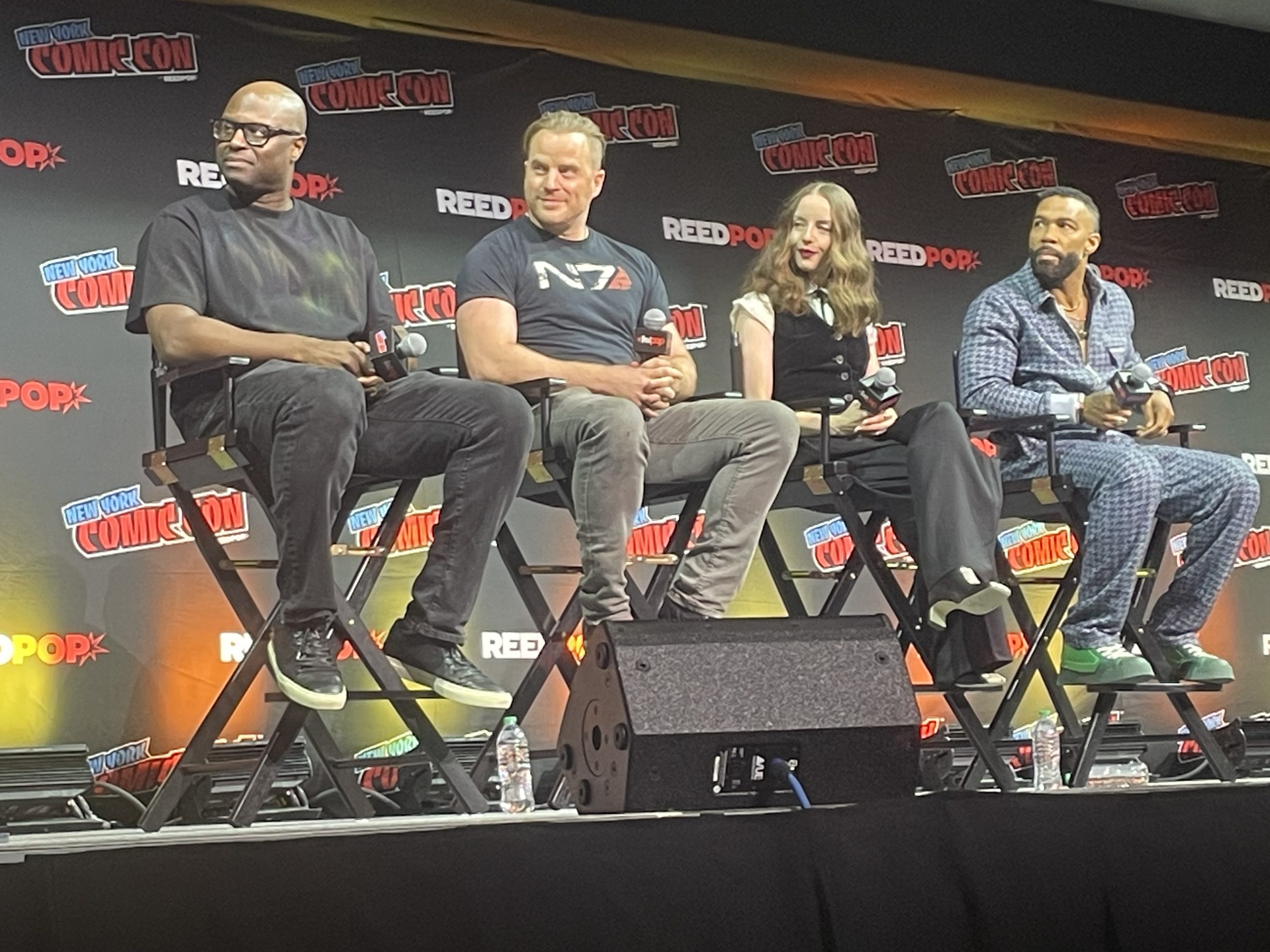

Director Olatunde Osunsanmi and several members of the cast of the upcoming film Star Trek: Section 31 sat down for interviews this weekend at New York Comic Con 2024 to answer questions about the project, which has up until now been, appropriately given its focus on a black ops division within Starfleet, cloaked in much secrecy.
“They are on a mission out on the edge of the galaxy, in an area where Starfleet is not allowed and not able to operate,” said Osunsanmi. The film, he confirmed, will be one complete story that will tie everything together by the end.
Michelle Yeoh’s Empress Philippa Georgiou has been attached as the lead since the project was first announced, though little is known about the new cast of characters filling out Section 31. Actress Kacey Rohl is new to the franchise but is playing a younger version of a character whose name will be recognizable to long-time fans, Rachel Garrett, played by actress Tricia O’Neil in the fan-favorite Star Trek: The Next Generation episode “Yesterday’s Enterprise.” In that story, Garrett was the captain of another Enterprise, the Enterprise-C.
“I definitely watched that episode a bajillion times,” Rohl said. She admitted to feeling the pressure of tackling a role the audience already knows as well as feeling some excitement at the prospect. “I think she did such an amazing job, and it’s cool to have that endpoint.” Rohl said she ultimately decided to make the role her own. “I didn’t want it to be like a mask or a costume that I had on. I wanted to bring my own humanity to it and not feel like I needed to sort of copy what she was doing. So I watched the episode, and I took that as sort of a template, and that will be part of the soup I’m making.”
Rohl said of Garrett’s role within the Section 31 hierarchy: “I think I’m there to watch over things.” She described Garrett as being “very by the book,” but it sounds like she’s a bit more like the one making sure this Section 31 team doesn’t stray too far from Starfleet’s values. Rohl and Osunsanmi agreed Rachel Garrett is on a journey of self-discovery where she’s forced to reconcile between, as Rohl said, “the hard and fast rules of Starfleet are absolutely the right thing to do and where softening some things might work.” Rohl says she wasn’t steeped in Star Trek growing up but that Trek was always referenced as representing an optimistic view of the future.

Photo: Jan Thijs/Paramount+
“Alok is the leader of the group,” Osunsanm said. “He is the team leader. And he’s on a wonderful journey of self-discovery as well, of figuring out who he is and why he’s here. And he’s a veritable badass. And Rob [Kasinsky] is playing Zeph, and he is a guy who has an exoskeleton that allows him to do some pretty incredible things. And he can use the power of the skeleton to manipulate the areas around him. And he’s a lot of fun.”
Omari Hardwick said of the role he portrays, “Alok is a character who runs a very motley crew of individuals who, in their own way and in their own right, are policing all the galaxy. They happen to be specifically on a mission rectifying what Michelle Yeoh’s character has done.”
“Alok is a storied guy who’s been around for a very long time, and he’s having to deal with the pain of his past, but remain optimistic about the future,” Hardwick explained. The character was preserved in a cryo chamber during The Eugenics Wars, a famous moment in Earth’s history in the Star Trek universe. This aspect of the backstory, Hardwick’s co-star Rob Kazinsky said he helped Writer Craig Sweeny develop. If Kacey Rohl was coming into Section 31 as a relative newcomer to Trek then Rob Kazinsky is the opposite, a dedicated fan of the franchise who can meaningfully quote it.
Alok came from a time of great chaos before being cryonically preserved. “It strengthened him, but it also, in many ways, figuratively weakened him,” Hardwick said. “So I need to have empathy for this character, who has been beaten up and beat down and left to make a decision as to whether he’s going to do the same thing to the crew, the band of brothers and sisters he’s brought together, and/or should he stay on the path that Rob always reminded us on set. Star Trek is about morals. Morals, morality, conscience — what side of the line drawn in the sand are you on?”
“Zeph is a very, very hand’s-on, boots on the ground, in the trenches with, on the left side and on the right side of my character, and he does it in such a beautiful, human way,” Hardwick said. “I’m the left hand that crushes while his right hand caresses,” Kazinsky succinctly said of his character in relation to Alok, picking up right where his castmate sitting next to him left off. If Section 31 can translate Hardwick’s and Kazinsky’s actual natural chemistry playing off each other to their characters, it could make for one of Trek’s best duos.

Photo: Sophy Holland/Paramount+
According to Kazinsky, Zeph is paraplegic. “He did it to himself by trying to augment himself, and the suit is his wheelchair. And he’s completely dependent on the suit, which gives the wearer the extra power of strength. And the idea is we really wanted to do a kind of — Obviously, in the future, we’ve moved past debilitating diseases and things like that, but there are still reasons you might need assistance or a wheelchair. And the idea was to be a really positive iteration of what a wheelchair is by it being a suit.”
Kazinsky also said he and Hardwick were given opportunities to improvise some dialogue. “Still staying in the vein of what Star Trek is,” Kazinsky said, “we’re talking about toilets on the spaceship. I know everything about Star Trek. Have you ever seen the toilet?”
Osunsanmi responded to fan concerns over centering a Trek project around an agency operating outside of Starfleet’s usual ethical principles. He acknowledged the spy agency has been a point of contention among Star Trek fans “for understandable reasons.” He continued, “We worked really hard to make sure we kept up the ideals of optimism and kept up the ideals of, you know, what do we want our society to be in the future.”
Rob Kazinsky spoke even more to this at length. “As every Star Trek fan, including myself, doesn’t want Section 31 to exist. I hated them when they came in, hated them all the way through. I was like, we’ve moved past this. That’s the whole point, isn’t it? Haven’t we moved past the idea that this has to exist? And then I come back to The Maquis. I come back to Deep Space Nine. I come back to Sisko, and his wonderful, incredible speech in the episode ‘In the Pale Moonlight.’ He said my favorite line in Star Trek, which is ‘it’s easy to be a saint in paradise.'”
Kazinsky continued with the passion of a fan. “Now the idea is that, sure, we can have the fuckin’ flagship Enterprise going out there and living in this optimistic, utopian universe that they’ve created. And they should. It’s great. But that’s only within The Federation. The whole point of ‘In the Pale Moonlight’ and the whole point of the Maquis was to show what it’s like to be outside The Federation.” For Kazinsky, it’s important to show that the path to achieving The Federation was paved in moral compromises. “The only reason The Federation exists in this optimistic utopian idea was because of Section 31, because of people like us who have built the foundation.”
One of the things, I think, that Alex Kurtzman said really well in continuing this franchise,” Osunsanmi said, “is creating different flavors of Star Trek. You know, we have multiple flavors. And hopefully, the Trek audience loves this flavor.”
Star Trek: Section 31 premieres January 24 on Paramount+.



You must be logged in to post a comment.