

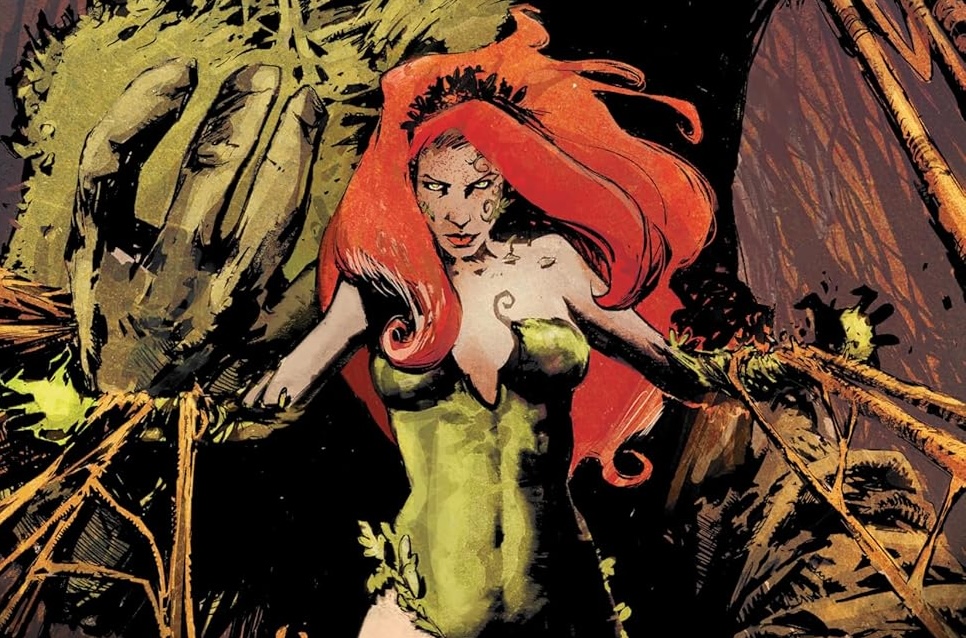

Poison Ivy/Swamp Thing: Feral Trees plays perfectly as a one-and-done horror story, complete with a cold open that would function nicely as a “pre-credits” scare, if this were a classic creature feature. Readers don’t have to be caught up on the current goings-on with either Poison Ivy or Swamp Thing to appreciate the main plot and the poignant character interactions throughout. However, having a working knowledge of these characters will pay off, as the questions this book asks of them enriches the story and adds new layers of pathos to both stars. In this issue, Ivy must once again question how far she’s willing to take her crusade against humanity (after all, the human race includes the love of her life, Harley Quinn), as well as whether or not she could ever truly become one with the Green.
Meanwhile, the story is full of exceptional callbacks to older Swamp Thing comics, including appearances from supporting characters we haven’t seen in decades. Writer G. Willow Wilson does a great job of giving readers just enough exposition that these reappearances feel like more than fan service, all without bogging the story down with too many explanations. Things move at a quick clip here, giving us philosophical arguments and emotionally charged speeches amidst an ever-changing and terrifying environment. One chilling standout moment comes when Ivy interrupts her own train of thought to ask Swamp Thing why the sky has disappeared.

DC
The horror elements are brought to vivid life by one of my favorite penciler/colorist duos in comics. This one-shot reunites the exquisite art team of Mike Perkins and Mike Spicer, who worked in concert to startling effect in The Swamp Thing, a series that felt like the second coming of Vertigo well before the line’s revival was announced. There’s some bloody violence here, but it’s never lingered on in an exploitative way. We see just enough to know that these trees mean business, and the contrasting tones on the surface vs. the underbrush teeming with bodies is enough to make your stomach drop without resorting to blood and guts.
The issue is teeming with small details that make the world feel lived-in, from the horrific vines that have grown through the forests’ victims to Harley’s own key to Ivy’s place sitting cozily in a bedside table dish. In the many dialogue exchanges and flashback sequences that draw the story toward its conclusion, the character acting and body language carries a great deal of emotional weight. I admit to getting choked up during Ivy’s meltdown toward the end of the book.
Perkins can draw Swamp Thing in his sleep at this point, but by no means is he coasting here. We get to see multiple Green avatars in this issue, providing us with fun updates of classic characters and even a slightly different vibe to Swampy himself. Swamp Thing’s body contains some interesting earthy tones, like leaves wilting in the cold, that give the creature an intriguing palette.

DC
Speaking of, I admit to feeling a little bit conflicted by Swamp Thing’s characterization here, particularly as a reader who has loved the character for decades at this point. Wilson gives him a few dry zingers, which nicely fit the uncomfortable energy of the book’s first half. Swamp Thing and Ivy are on unfamiliar ground, and it oddly ratchets up the tension in an interesting way when the typically inscrutable elemental is cracking wise. I also love how this issue embraces the fluidity of DC Comics continuity, giving us a Swamp Thing that has somehow been through everything thrown at him by Alan Moore, Rick Veitch, Nancy Collins, Scott Snyder, and Ram V, and many others. The character comes to the table with a perspective spanning decades of stories and beyond, retaining knowledge of every previous avatar of the Green.
However, this perspective has rendered the character a bit cold. This is undoubtedly necessary to create more of a contrast between Ivy and Swampy and to further explore the thematic elements at the heart of this story, but it also leads to Swamp Thing’s moral compass (if he has one at this point) being called into question. While some of his coldness surprised me, I’d be lying if I said it didn’t serve the story in a compelling way, particularly in how it compares to Ivy’s passionate response. Does Swamp Thing truly always put the Green first, or is this the same character who has commonly held all life sacred? Is he truly unmoved by the heartbreaking finale of the story, or is he playing at being stoic in order to reinforce a “tough love” kind of lesson for Ivy?
These are questions that I’ll be thinking about for some time, and while the characterization isn’t exactly how I typically view the character, it still feels entirely valid within the story Wilson has crafted. Ivy and Swamp Thing are definitely two sides of the same coin: A human woman who feels and bleeds for plant life — but cannot fully turn her back on her human attachments — and a plant who plays at being a man when it suits him. If you’re fond of either or both of these characters, you owe it to yourself to seek out Feral Trees. It’s a fascinating character study that perfectly suits the spooky season.



You must be logged in to post a comment.