

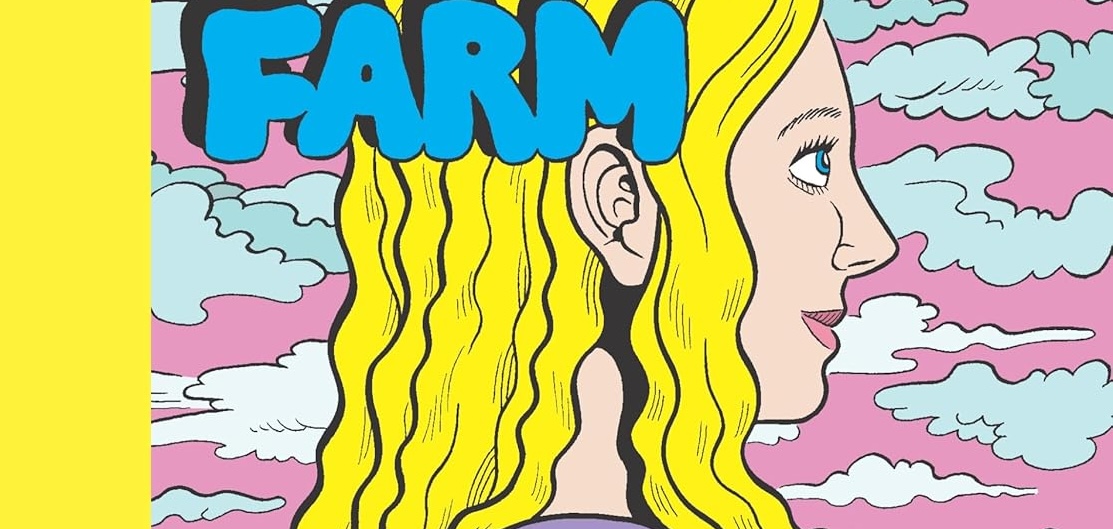

Jessica Farm is, by turns, ramshackle, juvenile, meandering, gruesome, and incredibly horny. I say these things with earnest and delighted affection.
Crafted at the rate of one page every month over the last twenty-four years, Jessica Farm is a project envisioned by an ambitious kid desperate to craft his magnum opus and dreaming big. That youthful naivete shows, not just in the pages crafted two and a half decades ago, but in the very fabric of the narrative; as cartoonist Josh Simmons grows older, more skilled, and more experienced (his comics career has proceeded at a pace of its own outside of this book) the book becomes more adept, more aware of itself, but it doesn’t quite deviate from what it is: a youthful fairy tale on an epic scale.

Fantagraphics
The book follows the titular Jessica Farm on a massive, chaotic journey on Christmas day. That journey introduces us to the bizarre (and occasionally horrifying) denizens of the farm, beginning with a delightful little talking monkey and escalating to, by book’s end, a life-threatening hoard of flesh-rending monsters.
Jessica, at first glance, might be any young fantasy protagonist, a sort of semi-manic Dorothy or Alice, but as the story progresses she matures (much like her creator did, in the real world) into a quasi-competent hero, eagerly sexual and unafraid of the noisome absurdity of her existence. As she progresses from her bedroom, through the farmhouse towers and secret underground caverns, the world opens up; both she and her adventures cease to be limited by their early trappings.

Fantagraphics
If Jessica Farm can be said to resemble anything, it could be compared to the proliferation of webcomics in the early 2000s. So many strips began with simple premises and evolved rapidly into mutli-act epics, crafted by young hobbyists who grew more adept at their craft day-by-day, month-by-month. Much of these graphic evolutions sprang from a sort of lack of foresight by their creators. Strips were created without any direct narrative plan – no outline, no end-point envisioned. As their creators grew, so did their narrative ambitions.

Fantagraphics
Simmons admits to this very inclination in his afterword to this volume: though this book’s conclusion was a vague concept of closure, he resisted the urge to constrain his narrative. Constructed at its own pace, the book becomes a sort of hyperactive sprawl of a story, its movements crafted by momentary whim. An incidental character, Mr Sugarcock, is introduced as the set-up to a gag without a planned punchline, but evolves into a heroic support character – missing the joke completely only to become a party member. Initially naked – an excuse to make a dick joke – he only finds himself clothed nearly 50 pages (or nearly four years of real-world time) later.

Fantagraphics
It’s this sort of unpredictable, insane progression that defines the journey in Jessica Farm, making less an adept story and more a compelling chronicle of the evolving mind of its creator. Though you develop affection for the characters (yes, even Mr Sugarcock) and find yourself invested in all the small pockets of strange inhabitants, the most compelling aspect of the book is its indecipherable, journal-like nature. This is an artist evolving, you realize, a creator becoming. It’s a spectacular thing to witness.
Initially planned to conclude in 2050, this book only represents what Simmons suspects to be the first chapter of a trilogy. This is a monumental achievement that has not yet been fully realized. However muddled and manic the book might be, it feels like a privilege to witness it.




You must be logged in to post a comment.