

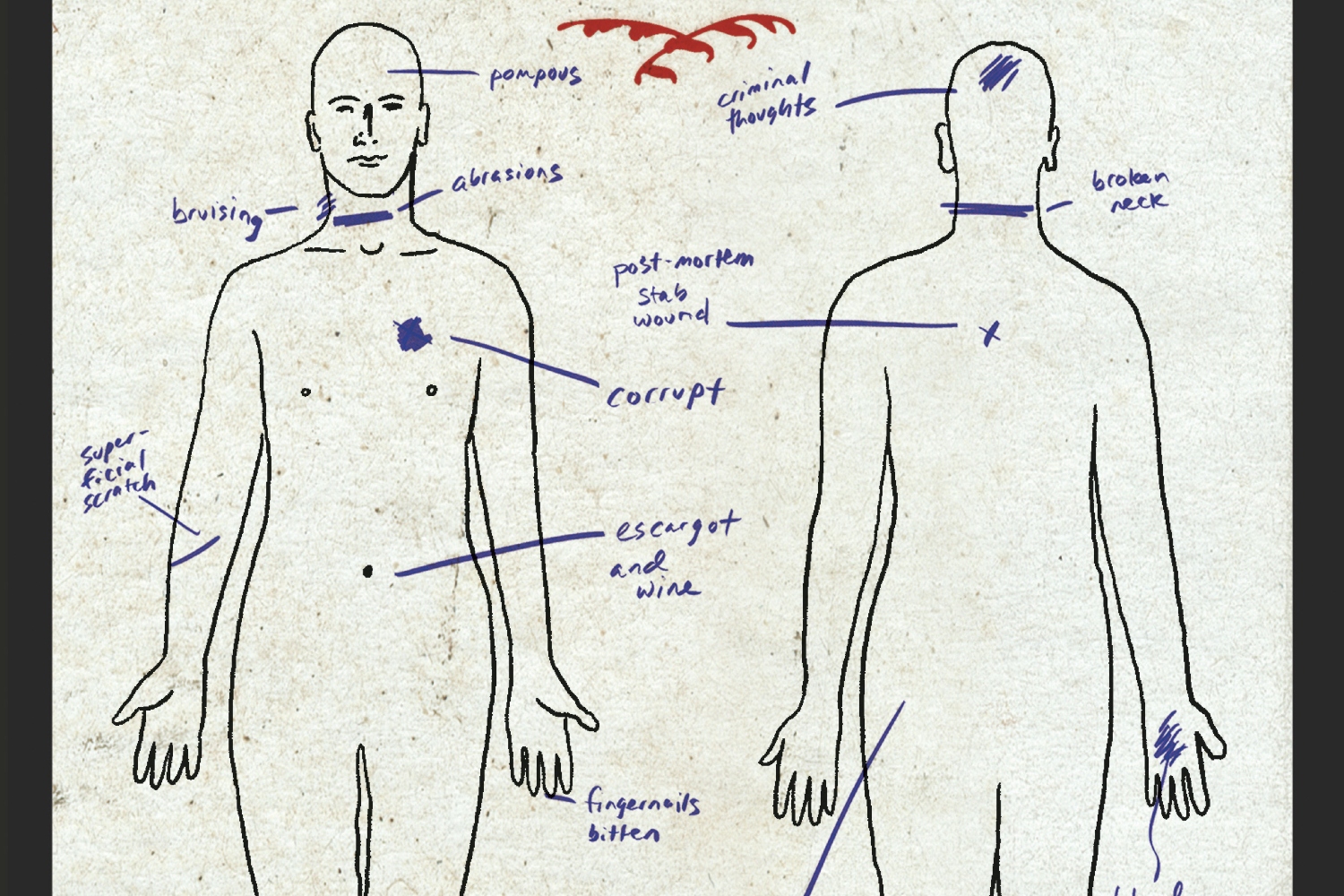

What’s the point of a murder-mystery? To indulge our love of the macabre? To explore some baseline guilt shared by humanity? No, I think the best ones are about engagement — bring the reader in, make them think they’ve got the case cracked, and then, hopefully, pull the rug out from underneath us and reveal some wondrous twist/deviation. In short, to make us feel excited and uneasy in the way all great stories can and should do.
And that’s what Gilt Frame did — mostly.
Because when I worked through issue #1, I believed that Matt and Margie Kindt had given us a kind of Wes Anderson-esque story about an aunt and nephew who solve international mysteries. (And their latest case dealt with a dead Parisian arts dealer and his less than wholesome family.) While I thought issue #2 had deviated from this with an especially cut-and-dry procedural, it was actually only getting us to look left. Because in came issue #3 from the right with the sweet surprise haymaker. Heck, they practically spoiled it with Gilt Frame #3’s solicitation, and I still didn’t really see it coming.

Courtesy of Dark Horse Comics.
Without spoiling too much, Gilt Frame #3 seemingly wraps up the murder of Louis Anouilh, with Inspector Vaillant delivering a masterclass of a speech that ends in an arrest. Except it’s not exactly what the good inspector thought, and that sense of unease and uncertainty is rewarded as we learn the true circumstances behind Anouilh’s death and how it relates to our dashing amateur PIs, Sam and Merry. Not only that, but what happened with their other cases and how all that ultimately informs the very essence of the Sam-Merry relationship.
In a way, even with the irksome detour that remains issue #2, the Kindts have told a story about people. It’s not at all the cute, quirky tale I thought it would be, and therein lies the rub: I came into the story with my own ideas and assumptions, and this mystery quickly dismantled all of that with this intricate, weaving effort that was about, if nothing else, engagement and the relationship between story and audience. Plus, not only do we get some insight into that the Sam-Merry “clan,” but we explore the tenuousness of Anouilh and his family, including his iffy niece Louise and her father, the dumb but brave Mr. Vautour. And, as if we actually needed another layer, it then gets all meta with the Kindt family pulling everyone’s strings. This issue does some damn solid work in revealing the beating heart of humanity underneath the glitz and gore of a proper whodunnit.

Courtesy of Dark Horse Comics.
Digging a shade deeper, Gilt Frame is actually a dissection of family wrapped in the tweed jacket of a murder-mystery. It uses the structural heft and prowess to examine perhaps the biggest mystery of them all: the oddly sturdy bonds we share with our loved ones. How far would we go to protect a family member? What beats at the heart of a relationship between, say, an aunt and nephew? And what happens if that bond is then tested? No matter the layers, or the specific family in focus, this whole book has been a way to understand how families inform so much of our personalities and worldviews. That by testing these relationships/structures in such a way, the Kindts have given us new understanding into something we all share and yet whose structures may look markedly different between respective groups.
Through the excitement and tension of the mystery format, our perspectives are dismantled and we’re allowed to see the way the family structure ripples out into the universe. And when either of those are called into question, you’d be surprised at what people are truly capable of (even to said loved ones).
Now, I don’t want to sell Gilt Frame‘s whole shtick as this absolute genius bit of meta-textual storytelling. There was this nagging sense, starting with Gilt Frame #2 really, that things were either being rushed and/or they felt heavy-handed. Yes, thematically and contextually, the end result lands with heft to really make us think about ourselves and the family structures we inhabit. But along the way you might feel a mix of unease and discomfort — sure, some of that’s the nature of a great mystery/whodunit, but it’s also something deeper. A small part of me that not only picked up on the nature of this winding, twisting story, but that felt pushed and not guided. That’s a teeny but mighty distinction, as the best kinds of these mystery stories walk the reader along the process and not shove them down the hallway.

Courtesy of Dark Horse Comics.
Again, totally loved the final destination, but I can’t entirely shake the thought that the Kindts manhandled us into getting there, hammering out a narrative and engagement “style” that was about overt manipulation and overwhelming readers and not allowing these realizations to dawn on us. By the time the book really unfurls what it’s actually trying to do, you may feel a bit bruised from the road’s big twists and heavy drops. Or, that you got pulled along some movie that missed a few key scenes just to make room for that big show-y set piece at the finale. In short, an imperfect process to get to a generally good destination that’s worth it even as you may still grapple with how you got there in the first place and what that pacing really says about the story.
As much as the Kindts’ approach felt too demanding and overt, I can’t say nearly the same for the art. In Gilt Frame #1 and #2, we really got a chance to marvel at Matt Kindt’s work — few people could’ve created such life and vigor with what’s basically bare-bones doodles like some Parisian art student. And while a lot of that talent and prowess gets lost in the shuffle of issue #3’s narrative feats (or corresponding shortcomings), this really is perhaps the most interesting issue artistically. Not only in how Kindt is able to build this world — from expertly staging a murder to revealing clues/context with grace and power — but in the sheer humanity of it all.

Courtesy of Dark Horse Comics.
We can connect deeply with each character in several instances, and feel their fear, love, anger, etc. in a way that’s as sharp and vivid as ever. Several moments, including as the inspector’s doing his big reveal, will have you feeling sweet, sweet anxiety and even a pop of enthusiasm. You may not notice how big and bold and inventive the world is (you should!), but you will feel that human connection above all else.
And that, dear readers, may be the true secret behind Gilt Frame‘s success: the minutiae of us. The way this book laid bare energies, concepts, and structures that we’re all familiar with, and did so to get us inside this story with an immediacy and intimacy like few others could fully muster. Sure, it wasn’t a perfect process — it felt brutish at times when more efficiency and gentleness was necessary — but you can’t argue with how the end result will make you feel. Like any good crime story, you may wonder at the pure emotionality of this story, and the way it all boils down to something irrevocably human.
This book’s guilty of a lot of things, but one of the best is how it’ll steal away your time and replace it with a calling card of earnest joy.




You must be logged in to post a comment.