

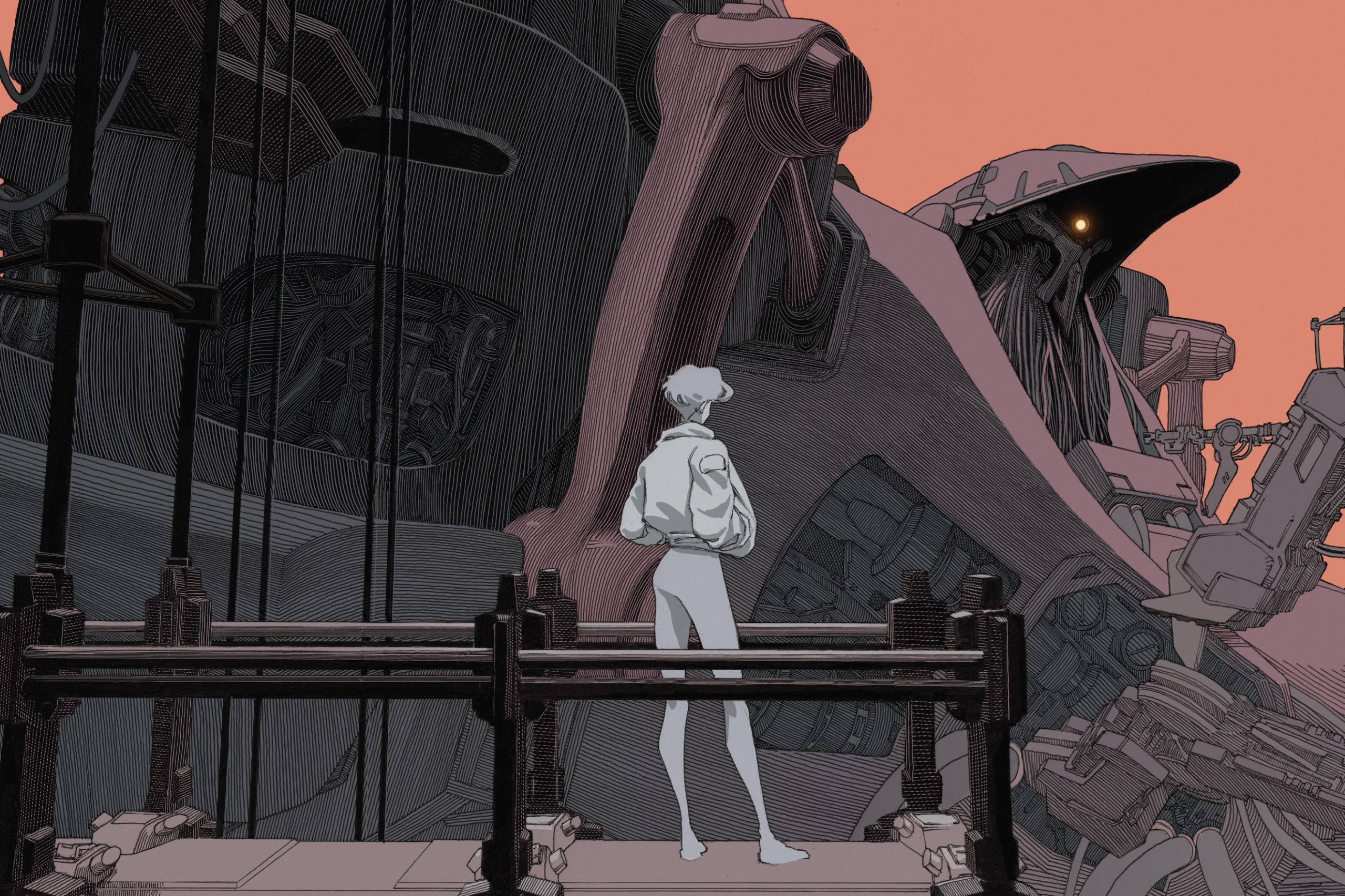

In the world of Dawnrunner, where mechanical giants meet lush landscapes and the boundaries of identity blur, artist Evan Cagle brings a rich tapestry of design and storytelling to life. It’s a series that has stunned with its artistry and creativity, as Cagle (alongside writer Ram V) delivered something truly special.
With the hardcover out today (December 24) in bookstores and comic shops, I had the opportunity to unpack the visuals during a recent conversation with Cagle. Among other insights, Cagle shared the conceptual, artistic, and thematic threads that are woven together this groundbreaking series.
P.S. Be sure to check out Dawnrunner #1, which is free to read exclusively on AIPT!

Courtesy of Dark Horse Comics.
The Genesis of Dawnrunner
For Cagle, the journey began with a cinematic spark.
“My initial visual inspiration came from the 1971 film Le Mans starring Steve McQueen,” said Cagle.
While the final product diverged significantly from those early influences, the creative process was rooted in meticulous research.
“I started with huge folders of reference images — architecture, vehicles, shoes, people, home furnishings, rock formations, color palettes — anything compelling or unexpected,” said Cagle. “This solidified into a loose rule set. Once those rules were in place, the rest was just noodling away on sketches until I settled on final versions.”
One of the most debated aspects of the design process was the Dawnrunner mech itself.
“Ram [V] and I spent a lot of time reviewing color schemes and debating the strengths and weaknesses of a dozen different versions,” said Cagle, showcasing the collaborative effort behind the series’ iconic imagery.
Building a World That Breathes
Cagle’s approach to worldbuilding was both grounded and visionary. Inspired by his time in Los Angeles, where greenery is a status symbol in the desert landscape, he explored the interplay of brutalist architecture and verdant overgrowth in the fictional Moshaus One.
“In the tropical South American region where the city is set, vegetation would be the rule, not the exception,” said Cagle. “Almost all my subsequent decisions about the world design flowed down from that one presumption.”
This careful layering of visual elements gave Dawnrunner its immersive feel, where even the smallest details contribute to the broader narrative.

Courtesy of Dark Horse Comics.
Characters as Storytelling
For Cagle, character design isn’t separate from storytelling — it is storytelling.
“There are tons of visual cues that describe these characters’ personalities and their places in the world,” said Cagle.
From there, he highlighted a poignant scene where Cat, one of the protagonists, visits a hospital. It’s a small but mighty demonstration of Cagle’s efforts.
“She’s slightly done-up, wearing earrings, which we’ve never seen her do before,” said Cagle. “It suggests she might have come from a date or a night out, yet she drops everything to be there for her friend Anita. The next scene, she’s back in her work shirt, exhausted but focused. That shift speaks volumes about who she is.”
As such, even the smallest choices carry weight.
“Lestern, for example, never wears shoes,” said Cagle. “Imagine being so wealthy you don’t feel the need to. What kind of person does that make him?”
Themes Beneath the Surface
At its core, Dawnrunner wrestles with questions of identity, autonomy, and transformation.
“Who are we in relation to others and to ourselves, and where these differ,” said Cagle. “Is one ‘truer’ than the other?”
While no single image or line of dialogue encapsulates these ideas, Cagle employs repetition and subtle visual cues to reinforce them.
“The butterfly motif for Annie is an obvious nod to transformation,” said Cagle. “But even consistent use of color can subtly inform how readers pick up on thematic elements.”

Courtesy of Dark Horse Comics.
Collaboration and Expansion
The partnership between Cagle and writer Ram V was a cornerstone of the project.
“Ram is a bit of an artist himself,” said Cagle. “When we discuss layouts or designs, we trade sketches back and forth to find what works. It’s a truly collaborative process.”
As for the future of Dawnrunner, Cagle sees vast potential from the book and this partnership.
“I’d love to revisit this world in animation or additional comic volumes,” said Cagle. “There’s so much to explore — other stories, other perspectives. Anita and Ichiro are at ground zero of the Tetza conflict, but what about a random mechanic or taxi driver living in the same world? Their stories could be equally compelling.”
A Snack for the Road
In a lighthearted moment, Cagle imagined the perfect snack for his Dawnrunner characters: coca leaf chewing gum.
“It’s got more pep than a sugary snack, keeps you going past your limit, and is very addictive,” said Cagle.
With Dawnrunner, Cagle has crafted a world that’s as visually arresting as it is thematically rich. Through meticulous design, collaborative synergy, and a keen eye for detail, he invites readers to explore a universe where every line and color tells its own story.



You must be logged in to post a comment.