

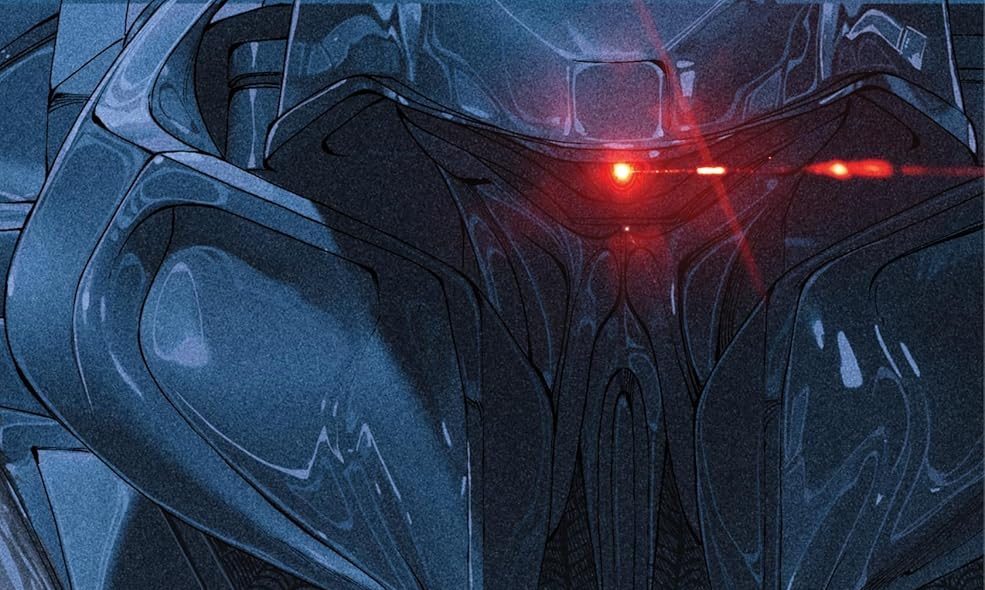

Mecha anime and kaiju cinema are some of the most popular media to come out of Japan. These two things have crossed paths and have made their way to the west, especially during the last decade where we had Guillermo del Toro’s Pacific Rim and Gareth Edwards’ Godzilla. Kaiju and mecha have also crept into comics, with Godzilla appearing in recent titles in both DC and Marvel. Original works that have put their own spin on these genres have also cropped up, including Dark Horse’s Dawnrunner.
Written by Ram V and drawn by Evan Cagle – both of whom would go on to do DC’s current series The New Gods – their first collaboration centers on a world that have been invaded by the Tetza for a century. As more of these giant creatures arrive via portals, the world bends all its effort to build the Iron Kings, great machines driven by pilots that battle the Tetza for humanity’s continued survival in gladiatorial combat. As war becomes more of a sport, star jockey Anita Marr has been chosen to pilot a secret new prototype known as Dawnrunner that could change the tide in humanity’s favor.

Dark Horse Comics
The majority of mecha anime are essentially soap operas where conflicts are often resolved by having giant robots hitting something. As it became more of a formula, series like Neon Genesis Evangelion deconstruct the tropes of the mecha genre, such as what happens to you psychologically when you pilot one of these mechanical beasts. When Anita starts piloting the eponymous mech, she starts seeing past memories from a male soldier who is trying to survive the Tetza war with his two children.
Over the course of five issues, Ram V is exploring a lot of ideas, beginning with a world that seems fixated on making the war into a sport until it gets out of hand. And then there is the emotional core, which Anita’s macro-micro dilemma that juggles saving the world from beasties, taking care of her sick daughter and potentially saving a soldier and his family whose fate has already happened. Five issues are not enough to convey all the ideas that the writer wants, especially during the slightly unwieldy climax where the central mystery and characterization keeps you gripped throughout.
Although the story has more to say than just kaiju battles, it helps that Evan Cagle delivers on that spectacle. Coming from a background in illustrative art, you can see the high level of detail from pages of small paneling to double-page spreads, whether to showcase crowds of people to the futuristic settings. Although you can see the Japanese influence in the design of the Iron Kings and the Tetza, Cagle’s illustrations, colored by Dave Stewart and Francesco Segala, has closer to the work of Geof Darrow, especially in the incredibly-detailed battles where monster guts are spilled.
The storytelling is too unwieldy towards the end, but Dawnrunner plays with the tropes of the mecha-kaiju genres in clever and dramatic ways.




You must be logged in to post a comment.