


“The only reason you’re walking away from this fight alive is because of the choice I am making to let you.”
Coming hot off the tail of Power Girl #15, Leah Williams and Adriana Melo return to the field with a very surprising conclusion to the ‘Ejecta’ arc. With the next installment being the return of David Baldeon as the new series artist, Melo uses this issue as a beautiful and action-heavy departure since joining as a series artist during issue #11.
Since that installment, Melo has worked to subtly redesign the main cast and main villain, Symbio. Alongside that redesign came Ejecta, the violent and technological parallel to the main titular character, who has proven a heavy threat to the series thus far.
Williams and Melo use this as a chance to give an engaging and fun action-filled issue that utilizes each character’s strengths and abilities, whether new or classic.
As a scriptwriter, Williams knows how to write action; ever since her days at the X-offices, she has managed to deliver some of the more chaotic action pieces of the group she’s a part of and makes no exception with this final fight. However, what can be said about Williams and her set pieces, in particular, is the lack of worldly interaction during the fight sequences.
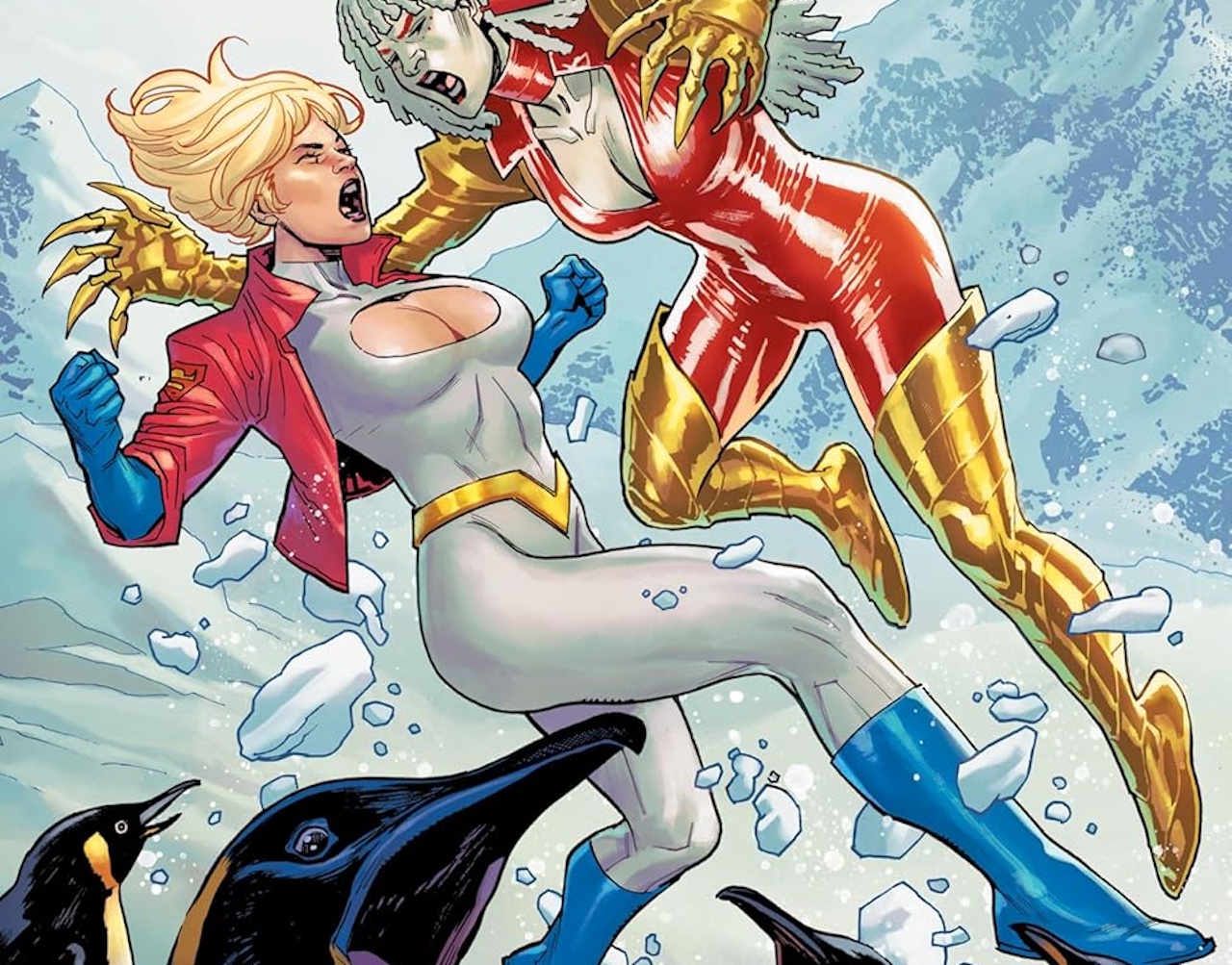
While bringing logic to the story’s main fight taking place around the Fortress of Solitude to avoid collateral, it creates a very barren and isolating atmosphere, which proves to be a double-edged sword that both benefits and muddles the overall action of the story. The personal fight between Ejecta and Power Girl is thrilling, and the story’s focus on the fight being isolated pays off their dynamic thematically with respect to Symbio. However, in a visual language, the fight, while fun, is lacking.

Rumble at the Fortress of Solitude, courtesy of DC Comics. Credit: DC Comics
Thankfully, Williams’ script makes up for the fight with some engaging dialogue between Paige and Ejecta, diving into the messy psyche of each character. The way they’re written comes off almost as estranged sisters, two women raised by the same father, yet only one has a psychological dependence on Symbio while the other doesn’t. It is a character analysis that pays off with Power Girl’s hostility taking center stage in the fight itself.
Something that should be noted with how Power Girl’s hostility is handled is that it feels connected to how her mainline counterpart is often depicted. Her mannerisms, her final speech to Ejecta, and how she overall talks down to her reflect Supergirl’s attitude toward her enemies. As a thematic detail, it strikes strongly due to the underlying themes of the two heroes blending together within the public eye.
All of this is perfectly balanced by Melo’s depiction of high-speed action. What will be missed by Melo’s departure from the series is how well her art complimented Williams and her scripting techniques, as the two often paid homage to many techniques seen by Power Girl creators of the past.
Something to be said about this arc’s conclusion is notably how the two creators take a page from Geoff Johns and use the art to frame Paige’s anger in a way this title hasn’t seen since now. This perfectly opens up a new path to explore with the series going forward.
In conclusion, Power Girl #16 is an engaging yet flawed end to the Ejecta arc. In the far future, readers will be expected to see the return of Ejecta and Symbio, whether it’s in the pages of JSA or continuing to appear in the pages of Power Girl. Until then, Williams and co. ends on a note that fully kicks off the All-In era for the character.



You must be logged in to post a comment.