

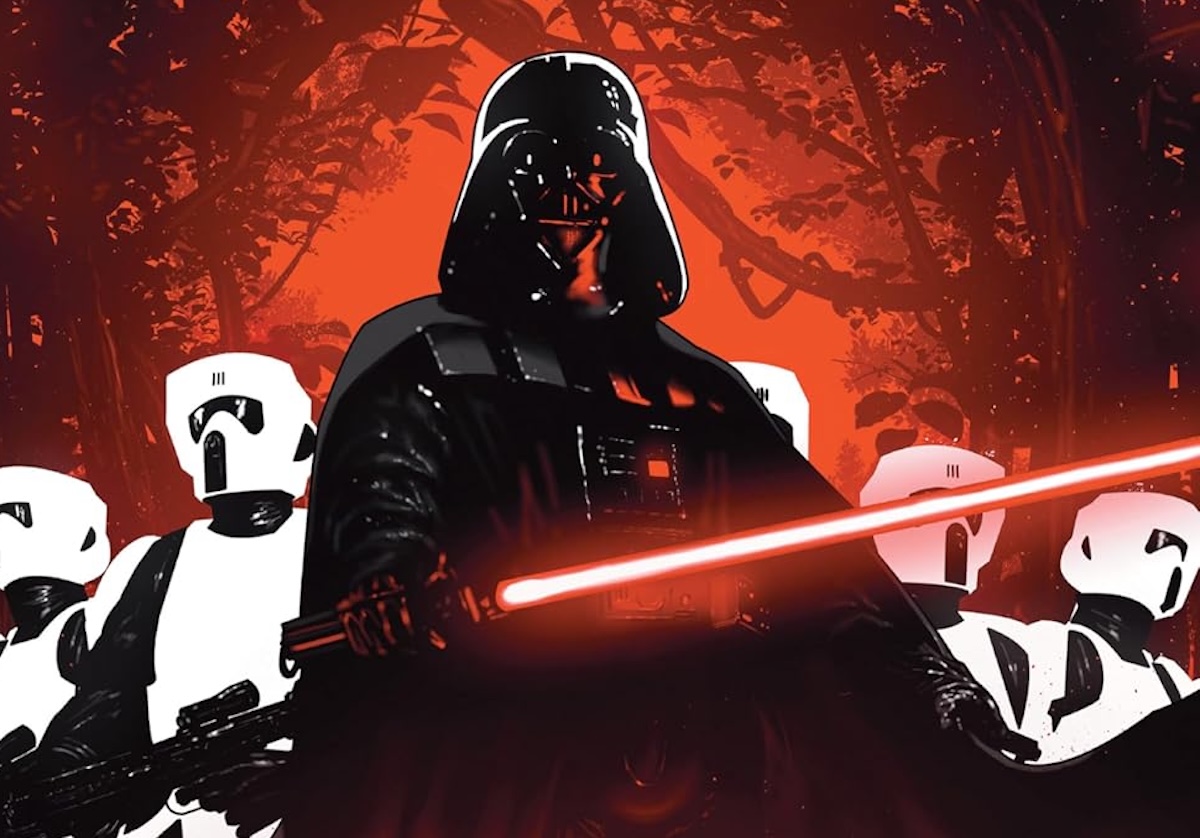

The proliferation of black and white books released by companies that don’t exclusively deal in black and white material generally feels as if they are meant to be celebratory in some way – the reduction of color in all those Batman: Black & White books seemed custom-designed to spotlight both character and artist, to strip away all but the most crucial of elements.
The addition to that trend of single or dual colors – Superman: Red and Blue, Teenage Mutant Ninja Turtles Black, White, and Green, etc, etc – might then be viewed as an exercise in nuance, of adding one single flourish to the barest canvases in comics.
More often than not, however, these books feel as if they miss that celebratory mark and become simple anthology books, proud of a gimmick rather than of exceptional output. Such is the case of Darth Vader – Black, White & Red, which features what feels to be an even split of the exceptional and the average.

Marvel
While the stories themselves do a good job of celebrating Vader – of spotlighting his cruelty, his power, and his mystique – the format of lightly-colored artwork does little to support those stories in ways that black and white (or full color) might do. At its most basic, the book is what it says on the package: black and white art with a little bit of red highlights. At its best – such as the stories by Peach Momoko and Daniel Warren Johnson, who color their own work – the book utilizes its one color as an effective spotlight of story, tone, and atmosphere.

Marvel
It occasionally feels like the book is at a loss for where to put the red, opting to coat the background in pink or dust a faint highlight on the eyes of Vader’s mask – washes of color that might appear in any story, any book, rather than a book meant to use its three colors as the combined forces of an artistic statement. In other places, it becomes the color, an oppressive red that the black and white struggle to find a definition within.
The most obvious use – Vader’s lightsaber – ends up being the best use of the color, most often as the nimbus-like haze around a stark white blade. This is the standard way of illustrating Vader’s saber, but that harkens to the necessity of reinvention of form: we illustrate this blade in such a way because we cannot render it in pen and ink in the way it was captured on screen.

Marvel
If that sort of reinvention could go into more aspects of the artwork – if the blacks and whites were used as profoundly – then perhaps a book could approach the sort of high-minded spotlight works of this style feel best equipped to provide.




You must be logged in to post a comment.