


“Rocks are ice in slow motion, if you think about it.”
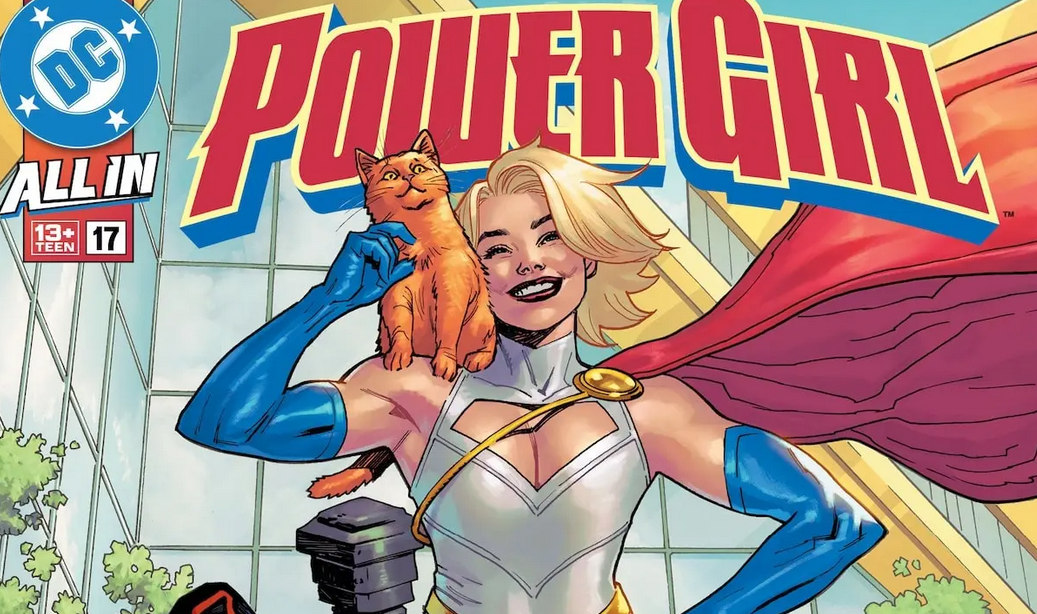
The new era of Power Girl begins as Leah Williams and new series artist David Baldeón properly set the stage for the All In initiative. Readers are greeted to a new home base, a classic rendition on Power Girl’s famous costume, and even a new cast of rogues for Power Girl and co. to do battle with.
Williams has leaned on the comedic storytelling of the series since the beginning, and with Baldeón’s presence, that force is stronger than ever. Script wise, this is Williams’ strongest as of late with smooth transitions between panels and settings that help introduce new faces throughout. However, what especially stands out for Williams is how she reintroduces older concepts such as The Star, formally known as the Daily Star.
The Star has been in Power Girl’s history for years, originally existing as the Golden Age precursor to the Daily Planet, and nodding to Superman’s Canadian roots with inspiration from the Toronto Star. Throughout the years, the concept of The Star evolved from either being a predominantly Earth-Two concept to being rebranded as The Metropolis Star etc. With how Power Girl’s relationship to her Earth-Two past has been explored, this new base is a fitting development.

DC
The name rebrand fits with this new arc’s theme of evolution and development, which there has been plenty of over the course of the run. Paige’s new costume is a modern take on a classic design so naturally, The Star would follow suit, establishing a new status quo for the cast moving forward. This is where the tricky part comes in, the introduction of The Void Three. First introduced in Power Girl #13, The Void Three are a nature-based trio of supervillains of which we have only met two, the first of which is Aquus, a water based entity and second of the Void Three.
As a concept these new rogues are phenomenal and move to fix a long term dilemma of Power Girl lacking a rogues gallery. However, the biggest problem of their introduction comes with the reintroduction of Aquus and admittedly an ongoing problem with Williams’ scripting. Much like series love interest Axel Gust, she was later reintroduced due to a lack of focus on her character. Some of it being intentional until the reveal of her origins of course, but it didn’t feel as natural as it should’ve to sell the new threat.
Aquus deals with the exact same problem, with her reintroduction feeling more definitive than her initial first appearance. If it wasn’t for the editor’s note we see, readers could’ve easily assumed this was her first appearance in the series. Thankfully, Williams manages to balance this out but having the action sequences feel as chaotic and fun as possible. David Baldeón aids in this endeavor with his high-stakes old school cartoon-like approach to comic art. He manages to make the book feel like it’s animated whether with a character’s action scene or a simple expression. He manages to help take the book in the right direction needed creatively to match Leah’s action and comedy sensibilities.

DC
Additionally, Fajardo Jr. delivers some of his best work yet as he molds himself to Baldeón’s pencils. His coloring was always a highlight of the series but truly shines with Baldeón’s linework and visual personality. Together, they are a striking creative duo and a perfect match for Williams and her chaotic storytelling.
All in all, Power Girl #17 is a deeply charming status quo shift that picks up storylines that haven’t had much time to cook, while also pushing the series in a new direction that makes it serve as a good jumping on point for the character.




You must be logged in to post a comment.