

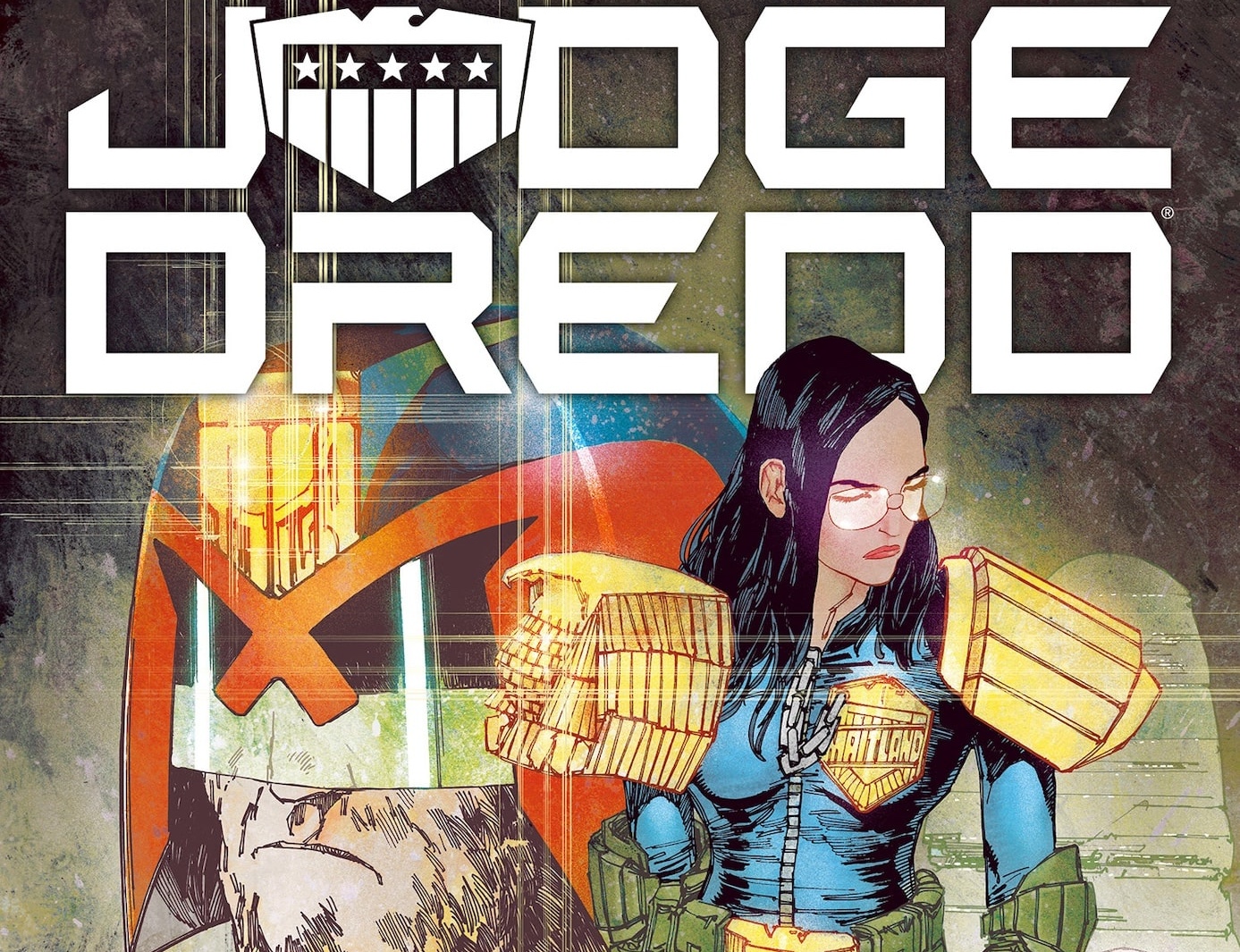

In Judge Dredd: A Better World, co-writers Rob Williams and Arthur Wyatt present readers with a gripping tale that explores themes of reform, systemic oppression, and media manipulation. The new graphic novel is out now.
Set in the sprawling, anarchic landscape of Mega-City One, the graphic novel starkly reflects our modern world, casting a dystopian lens on pressing social and political issues. But what makes this story truly compelling is its ability to pair biting satire with grounded human struggles.
I had the opportunity to speak with Williams and Wyatt about the inspirations behind their work, the challenges of balancing satire with storytelling, and how their latest graphic novel builds on the legacy of Judge Dredd while addressing some of the most pressing issues of our time.

Tackling Reform in Mega-City One
At the heart of A Better World lies the bold vision of Judge Maitland, a reformist who dares to challenge the deeply entrenched authoritarianism of the Justice Department. Maitland proposes reallocating resources from militarization to education and rehabilitation—a notion that strikes a nerve in the perpetually chaotic Mega-City One. For Williams, this premise springs from the essence of science fiction itself.
“Judge Dredd is, essentially, science fiction,” Williams explains. “And all the best sci-fi looks at what’s going on in the world around us right now and expands those themes. We’re dealing with media control, authoritarianism, and the pursuit of power—subjects that are heavily pertinent for us today.”
Wyatt, on the other hand, drew direct inspiration from recent history, particularly the 2020 protests. “A lot of A Better World comes out of watching people propose solutions during the protests, only to see those ideas brutally stamped out,” Wyatt recalls. “Translating that into Dredd’s world felt natural—it’s a hyper-realist playground for exploring these themes.”

Courtesy Rebellion
Judge Maitland: The Pragmatic Reformist
Judge Maitland is a fascinating character—equal parts idealist and realist. Her reformist ideals are not born of sentimentality but cold, hard data. “Maitland is an Accounts Judge who 100% believes in the purity of numbers,” Williams explains. “She sees that by taking money away from weaponry and putting it into social reforms, crime numbers go down. It’s not about being a bleeding heart; it’s about being practical.”
Wyatt elaborates on Maitland’s dynamic with Dredd, emphasizing her credibility as a cornerstone of the story. “She has to be someone Dredd trusts for the story to work. Nothing she says is something he’d naturally support, but he knows she knows her stuff.”
The meticulous grounding of Maitland’s arguments in practicality is part of what makes her vision so compelling. It’s a subtle yet powerful critique of the excuses authoritarian systems make for perpetuating the status quo.
Media Manipulation and Oligarchs
Another key thread in the narrative is media manipulation, embodied by Robert Glenn, a media mogul whose tactics mirror those of real-world oligarchs. “Glenn pushes division and hatred to stir up the population,” Williams notes. The more chaos he creates, the more his share price rises. He’s the defender of the ‘ordinary man’—all while those same people are victims of the riots he incites.”
Wyatt hints that Glenn’s storyline will continue to evolve. “We’ve seen a little of this in follow-up stories like ‘Soft,’ and there’s more to come.”


The Art of Mega-City One
The visual storytelling in A Better World elevates the narrative to new heights. Artists Henry Flint, Boo Cook, and Jake Lynch each brought their unique styles to the project. However, Williams singles out Flint’s contributions as particularly extraordinary.
“Henry is one of the great talents of modern comics,” Williams says. “His storytelling is impeccable. He broke traditional panel layouts into incremental acting beats—12, 13, 14 panels per page—creating something truly beautiful.”
A Reflection of Today’s Challenges
Despite its futuristic setting, A Better World feels eerily timely, especially given recent political developments. Williams and Wyatt intentionally crafted a story that speaks to our current struggles with systemic inequality and the abuse of power.
“Vested power structures tend to hold the line, whether it’s in America, the UK, or Mega-City One,” Williams observes. “The hope comes from the fact that there are good people out there trying to make a difference.”
Wyatt agrees, adding, “Even proposing an alternative to the status quo is a radical act.”

Courtesy Rebellion
A Legacy Among Dredd Classics
Comparisons to America, one of the most celebrated Judge Dredd stories, are inevitable. Yet A Better World stands apart as a thoroughly modern tale that challenges foundational assumptions about Dredd’s world. “America is one of John Wagner’s classics, and we’d be lying if we said we weren’t influenced by it,” Williams admits. “But A Better World is very much a graphic novel for today.”
A Message of Hope Amid the Grim
Ultimately, A Better World is as much about the possibility of change as it is about the grim realities of Mega-City One. As Maitland’s campaign slogan—suggested half-jokingly by Wyatt—proclaims, “A better world is possible.” Whether or not that better world comes to pass in the pages of Judge Dredd, the graphic novel leaves readers questioning how much of it is already within their grasp.


For anyone seeking a hard-hitting, visually stunning story that dares to imagine change in an unrelenting dystopia, Judge Dredd: A Better World is not to be missed.



You must be logged in to post a comment.