

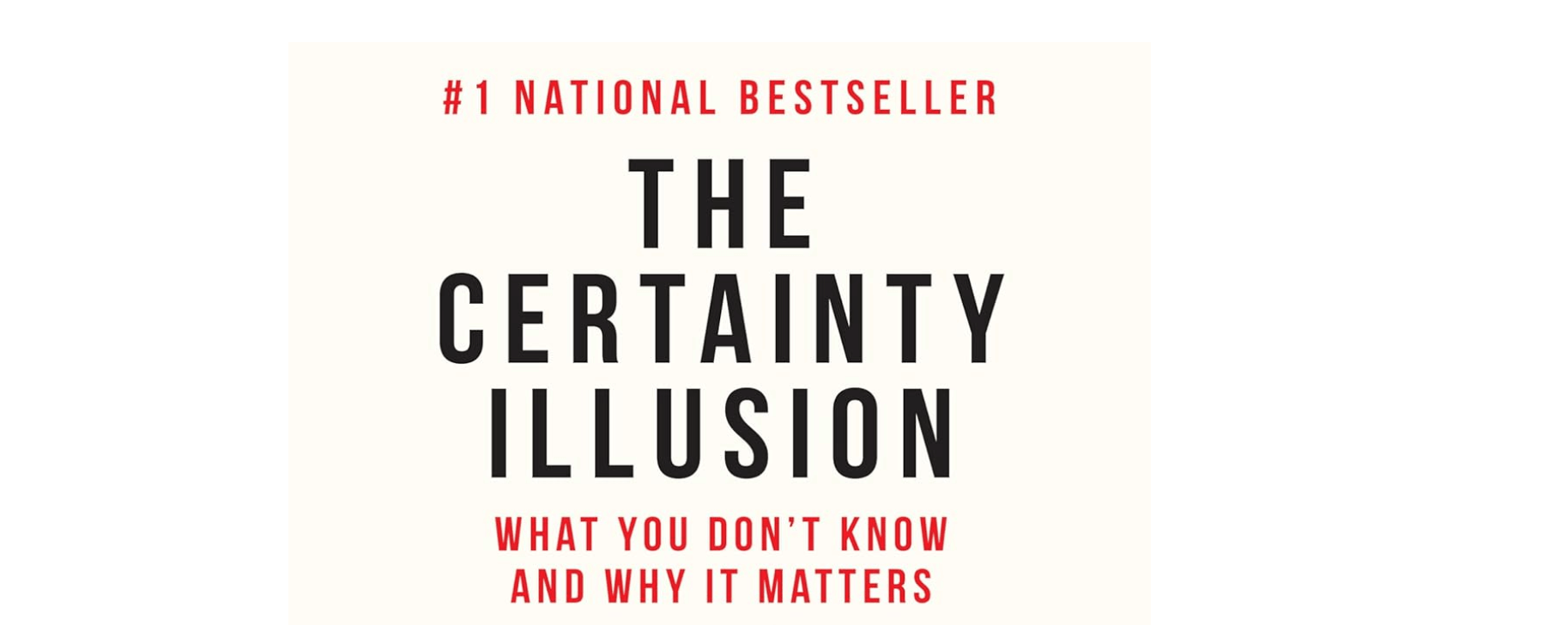

In the introduction to Timothy Caulfield’s book The Certainty Illusion: What You Don’t Know and Why It Matters, the author asks:
“What if I told you the problem wasn’t simply that our information ecosystem isn’t providing us with reliable information? What if I told you it has become rigged to promote information chaos? What if I told you it has become incentivized to deceive us? The question is: how did we get here? And much more urgently: how do we get out of this mess?”
When presented with an optical illusion, such as a mirage on a distant horizon, or a drawing that plays with our depth perception, how do you know it’s an illusion? The Certainty Illusion helps us identify such things in science, goodness, and opinion, so we’re not led astray so easily.
According to Caulfield, studies show that “science-y jargon helps to create an illusion of certainty,” which he calls the science illusion. Of course, I just said “studies show,” so perhaps I’m engaging in the science illusion myself. Does Caulfield have good data to back these claims up? He does reference many studies, listed on pages 242-295. If we estimate about seven references per page, then that’s about 371 total references!
In part two of The Certainty Illusion, Caulfield defines the goodness illusion as “exploiting our desire to achieve an evidence-informed virtuous goal,” and goes to great lengths dispelling the myth of the “health halo.” While the science illusion plays a part in how these things are perceived, the goodness illusion acts differently, by implying that the product is more virtuous or “cleaner.”
It’s actually a moral argument. This organic food is natural, therefore it’s better. End of discussion. But what does natural even mean? As The Certainty Illusion points out, many research studies find that participants have better feelings about products that exhibit the health halo, even convincing themselves that those foods are tastier. Yet, many blinded studies show that participants can’t tell the difference between, for example, the taste of an organic apple slice and a conventional apple slice. Or that organic potato chips can be just as unhealthy as conventional potato chips.

Caulfield surprisingly extends the goodness illusion to ancient aliens and toxic masculinity. “It turns out that, on average, as compared to scientifically accurate content, misinformation is easier to process, more emotional, scarier, and focused on morality,” he writes. “A claim that there is an urgent need to irradiate your balls to save your manliness and the entire free world seems to fit this formula pretty well.”
The opinion illusion is the third part of Caulfield’s The Certainty Illusion. It’s a fairly straightforward idea related to the ad populum informal logical fallacy. Namely, that we are increasingly swayed by collections of anecdotes, such as online reviews. Studies show (there’s that phrase again!) a number of deleterious biases and reasons to be highly skeptical of online reviews, even in aggregate. We’ve all bought something on Amazon based on the reviews, and found the delivered product underwhelming.
That might sound trivial, but Caulfield’s point is important. How about that cancer treatment facility? Well, it has a 4.4-star average rating, and one reviewer says they cured their cancer! Never mind that the treatment is bogus and the doctors lack credentials. Even worse, Caulfield points out that it’s nearly impossible to reliably spot fake reviews. This reminded me of Maria Konnikova’s conclusion to her book The Confidence Game, which says it’s nearly impossible to reliably spot a con. It’s always some other dupe who gets conned, not me!
In the final chapter of The Certainty Illusion, Caulfield astoundingly claims to have the fundamental solution: “fix the way that science is funded, done, and communicated”. He builds a reasonable argument, but in the end it’s less certain this is the fundamental fix. The question remains: how can we do that? Caulfield notes many different reforms that can be implemented, but they’re numerous and require coordination, lots of work, and money to implement.
This is why Caulfield himself calls his fix a “cheat.” It’s very easy to suggest such far-reaching reforms, but it’s far harder to implement them. With a presidential administration firing bureaucrats explicitly because they say their expertise is a waste, it’s not clear that society, at least in the U.S., will welcome experts trying to reform science. “Let your local and federal politicians know you want action!” Caulfield writes on page 74. We should all do that, but it’s hard to imagine DOGE or RFK Jr. are going to get right on it.
The Certainty Illusion is recommended for two groups of people. First, to people who are coming to understand misinformation and manipulation who haven’t encountered a diverse set of examples before. The book is excellent as a tool that shows how to dissect claims and what kinds of things to look out for, in general. You might also learn new facts and details about popular pseudosciences. Second, to people who’ve already heard all or most of these things, but would genuinely enjoy hearing them again, all in one place.
The dilemma of science advocates and communicators is that we recommend listening to the scientific consensus, but we have to point out that a lot of science is biased, hyped, published in predatory journals, or of poor quality. The Certainty Illusion does a fantastic job pointing out the large-scale problems, while simultaneously making some impractical recommendations for the average person.
AIPT Science is co-presented by AIPT and the New York City Skeptics.



You must be logged in to post a comment.