

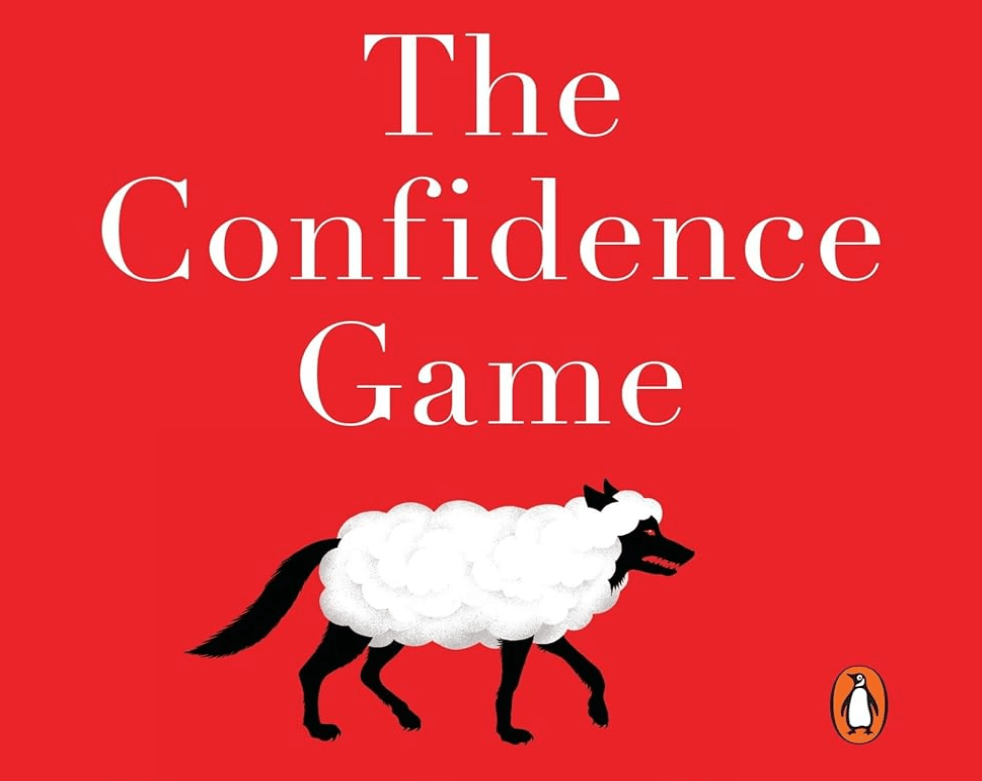

The Confidence Game: Why We Fall for It … Every Time by Maria Konnikova is an interesting mix of stories, psychological studies, and reflection on what makes a con artist, and what kinds of tricks they use. One of its key lessons is that human nature is complex and varied. We can tell just-so stories about human behavior, but the reality is rarely so clear cut.
According to Konnikova, three traits make up a con artist’s psychology: psychopathy, narcissism, and Machiavellianism. However, you might immediately notice that not everyone who has these traits is a con artist. There are plenty of egotistical narcissists who never attempt to con or defraud someone.
So what might lead someone with those traits to perpetrate fraud? The Confidence Game says that for a person to turn to con artistry, their motivation (including the aforementioned three traits), an opportunity, and a plausible rationale all need to align. Of course, you might guess that someone working in finance with early access to initial public offering information, if they felt so inclined, might commit some form of securities fraud. I’m sure you can imagine many examples of crimes of opportunity across a wide range of professions.

The Confidence Game intersperses stories of con artists throughout, and Konnikova’s discussion of motivations coincides with her story of the Great Impostor, Fred Demara. She says that when Demara was a child he would pray that he would not be poor anymore. Thus, she wonders if trauma can be what leads some people to con artistry. Konnikova laer brings evolution into it, and wonders if there is an evolutionary psychology principle underlying the desire to con.
If we know the traits and have loose ideas of what might lead someone to be a con artist, then can we spot one in a lie? The Confidence Game argues that all the behaviors people associate with con artists and liars are not accurate at all. Studies show that 95% of people can’t do better than chance at guessing whether someone is lying or not, regardless of what “tell” they look for. The other 5% might be able to if they’re experts in microexpressions. But even then, the con artists and liars who are truly comfortable lying can’t be found out in this way.
If we can’t tell who a con artist is, then maybe we can tell something about their success based on the traits of the people they con. The fact is, we often don’t have time to investigate every claim or deal with normal activities in a slow, careful manner. Indeed, in our modern culture where we’re always told “there’s an app for that,” it’s hard not to rush through things. But is there something fundamental that runs through all successful cons?
The Confidence Game brings up a study on a college swim team. The swimmers were given tests to determine how realistically they perceived themselves, and then their performance in competition was measured. “It wasn’t the people who saw the world most clearly who did best; it was, rather, those most skilled at the art of seeing the world as they wanted it to be. And the world-as-we-want-it-to-be is precisely what the con artist sells.” The best con artists, and the ones who perpetrate long cons, seem ultimately to rely on their targets’ hope.
Many of these points may not seem all that surprising. Pundits have pointed out that a politician who delivers on their promises to their hopeful constituents is a hero, while one who fails is a liar and a cheat. The same could be said for business founders (especially in tech startups over the last couple of decades) who over-promise and then under-deliver. Are they frauds or did they simply make the wrong bet?
Interestingly, it can be difficult, to tell even in cases like purported psychics. While the science is pretty clear that psychics don’t know something the rest of us don’t, what’s less clear is how to treat “psychics” who rely on their services as a source of income. Has the psychic deluded themselves as much as the people they fool into giving them money?
The Confidence Game: Why We Fall for It … Every Time weaves some fascinating stories of cons and psychological studies together to produce a tantalizing narrative, which doesn’t lead to enlightenment so much as it reminds us that some people thrive in the gray areas of life, and sometimes, unfortunately, that can lead to crime and people getting hurt.
Every February, to help celebrate Darwin Day, the Science section of AIPT cranks up the critical thinking for SKEPTICISM MONTH! Skepticism is an approach to evaluating claims that emphasizes evidence and applies the tools of science. All month we’ll be highlighting skepticism in pop culture, and skepticism *OF* pop culture.
AIPT Science is co-presented by AIPT and the New York City Skeptics.



You must be logged in to post a comment.