

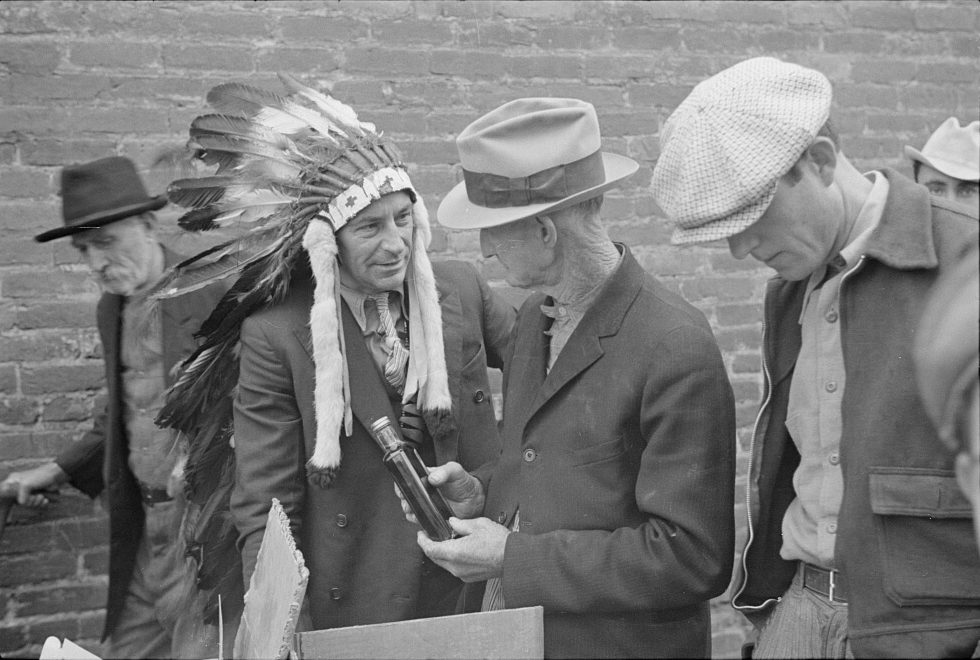

In September of 1881, a pair of peculiar characters appeared on the street in Stockton, California, selling medicine from a wagon:
“‘Yellowstone Kit,’ a slender man with long hair dressed in the Buffalo Bill style, and displaying three yards of watch chain from his leather belt, stood in a carriage on the opposite corner as aid-de-campe to a jolly fat man who was extolling the merits of Yellowstone Kit’s new Indian remedy, ‘Hokey-Pokey,’ warranted to cure all diseases known to the human family by its subtle and mysterious action on upon the kidneys, liver, and lungs. In order to make his address interesting he exhibited a two-foot bowie knife with which ‘Kit’ had slaughtered an immense grizzly in the Yellowstone country after Kit had three ribs and an arm broken. There were 500 people around this carriage at one time last night and sales were correspondingly brisk.”
This display is an example of the America medicine show, a popular form of American entertainment from the end of the Civil War through to the Great Depression. Here a reporter for The Evening Mail helpfully identifies the inspiration behind an Indian-themed medicine shows like Kit’s: William “Buffalo Bill” Cody, who was a symbol of heroism, derring-do, and manliness in the American mind, thanks to popular novels which dramatized his exploits as a scout and borderman. By the time Cody started his own Wild West show in 1883, western-themed medicine shows were already crisscrossing the country, helmed by characters like Yellowstone Kit.
A typical medicine show would set up in an open lot, erect a stage, plaster the town with announcements, and fill the papers with advertisements. Shows that anticipated longer runs might rent a theater. Small shows of just a few people might set up a platform on a sidewalk and attract their crowds with a “ballyhoo,” some sort of novelty, like a display of exotic animals, an attention-grabbing stunt or magic. Once a crowd had gathered, the medicine worker would segue into his sales pitch.
Larger aggregations tended to put on variety shows with comedic and dramatic sketches, blackface, and music, and sold their medicine between acts. Yellowstone Kit toured for years with a Japanese magician (and former child-star) known as “Little Allright,” a band of black musicians, and a contortionist, Herbe “The Spanish Wonder” Norman.

One of the most popular shows was the Kickapoo Indian Medicine Company, which was established the same year that Kit arrived in California, 1881. The two principals of the company, “Texas Charlie” Bigelow and John Healey, were experienced traveling medicine men by the time they struck up the idea of a brew they called “Indian Sagwa.” The Kickapoo idea, as historian Brooks McNamara called it, was that they’d bring some indigenous people on the road, who would brew Sagwa in the background of the stage or in a teepee. They’d perform traditional dances and ceremonies, while the white men posed as “Indian agents” who were merely bottling Sagwa for the Kickapoo tribespeople. Only the Kickapoo knew the whole recipe, the agents said, because it included a special element that allowed it to defy chemical analysis.
The problem is that it was pure bunk. “Sagwa” was a word that Healy and Bigelow invented, there were no Kickapoo in the show or associated with the enterprise, and one or two of the natives were in fact natives of Ireland or Italy. Other than that, it was completely above board. By packing their shows and traveling Indian encampments with artifacts and natives, Healy and Bigelow could sell the show as a sort of authentic educational experience.
A different tack was taken by the Hamlin Oil Company, who marketed and deployed entertainment teams to promote Hamlin’s Wizard Oil. John Hamlin, the company’s founder, innovated by mass producing respectable touring shows. He set strict guidelines for dress and behavior for his touring companies. McNamara points out that every sales unit was uniform: a four- or six-horse carriage that expanded into a stage with a driver, a lecturer, and a four-piece brass band that also sang. You knew what you were getting when a Hamlin show rolled into town.
These groups primarily stocked pharmacy shelves with Hamlin products — liver pills, cough remedies, and their liniment — and they generated interest in the product by holding public shows. The band’s services were also donated to charity fundraisers and church choirs, so Hamlin’s traveling shows were welcomed by most communities. Yellowstone Kit, when he struck out on his own across the American south in the 1880s, loaned his musicians out to charitable institutions and used conspicuous charity as a mode of garnering the favor of communities.

Library of Congress
Not all towns were open to medicine shows, though, and licenses (known as “readers”) could be hard to procure or prohibitively expensive for small operators. Opposition to the shows was based on the fact that medicine shows sold bunk remedies and often took money from sick people and the worried well. Traveling shows were widely seen to be taking sales away from local pharmacists, too, and removing that money from the local economy. The shows might be loud and the crowds could be obstructively large, leading to the frequent charge they were simply a nuisance. Nonetheless, while city elders and newspaper editors often found much to criticize the medicine shows for, they remained very popular.
Medicine shows, it turns out, were very important in shaping modern American popular culture. The performers tended to have large repertoires and a variety of skills; in order to draw crowds to one venue for several nights in a row, they often had to put on a different program for each performance. Medicine workers went to where the money was, taking their shows into small towns and the countryside. They picked up performers from those communities constantly, and spread regional musical traditions around the rest of the country.
In so doing, they cultivated a national song book, a common folk culture. Many of the innovators of blues, jazz, and country music got their start on the medicine show stage, as did performers on the Vaudeville circuit, who brought the comedic skits and songs they’d learned in the med shows to other mediums, like radio and film.
Medicine shows also pioneered the format of free American popular entertainment. Specifically, you get entertained, then you watch a commercial, then you get entertained some more, and then you get another commercial. The format that now funds radio, television, and YouTube all started in the largely bunk-filled medicine shows.
Every February, to help celebrate Darwin Day, the Science section of AIPT cranks up the critical thinking for SKEPTICISM MONTH! Skepticism is an approach to evaluating claims that emphasizes evidence and applies the tools of science. All month we’ll be highlighting skepticism in pop culture, and skepticism *OF* pop culture.
AIPT Science is co-presented by AIPT and the New York City Skeptics.



You must be logged in to post a comment.