

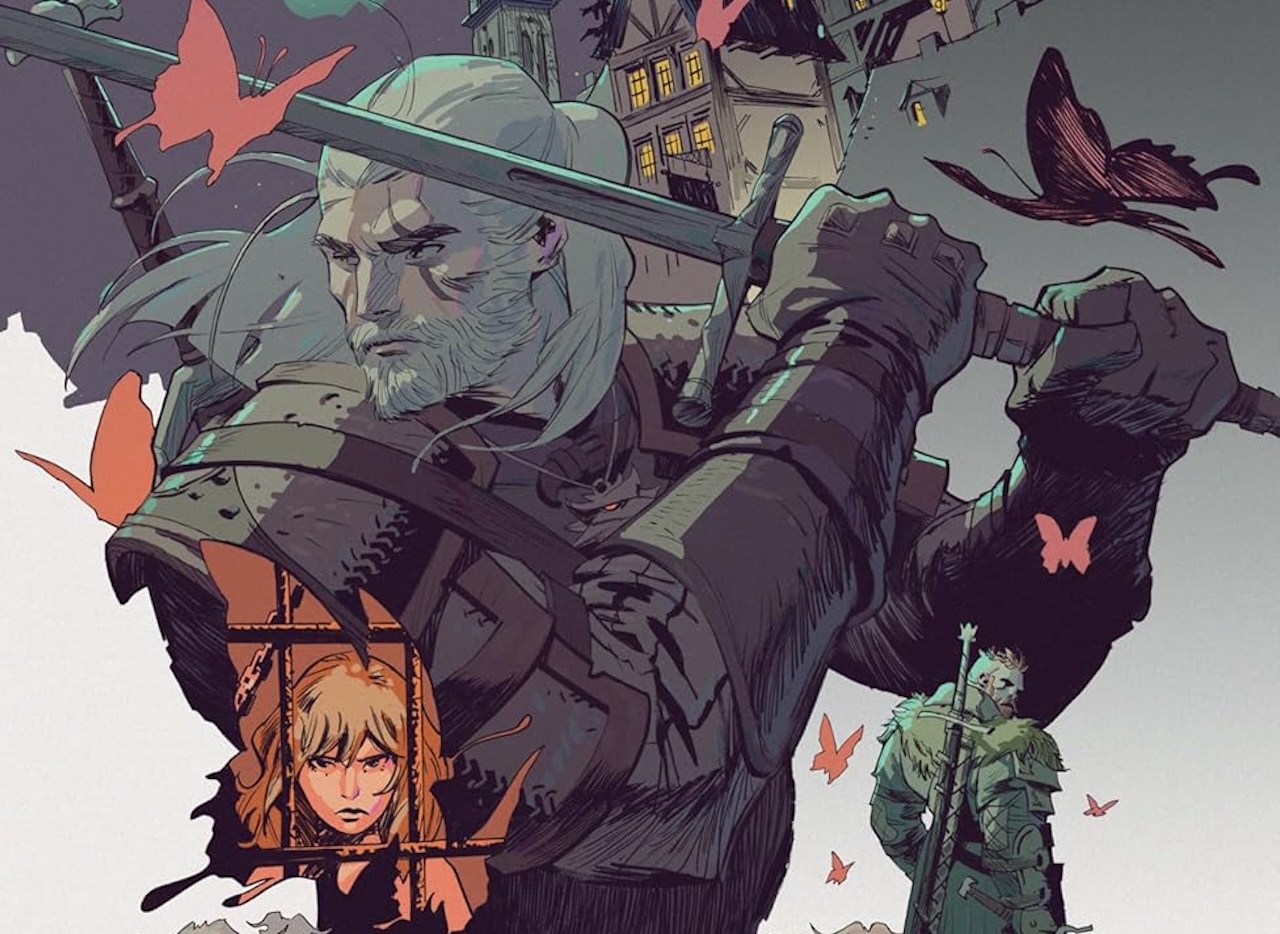

Writing a new story in an established world comes with benefits and pitfalls alike, both of which Si Spurrier, Stephen Green, and José Villarrubia handle with grace and reverence in The Witcher: The Bear and the Butterfly #1. What’s nice about the world of the Witcher is that it is a world made of stories, rather than a single world with a unified story. That means that a million and one stories could be spun out of this universe. So how do you tell that story, the one that starts with so many possibilities? By sticking to what works and getting rid of what doesn’t, which is exactly what’s done here in issue #1.
Some fans last saw Geralt in Toussaint from The Witcher 3’s Blood and Wine expansion (or the Netflix show). At the time, the bright colors and sense of whimsy from that wonderful expansion felt like a blank canvas for Geralt to spill blood on. In The Bear and the Butterfly, we’re back to shadowy alleyways and frozen tundra, places that hide monsters and echo with unease. The colors here are vivid when they need to be, especially when blood sprays across the snow or the flash of a silver blade catches the light.
Geralt sets out on what seems to be a run-of-the-mill vampire hunt when his tracking skills quickly sniff out a more dangerous enemy. The discovery that changes everything mid-hunt is familiar, sure—but it’s a feature, not a flaw. This is a world built on repetition with variation, and the suspense builds naturally, in a way that feels pulled straight from Sapkowski’s pages or CD Projekt Red’s quest design. Comics, as a medium, are perfect for diving into the darker corners of the Witcher mythos where violence, mystery, and moral murkiness thrive.
Writing Geralt is also somewhat of a loaded task, with his gruffness and lack of verbosity being two of his biggest calling cards. He sometimes speaks in clipped sentences, which Spurrier captures perfectly. Besides Geralt, a lot of the characters in this first issue seem to be temporary fixtures with that act as stepping stones to move the Witcher along in the plot. We’re looking forward to seeing what other characters are going to get a deep exploration in the coming issues so that the story doesn’t have to rest on Geralt’s development alone.
We know Geralt to be a skilled monster hunter, and perhaps the greatest Witcher to have ever lived. This means finding a worthwhile enemy for him can be daunting, and his battle with a mutant wolf in this issue proves to be an omen: perhaps he’ll need a little bit of help to get through what’s to come.
Though he only looms over this issue briefly, we see an entirely new Witcher that we’ll get to know in the coming issues. Hailing from the Bear School (as shown by his glowing amulet), he seems to be a formidable monster hunter and a possible adversary for Geralt. If we’ve learned anything from reading Simon Spurrier over the years, it’s that things won’t play out in any obvious way. We have to expect the unexpected, which in this case might be a showdown between rival Witchers rather than a monster hunt. But is there something besides coin that will set them on conflicting paths? As we’re shown repeatedly, coin is king in this world. Geralt, though, is someone who lives beyond the world of kings and coin — somewhere dark, yet with a store of humanity that some of his professional counterparts lack.
The Witcher: The Bear and the Butterfly #1 is packed with plenty of action and drama, all of it evenly paced and free of clunky exposition that could weigh down the momentum. The art does a lot of work to truly set the reader in this specific world through visual cues and a consistent style, and the dialogue feels true to the tone readers might be expecting. Although it might seem like some obvious choices were made in this issue, they all work really well and act as a great setup for the rest of the series.