

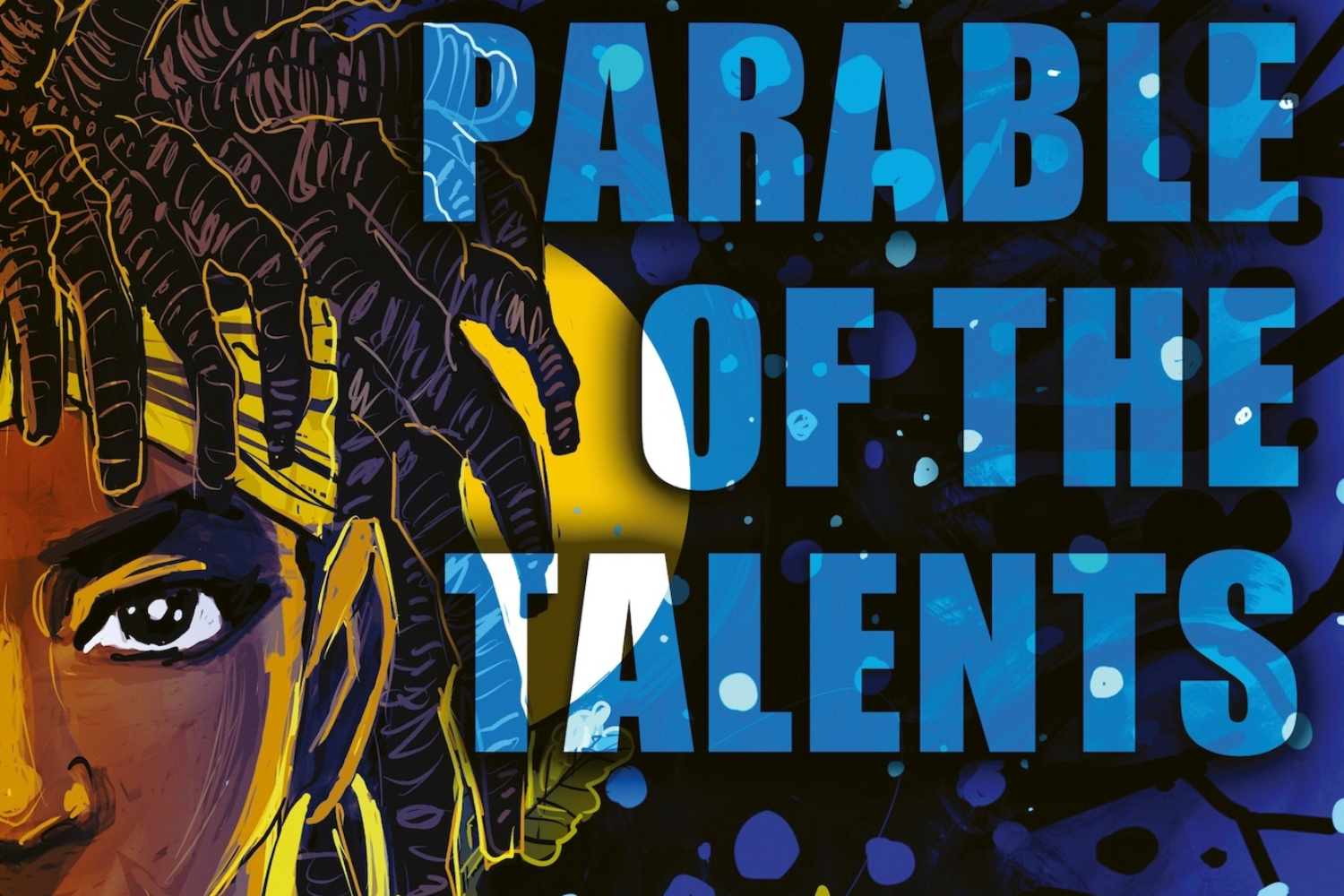

Nearly three decades after Octavia E. Butler published Parable of the Talents, her prophetic sequel to Parable of the Sower, the dystopian novel has found urgent new life in graphic novel form.
Adapted by Damian Duffy, and illustrated by John Jennings (joined this time by layout artist David Brame and colorist Alexandria Batchelor), the graphic novel translates Butler’s harrowing vision of an authoritarian America into a daring new format at a time when its themes have never felt more prescient.

Courtesy of Abrams.
Living Inside the Parables
“If Parable of the Sower felt eerily timely,” said Duffy, “Parable of the Talents feels like prophecy.”
The script itself was completed in March 2020, just before the COVID-19 lockdown began. As such, the creative team has had a ample time to really sit with this story.
“I’ve been marinating in this strange experience for years now,” Duffy said, adding that he was feeling “like I finished writing about the world of the Parables, and now I’ve gone to live in them.”
That grim overlap between fiction and reality is not a coincidence, he said, but the result of Butler’s laser focus on systemic consequences.
“Parable of the Talents was constructed from dedicated research into the likely outcomes of U.S. policies… if they continued in a similar fashion for a few decades,” Duffy said. “This was all foreseeable and avoidable.”
From Lauren to Asha: A New Narrative Voice
Set in the aftermath of Sower, the sequel shifts its narrative gaze from Lauren Olamina — the visionary leader and founder of the Earthseed religion — to her daughter, Asha Vere. Told through overlapping voices and perspectives, the story chronicles Asha’s reckoning with a mother she barely knew as well as the trauma inherited from a nation gripped by fascist Christian nationalism.
“Asha’s narration occasioned the biggest change,” Duffy said.
While Lauren’s journals anchored the first book, Talents required juggling multiple narrators, including Asha, her father Bankole, and her uncle Marc. Each was given a distinct visual identity and tone.
“Marc’s Christian American fervor… uses a sans serif font to contrast with the serif font used for Earthseed verses,” Duffy said.
Asha’s narration added another layer entirely, reframing the story as a virtual reality experience.
“She’s the only character given control of the images and how they appear,” Duffy said. “[That] gave us the opportunity for more fantastical imagery, like a giant Asha Vere strolling along the coast of a satellite view of California.”

Courtesy of Abrams.
Visualizing the Apocalypse: Brame, Batchelor, and Artistic Challenges
This added experimentation was made possible by Brame’s vivid artistry.
“David’s approach to layouts tends towards more dynamic panel layouts than John typically employs,” Duffy said. “That actually ended up fitting well…the multiple narrators had already pushed me to suggest more experimental page designs.”
Meanwhile, Jennings added, “David’s quickness, confidence and style gave me and my team the license to be more expressive…That trust was vital.”
Colorist Alexandria Batchelor also played a crucial role in maintaining visual cohesion.
“She helped us nail down the consistency of the book and also streamline our process,” Jennings said.

Courtesy of Abrams.
Drawing Trauma Sans Exploitation
For Jennings, the balance between depicting brutality and preserving humanity was one of the toughest challenges.
“This is a tough book to read. It’s an even tougher book to draw,” Jennings said. “Your first instinct is to just show all the dread and trauma. However, then it could overshadow the messages that Butler gave us.”
Duffy echoed the sentiment: “We had to communicate the horrors… while avoiding any depictions that might be read as exploitative.”
In scenes set in religious nationalist camps, they aimed for impact without sensationalism.
“The challenge was finding ways to present the more mundane but hopeful moments… as visually important as the intense scenes,” Duffy said.
Echoes of Today in Butler’s Tomorrow
Asked about the adaptation’s parallels to current events, Duffy said the real world was already echoing Butler’s fiction — so there was no exaggeration needed.
“Every one of the ‘Crusaders’… could have been rocking red baseball caps,” Duffy said, “But that seemed…like putting a hat on a hat.”
Duffy added, “This was never a problem caused by one charismatic leader. “It’s always been a prejudicial nightmare undergirding the American dream.”
Jennings added that their cartooning approach helped deliver this urgency without overwhelming readers.
“The lines are unkempt, quick, powerful and unkind to the characters… but it’s that abstraction that helps push the narrative while giving the audience room to breathe,” Jennings said.

Courtesy of Abrams.
A Mother’s Legacy and Generational Trauma
As mentioned, central to Parable of the Talents is Asha’s struggle with her mother’s legacy and the weight of generational trauma.
“Asha controls the narrative visually,” Duffy said. “But over time we see that, like Lauren, she suffered from the same chaos and lack of control.” Their lives are mirrored, yet disconnected, with Duffy adding, “They grow similar but never quite connect.”
Jennings emphasized the emotional labor involved in this kind of storytelling.
“In cartooning, you are an actor… you have to understand the pantomime to effectively convey emotion,” Jennings said. “David is a master at this craft.”
Preserving Butler’s Voice
After adapting Kindred, Parable of the Sower, and now Talents, the duo have learned to treat their work as a collaborative translation.
“We’re the scaffolding,” Duffy said. “The comics elements…are where our vision manifests. But all of them are created in service of functioning as a conduit for Butler’s voice.”
Added Jennings, “Octavia Butler is our other collaborator. We’ve never lost sight of this.”

Courtesy of Abrams.

Courtesy of Abrams.
The Hope That Survives
Despite the horrors within Parable of the Talents, the story (much like its protagonist) refuses to surrender to despair.
“The most obvious takeaways…are not all there is to this story,” Duffy said. “It also tells us that joy, love, mutual support, and hope are possible—and all the more necessary.”
Jennings closed with a reminder that lingers long after the final panel.
“Despite the darkness and the horrors, there is always hope down in the bottom of that Pandora’s box,” Jennings said.
Parable of the Talents is out now via Abrams.



You must be logged in to post a comment.