

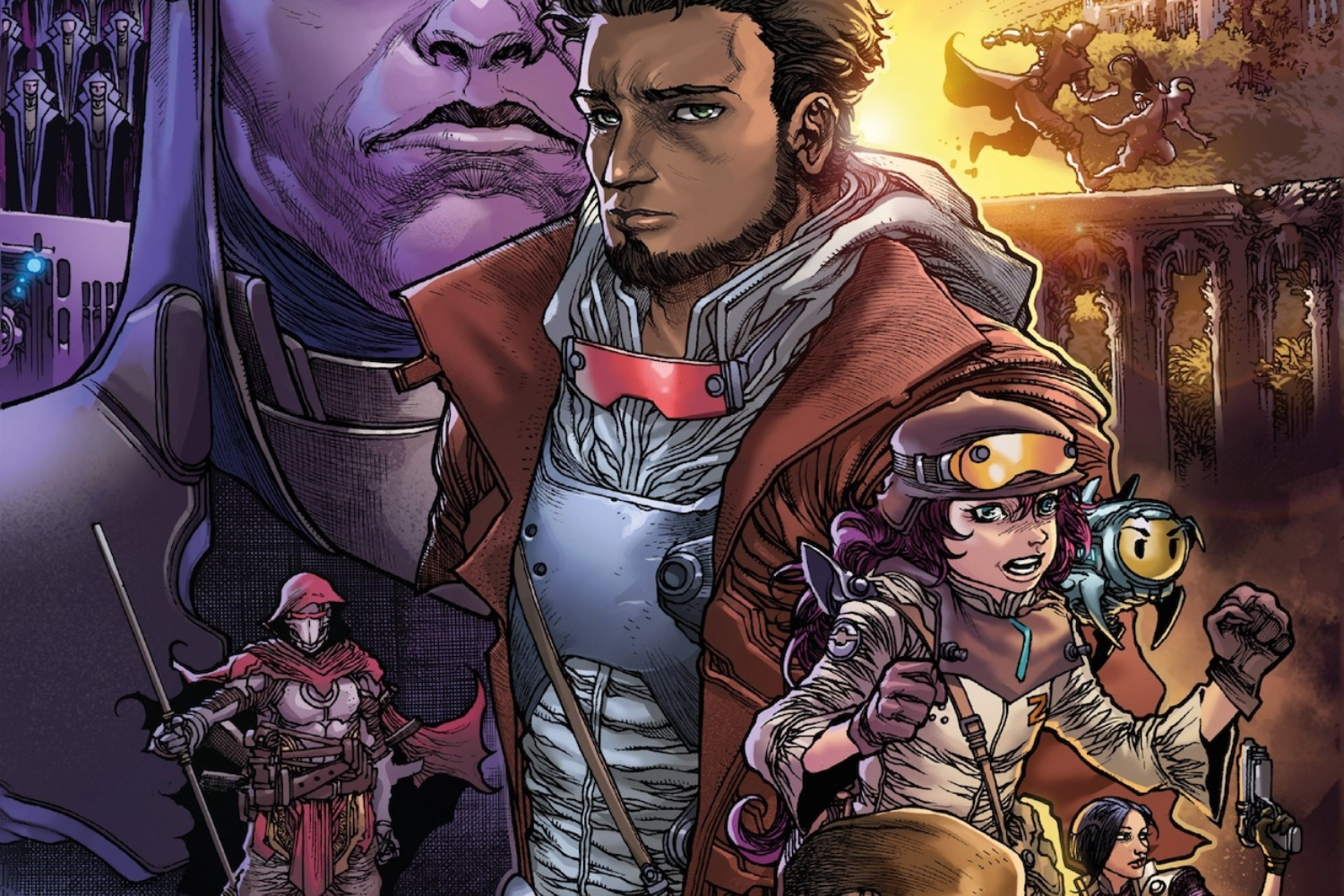

Best known for shaping worlds both legendary (Arrow, Star Wars: Jedi Knights) and emotionally grounded, Marc Guggenheim is no stranger to epic storytelling. But with his ComiXology Originals debut The Adventures of Ulysses Monarch, Guggenheim (alongside artist Harvey Tolibao) steps into a new frontier — one that merges futuristic world-building with a nostalgic reverence for the present.
Set in the year 3026, The Adventures of Ulysses Monarch follows a daring explorer and archeologist who scours the galaxy for artifacts from the 20th and 21st centuries (aka, our present). Inspired by the classic archeologist-adventurer template, Guggenheim puts a fresh sci-fi twist on the story trope, imagining how the mundane items of today might become the treasured relics of tomorrow.
In this exclusive interview, Guggenheim discusses his collaboration with artist Tolibao, the origins of a futuristic archeologist hero, and how a relic as simple as an iPhone can become the Rosetta Stone of our era, among other topics and tidbits
The Adventures of Ulysses Monarch #1 is available right now.

Courtesy of ComiXology.
AIPT: Ulysses Monarch is a futuristic adventurer searching for relics of our present day. What inspired this twist on the classic archeologist hero?
Marc Guggenheim: It started off on the television side of my career. Streamers were looking for family-friendly “adventure shows in the vein of Indiana Jones.” In response, I tried to decode Indy as a character to determine what makes him cool. Among other things, it was, for me, the fact that he’s essentially exploring the past. And that got me wondering what it would be like if the “past” he was exploring was our present.
Of course, the idea of a futuristic adventure series would have blown the budget of any TV show. Fortunately, however, I also write comics…
AIPT: Follow-up: Were there any real-world events or artifacts you knew you had to include?
MG: Including an iPhone was part of the idea from its earliest conception. The iPhone, to me, is just a quintessentially 21st century object.

Courtesy of ComiXology.
AIPT: You’ve written epic stories across TV and comics, from Arrow to Star Wars: Jedi Knights. What creative muscles did you flex differently for The Adventures of Ulysses Monarch?
MG: There’s a big difference writing my own characters as opposed to the licensed work and work-for-hire series that I write. I have to bring a lot more creativity to the table and write with the understanding that these characters are brand new to the audience.
AIPT: Working with Harvey Tolibao, whose art is so detailed and dynamic, how did the collaboration shape the look and tone of the series?
MG: Well, I basically wrote it for Harvey. He and I had worked together on an arc for the adjective-less X-Men series back in the day and had been talking about doing a creator-owned book together. The Adventures of Ulysses Monarch just seemed like a perfect fit with Harvey’s style and his talent for design and world-building.


AIPT: Did you write any scenes specifically thinking, “Harvey’s going to crush this”?
MG: Pretty much every page, to be honest. But it really started at the design phase because, as I said, Harvey is such a terrific world-builder. He’d give me 20 designs for each thing and character — and they’d all be amazing.
AIPT: The antagonist appears to be a mysterious religious sect. Can you tease what kind of ideological or narrative conflict they bring to Monarch’s journey?
MG: In looking for an antagonist, I really wanted to find a human one — no aliens in this series (yet, at least) — and that got me thinking about who would be in power a thousand years from now. That question sparked the idea of a theocracy and I started to become intrigued by the idea that a religion had seized power throughout the galaxy.

Courtesy of ComiXology.
AIPT: This story is being released digitally through ComiCology Originals. Did the format or platform influence how you approached pacing, structure, or cliffhangers?
Marc Guggenheim: A very little bit, but overall, no. Before going with ComiXology, Harvey and I had experimented with a bunch of different formats and distribution methods.
AIPT: Ulysses Monarch is all about discovering artifacts from the 20th and 21st centuries. So, what one object from your lifetime would you put in a time capsule for future explorers to find—and why?
Marc Guggenheim: Great question. I mean, I have to pick a comic book, right? If so, I’d probably choose Uncanny X-Men #139 — the very first X-Men comic I ever read, and it absolutely blew my mind. I suspect it would blow the minds of any future archaeologists as well.


AIPT: Fun question time: If Ulysses Monarch crash-landed in our time and had to team up with a real-life archaeologist, who would it be: Indiana Jones, Lara Croft, or Nicolas Cage from National Treasure?
Marc Guggenheim: Ha! Awesome question! I want to be cheeky and say that none of the people you mention are “real-life archeologists,” but I get where you’re coming from, and I’d have to go with Indiana Jones. I mean, there’s no Lara Croft or Benjamin Franklin Gates without Henry Jones, Jr.



You must be logged in to post a comment.