

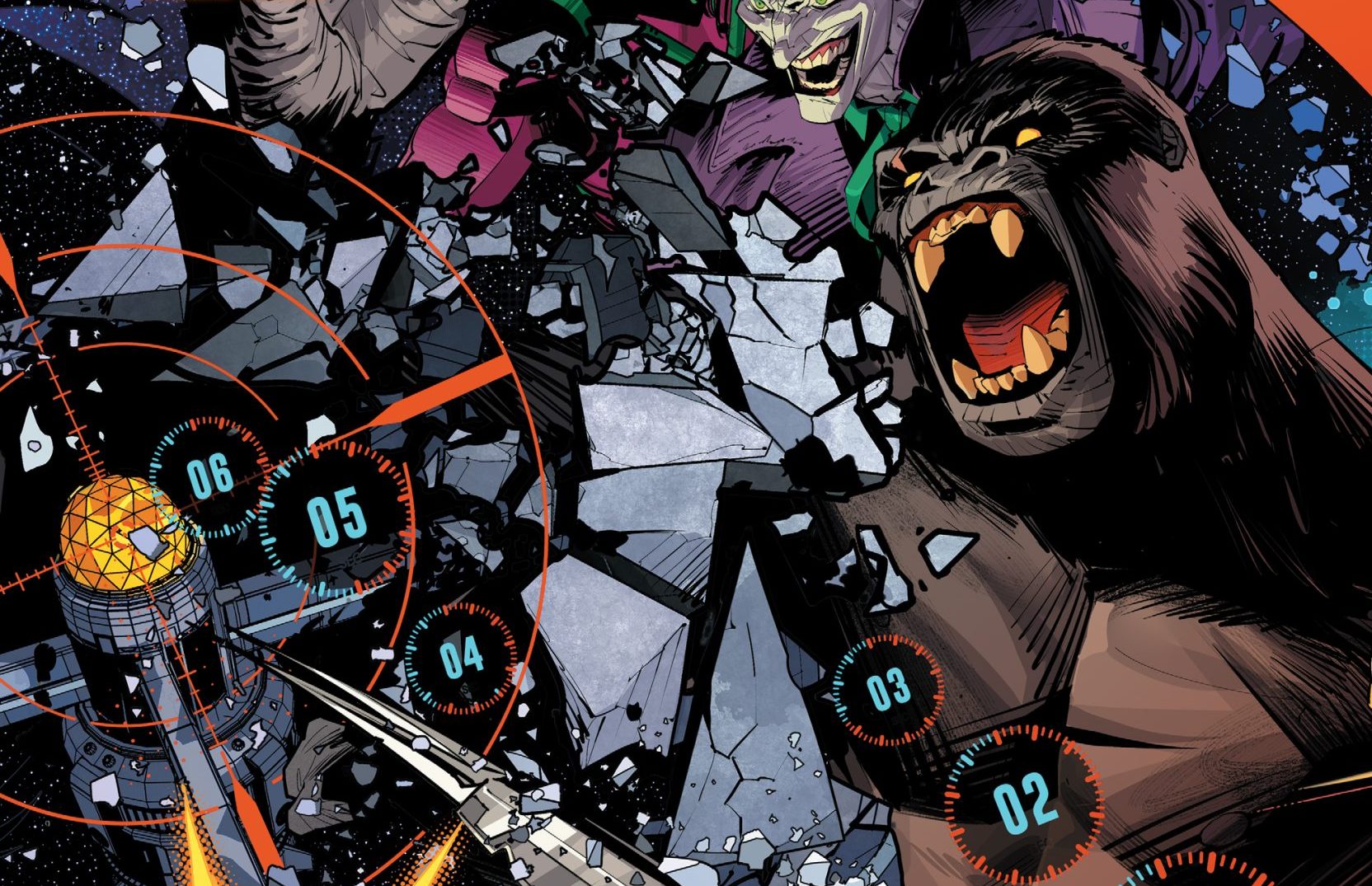

“Too many invulnerable types for a one-size-kills-all firearm, frankly. The delicious alternative was to leave them alive…tortured by the agony of knowing they are utterly helpless to spare the earth the hellstorm we are about to bring.”
The Legion of Doom strikes as their vendetta against their contemporary nemeses is fully put into motion. After carefully placed dominoes led to their invasion of the Watchtower, the Justice League has been scattered across time by Air Wave, leaving the station sharply under-defended, and bringing Grodd closer than ever to his mysterious goal. In this penultimate chapter of We Are Yesterday, the hectic time caper comes to a head. And though the narrative has been a bit scattered up to now, Justice League Unlimited #7 advances the plot with some much needed intrigue, though it is not without its faults.

DC
Now, Grodd’s strategy is a simple one that’s been camouflaged by coordinated chaos: harness the power left in the wake of Darkseid’s demise. As a major Flash villain, it’s not a plan that’s typical of the telepathic ape, but it presents a desire to show off the potential he’s been given following the major power shuffle that the heroes have been dealing with since Absolute Power. Worth noting once more is that Grodd is the only member of this new Legion—AKA Inferno—from the present, and his wildcard isn’t say, the Joker, but rather the Pythoness, who died young and thus doesn’t have a contemporary counterpart.
Such a push for these villains is a uniquely bold one for such a crossover, and the results are more than engaging enough when put against the time travel shenanigans. Unfortunately, it still feels cheapened by the fact that Inferno was a red herring for the Legion of Doom’s return. While it’s not a dealbreaker by any means, especially since this mini event is intent on continuing the overarching story of All In (and does so pretty well), we can’t help but feel like the immediate switch up on a threatening new villain group was unearned. Because of this, we worry that the series’ individual momentum could be lost beyond the confines of this story.
None of this is to say that this isn’t a fitting Legion of Doom story or a bad Justice League story. In fact, it’s been rather refreshing that Grodd is in the spotlight with someone like Lex Luthor feeling more like fodder this time around. Waid’s commitment to returning so many hero and villain characters to their pre-Crisis roots is more than apparent. With Grodd feeling like a Silver Age villain with something to prove against more than his main enemy, and the classic power to time travel being returned to the Super cousins, this is a welcome testament to the “everything is canon” sentiment that DC has been running with for the last couple years.

DC
What really gives this book its edge, especially amidst such a big cast of characters, is the focus on the underdog characters who typically don’t get the same attention as modern heroes. Waid has always been a champion of the more niche parts of DC’s rich lore with a unique respect for it, and here that is evident in moments such as Elongated Man’s last stand against Grodd as well as the climactic emotional beats tied to Air Wave’s death earlier in the crossover. What bodes poorly however is that the book finally feels like it’s using too many characters simply for a sake of it, obviously with the intent of capitalizing on the premise, but it almost trivializes a narrative that otherwise has long term potential, and hopefully capitalizes on that.
Fortunately, Travis Moore regains his footing following his last issue, allowing the heroes’ spacing across different eras to once again give off that scale and variety that had been previously missing in the crossover that made JLU so appealing before it. It’s always nice to see him draw Nightwing of course, but Moore shines across the board this time around. Even amidst the numerous cast members, it’s easy to see that he has his favorites, and that’s more than respectable in a book designed to appeal to not just Justice League fans, but fans of the greater DC universe as a whole.
To the creators’ credit, this latest issue of Justice League Unlimited is an entertaining time travel romp that advances the plot more than previous issues, and gives time to shine to some of the underdogs of the series. However, the book loses itself in its crossover chaos and feels lacking in stakes despite directly tackling important All In plot points. Though there are undoubtedly some worthwhile developments, we can’t help but feel the series’ own story beats have been disrupted and made underwhelming by the crossover.




You must be logged in to post a comment.