



Zackary J. Pinson and Jonathan Lackman’s The Woman With Fifty Faces is not a bad comic, but it is an unsuccessful one. Its subject, alleged film star turned model to over fifty of the early 20th century’s most significant artists Maria Lani, is fascinating. Its craft is impeccable, especially illustrator Pinson’s invocation of the grotesque when depicting horrors and his presentation of some of the styles in which Lani was immortalized. But, for all that Pinson and Lackman do well, their work is undercut by a combination of creative missteps and the lack of information about Lani’s life. The Woman With Fifty Faces aims to bring depth and dimension to someone who had long gone down in history as little more than a con artist, to become a fifty-first face, so to speak. In the broad strokes, it succeeds. In the details, though, it becomes blurry to the point of alienation.

To quote Lackman’s 2014 article “Maria Lani’s Mystery,” which he paraphrases throughout The Woman with Fifty Faces:
When Maria Lani arrived in Paris in the spring of 1928, a self-proclaimed silent film star from Berlin in town to make a new movie, she quickly caused a stir, persuading fashion mavens and many of the city’s most advanced artists to lend support to her dream project…An exhibition of these works, most made for potential use on set, traveled to galleries and art centers…Vanity Fair devoted a spread to Lani and her images. A decade and a half later, Thomas Mann coauthored a screenplay inspired by her. Jean Renoir agreed to direct, with Garbo to star.
By then Lani had disappeared. When she died in obscurity in 1954, a new story emerged—that she was no actress, just a fraud, a stenographer from Prague who absconded to America with portraits she didn’t own and subsequently sold.

Fantagraphics
Lackman has researched Lani for over a decade, and per “Maria Lani’s Mystery,” concluded that “Maria Lani, Con Artist and Art Thief” is as much a fabulism as “Maria Lani, Acclaimed German Film Star.” Brian Moynahan of Vanity Fair likewise noted in his 2018 article “Maria Lani Was the Muse of Modernist Masters—Then She Vanished Without a Trace:”
The real-life Maria Lani was certainly elusive, and remains so in memory. Occasionally she comes up in a magazine article or an exhibition. But one thing remains certain: the paintings (some 58 of them, given that some artists painted her several times), along with a dozen photographs and a half-dozen sculptures, exist. They hang in great museums, and they appear at auction from time to time. They are real.
Abramowicz (Maria’s husband, Maximilian Abramowicz) and Lani never had a golden hoard of artwork.
Lackman and Pinson present The Woman with Fifty Faces as a counternarrative to the posthumous rumors that have long defined Lani. “The truth,” Lackman writes in the final line of his introduction to the comic, by comparison to the “Con Artist and Art Thief” tulpa, “is… even better.”
It is, in the sense that what Lackman and Pinson have learned about Lani and present in the comic is incredibly intriguing and decidedly more human than the rumor. On its own terms though, as a story and a work of sequential art, The Woman with Fifty Faces struggles with the distance imposed by the limited surviving information on Lani and with Pinson and Lackman’s decision to lean into that distance while making Lani their primary subject.

Fantagraphics
While the writings of those who knew Lani—particularly her husband Abramowicz and her one-time admirer and promoter Jean Cocteau—are quoted extensively in the comic, little of Lani’s writing survives. According to The Woman With Fifty Faces, the one piece that is confirmed to be her writing is an excerpt from a memoir that is either unfinished or lost, where she reminisces on sitting for a portrait by Jules Pascin. 71 years after her death, Lani is an enigma. Per Lackman, the same was true in life, even for those closest to her. Of Abramowicz, Lackman writes, “Until his own death…Max obsessively wrote poems to Maria, still trying to make sense of the woman who ultimately even eluded her husband.” With so much of Lani’s perspective unknown, there is only so much that The Woman With Fifty Faces can explore it.
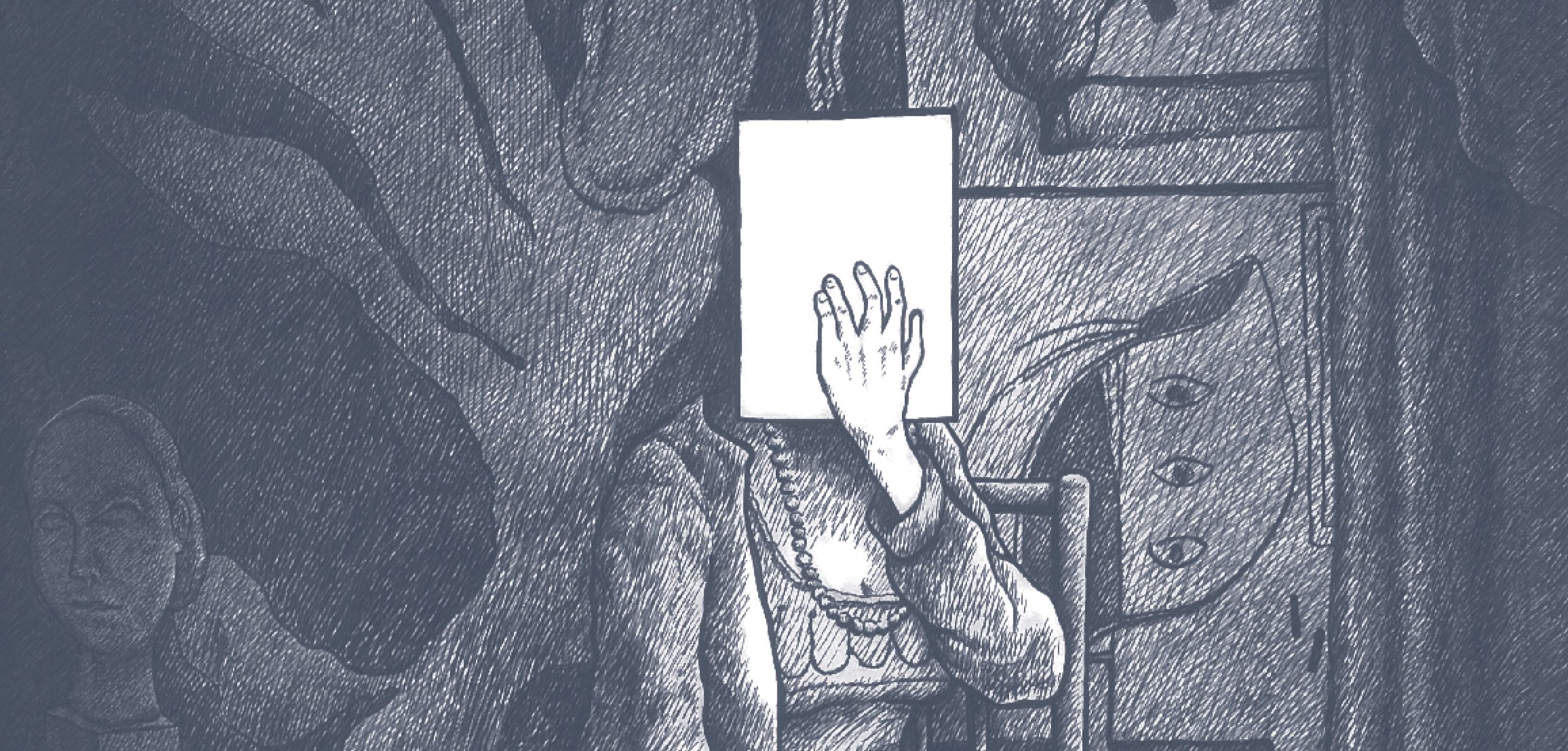
Pinson and Lackman try to take the unanswerable questions from Lani’s life and build them into the comic’s art and themes. Outside of Pinson’s recreations of the art Lani modeled for, her face is never seen in full. Indeed, facelessness becomes a core part of The Woman With Fifty Faces’ visual language. In some of its strongest sequences—those dealing with the antisemitic violence Lani fled repeatedly, first as a child and young adult in Poland, and then when she and Abramowicz escaped to the United States in 1941—Pinson strips away the details from the murderous bigots’ faces, leaving only hateful snarls and sneers. It’s an elegant, nightmarish way to capture both the ways that bigotry poisons the soul and the anonymity that states either looking the other way towards or actively enforcing that bigotry granted to protect the perpetrators.
But where the vicious’ repeated facelessness is a skillful use of sequential art, Lani’s facelessness frustrates. She is already a mystery due to how little of her writing survives and the extended parts of her life spent in comparative obscurity. Eliding her further does not constructively add to that mystery; it puts up a barrier between the audience and the comic’s ostensible protagonist. Moreover, while Pinson’s artwork is striking, whether beautiful or horrifying, its heavy stylization undercuts one of The Woman with Fifty Faces’ primary interests—the immense variety of ways in which the artists who depicted Lani saw her. Pinson’s interpretation of Lani is placed in conversation with the pre-existing interpretations of his fellow artists. With her features consistently obscured and the comic’s continual emphasis on her unknowability, that conversation feels like it is missing crucial context.

Fantagraphics
Indeed, The Woman With Fifty Faces always feels like it is missing something vital. The portrait that Lackman and Pinson paint with the comic is, as they promise, fuller and better than the unsourced caricature of “Maria Lani, Con Woman and Thief,” but too much of Lani remains unknown for her to succeed as a protagonist. Since so little information about Lani—and especially information from her herself—survives, getting more specific may not be possible. Consequently, the resulting comic never quite clicks as a character study for Lani or Abramowicz and the artists, who lack her panel time. A brief epilogue that focuses on Pinson and Lackman’s initial conversations about making the comic offers a tantalizing glimpse at an alternate path, one grounded in concrete perspectives and the act of delving into the mystery of Lani’s life, rather than emphasizing that mystery to the detriment of the comic as a narrative.
The Woman with Fifty Faces’ subject is an intriguing one (and the difference between how people are perceived and how they are has made for terrific comics over the years). Its comicscraft is impressive, but a combination of limited information to draw from and the narrative choices made in presenting it means it ultimately does not come together. It’s disappointing.




You must be logged in to post a comment.