

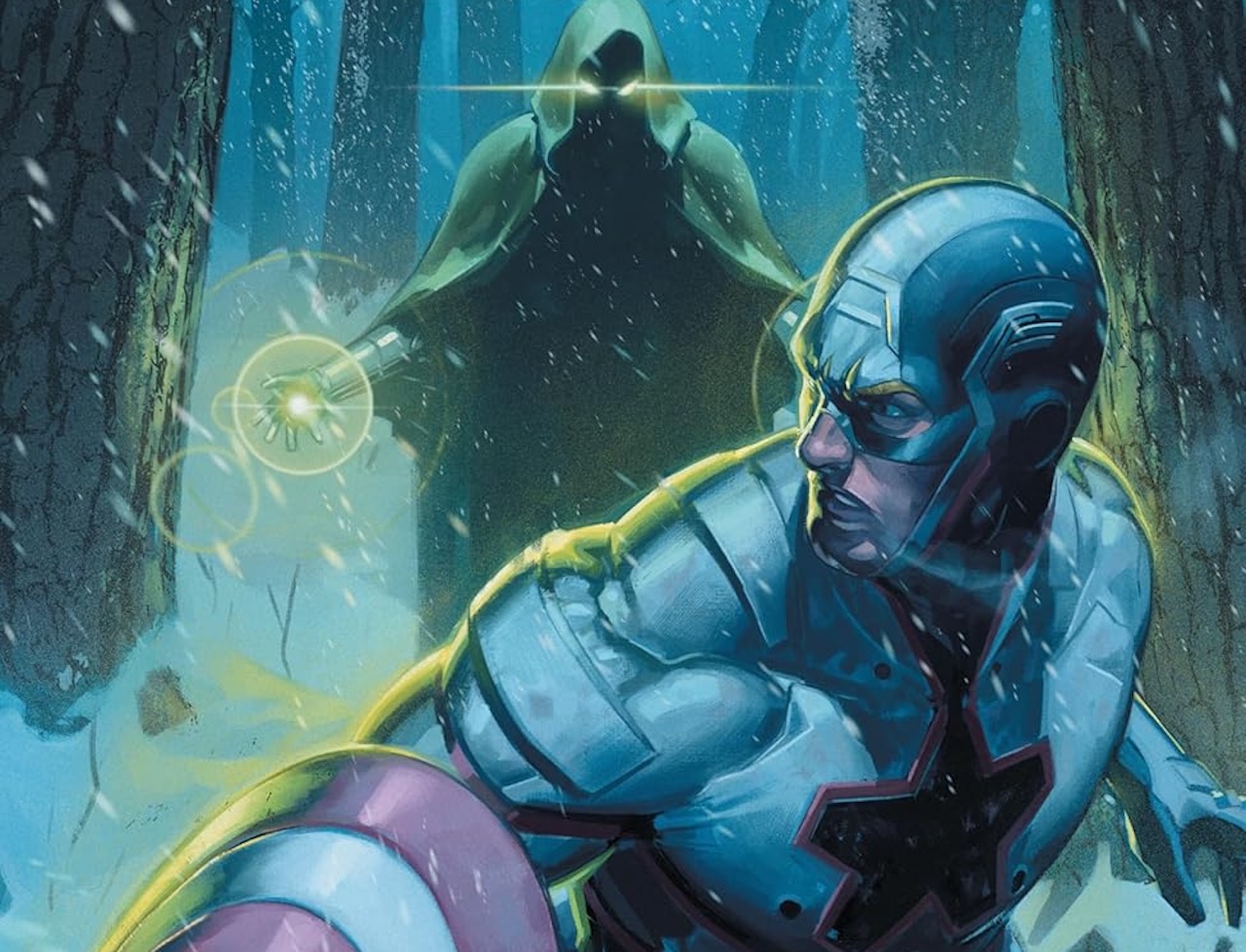

Captain America, under Chip Zdarsky and Valerio Schiti, came off the blocks with a bold opening issue. It brought 9/11 and a modern take on Captain America via a new super soldier, although it’s not until the second issue that we understand what makes this new Cap different. In a series that gets more compelling with every page turn, Captain Colton reveals what it would be like if an American boy who witnessed 9/11 fought for freedom.
Captain America #2 opens with Captain Colton basking in the beauty of freeing Kandahar from the Taliban during the War in Afghanistan. He’s all smiles, but his translator, Quasim, a native who’s helping America, sees it differently. The creative team is showing us a man who hasn’t yet been tainted by the endless wars and atrocities that take place in the name of freedom.
The story then cuts to the present, which is one week after Captain America was broken free from the ice. Captain America and Colton are on a mission to free soldiers from Doctor Doom, and we learn the mission is to free the people and leave Doctor Doom alone. This is a hard thing to grasp for Captain America, who sees an opportunity to free the world of a fascist dictator. The differing outlooks are a big part of the issue, and while Steve Rogers makes choices that feel right, we see that war in modern times is far more complicated than even Steve might want to admit.

Time to hero up!
Credit: Marvel
It’s clear that the differing viewpoints of Colton and Rogers are compelling. It’ll get you thinking about the concept of war today versus World Wars 1 and 2. Captain America is still bright-eyed and hopeful, while Colton is aware that following orders in the name of freedom is far darker than anyone wants to admit. The flashbacks with Colton reveal a man trying to do what’s right and finding out the hard way that nothing is black and white in wartime. The hope Captain America holds dear is easy to see, given the fall of Hitler, and the juxtaposition is going to be fun to unpack as the series goes on.
If it sounds like there’s a lot of talking and contemplating, there certainly is. For a superhero comic, there isn’t a lot of action, with one quick scene acting like a requirement rather than a necessary one. The point being, the creators know they need to infuse a superhero book with action, but I don’t think that’s the goal or necessarily the desire. It’s a double-edged sword problem, as Captain America hasn’t felt this impactful and real in ages, while the punching and fighting do feel low for a series like this.
This issue isn’t all about the fog of war, as there’s some action in there. Schiti does a great job with all the character acting, with the story opening up in the last few pages with Cap taking on a supervillain. Zdarsky smartly reminds us this is a Captain America who fought Nazis with pistols, not super-strong villains with electric blasts. Schiti does a great job conveying the brute force Captain America is up against, and how he can’t fight like he used to during World War II.
Captain America #2 deepens the moral and emotional stakes set up in its bold debut, trading bombast for introspection as it contrasts old and new ideologies of war through the eyes of Steve Rogers and Captain Colton. With smart writing and expressive art, it’s a thoughtful and timely take on heroism in the modern age, even if it’s light on the usual fireworks.




You must be logged in to post a comment.