


When the classic serial comic strip Prince Valiant in the Days of King Arthur – often known simply as Prince Valiant – was translated into German, the protagonist and title became Prinz Eisenherz (literally “Prince Ironheart”). This legendary and long-running comic strip about the Knights of the Round Table – their chivalrous deeds in the romanticized medieval world, fighting and defeating demons, sorceresses and evil of any kind – captured the hearts and imaginations of the German-speaking audience just as it did the American readers. For many, this vision of the Arthurian world remains the standard on which all tales of knights and chivalry are based.
Austrian-born cartoonist Lukas Kummer knows and understands this genre and its expected tropes very well. And so he gave his comic – originally written in German – a play on words as a title: Prinz Gigahertz. In translating the work into English, Top Shelf Productions at IDW decided on a similar play on words: Ionheart. Kummer wants the reader to think about all those childhood dreams of knights, princes and princesses when they start this graphic novel. But he wants us to recall all of these themes only to undermine them in ways we won’t by expecting.

Courtesy of IDW
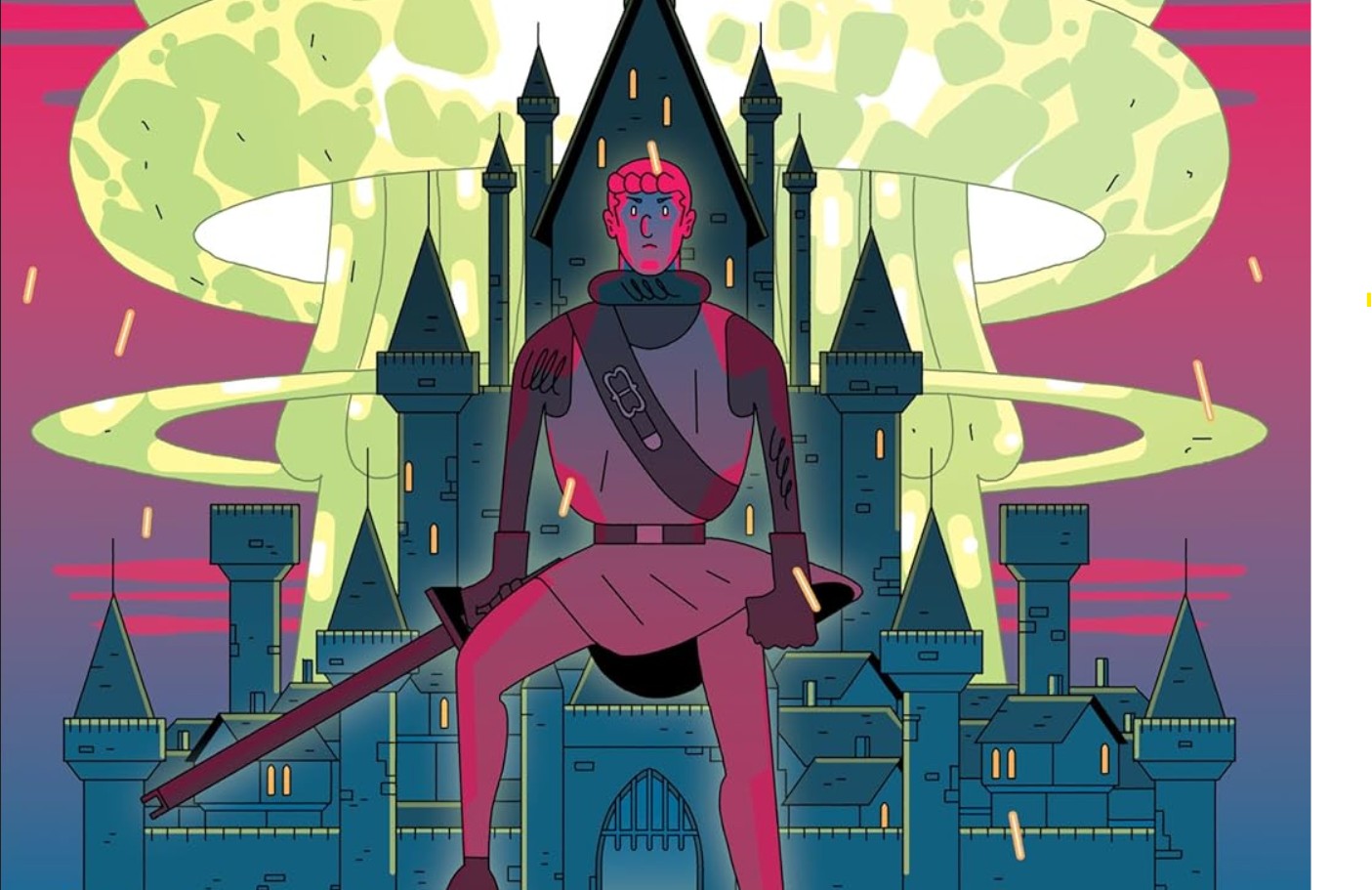
That starts in the title, mixing the medieval name of a knight with modern scientific terms. And so we are a bit forewarned when some modern technology slowly creeps into the medieval world Kummer builds. And when a nuclear explosion turns the kingdom into a wasteland near the beginning of the story, we realize that this is anything but a simple tale of knights and chivalry.
This is the greatest strength of Lukas Kummer’s Ionheart in my mind – the way he starts with a recognizable genre but then perfectly times interesting reveals and twists that smash genres together and gradually undermine all of my expectations.
This is also done with the art itself – very minimalistic drawings in the style of childhood cartoons like Adventure Time or humorous comic strips like Pickles. But be warned, this is no children’s comic. Instead, Kummer uses the childlike nature of the art to build a feeling of childlike trust, which he then shatters to even greater effect with suddenly gory violence and unexpected salacious sexual scenes. Adult themes and situations run throughout the whole book.

Courtesy of IDW
The book is split up into three chapters, which are actually three complete stories originally released separately in German, collected for this graphic novel.
The first chapter is definitely the strongest, in which Kummer builds an interesting, genre-bending but completely consistent and thought-out world. The great pacing is most apparent in this story of Prince Ionheart furiously trying to escape the relentless ‘demon’ chasing him. As the tension grows, more and more unexpected surprises are revealed and we learn more about this weird world. Also in this chapter, Kummer displays a good sense of cinematography, often repeating the same setting or scene both before as well as after the nuclear explosion, adding weight to the narrative.
The second chapter is basically a prequel, relating the origin story of both the protagonist as well as the medieval world he comes to call his own. Well actually, the origin story is really used as a framework to reflect on the ups and mostly downs of marriage. I hope Kummer intends this as a cautionary tale, but I’m not so sure. In any case, it definitely fits well with the post-apocalyptic nature of the book and is filled with good metaphors of its themes.
The final chapter – the weakest – plays as a detective story running through both the protagonist’s past and future. But it seems like this murder mystery is only used as the narrative frame necessary to bring a sense of closure to the romantic plot between Prince Ionheart and his beloved Princess. It’s a nice ending to the book, but leaves things open for more adventures.

Courtesy of IDW
As you may have assumed already, Kummer utilizes non-linear storytelling throughout Ionheart. Fortunately, he uses different color schemes to make the jumps in time easy to follow. I really enjoyed the non-linear method, as Kummer uses it well to support and expound upon the unexpected twists and reveals.
Ionheart – the English-language debut of German-speaking, Austrian-born cartoonist, Lukas Kummer – will undermine all of your expectations. What at first appears to be a Arthurian-like adventure of knights and chivalry – drawn in a child-friendly, comic-strip style – quickly becomes a genre-smashing fantasy meant solely for mature audiences. It probably won’t be everyone’s cup of tea, but Kummer had a very creative vision that he expertly brought to paper in this collected graphic novel.




You must be logged in to post a comment.